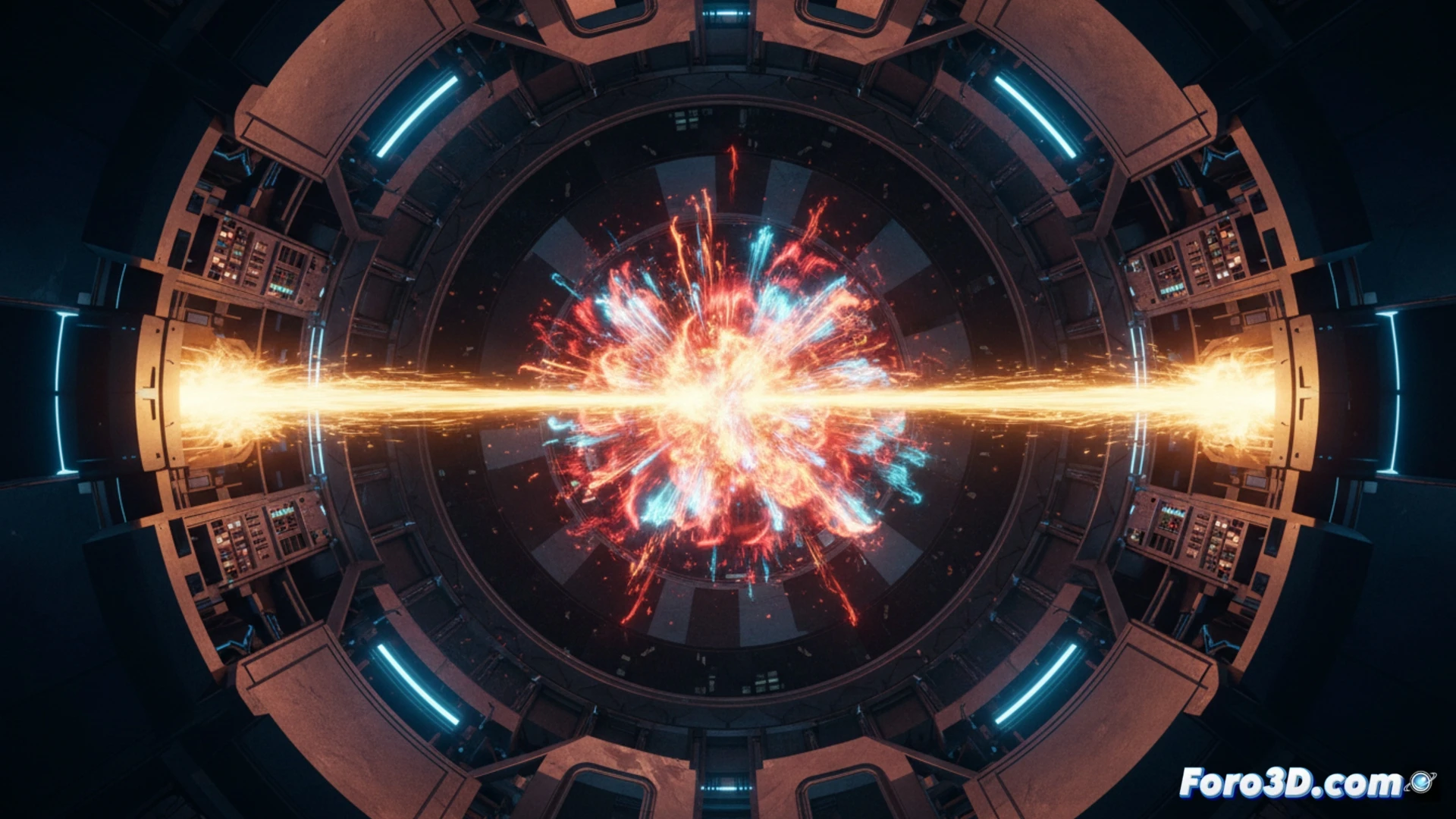
The Great Collider Retiring After Deciphering the Cosmic Soup
How can we dismantle matter to see its most intimate components? 🤔 Particle colliders act as giant microscopes, but they use impacts at extreme speeds instead of light. After a quarter of a century of operation, the RHIC (Relativistic Heavy Ion Collider) in the United States is closing, leaving a trail of discoveries and paving the way for its replacement.
A Machine That Simulated the First Moments of the Cosmos
Unlike the Swiss LHC, the RHIC did not collide protons, but heavy ions like gold nuclei. Its main goal was to reproduce, for brief moments, the quark-gluon plasma. This state of matter existed microseconds after the Big Bang and is considered the primordial soup from which everything emerged. These collisions helped understand how fundamental particles acquire their mass. 🔬
Key Findings from the RHIC:- Achieved recreating the quark-gluon plasma, a state of matter not seen since the early universe.
- Discovered that this plasma behaves like a perfect liquid, with almost zero viscosity, the lowest known in nature.
- Was the first collider to collide protons with polarized spins, a vital technique for studying this intrinsic property of particles.
The quark-gluon plasma is not a chaotic gas, but the most perfect liquid that physics has observed.
From Breaking Atoms to Mapping Them in High Definition
The era of atomic demolition of the RHIC is coming to an end. Now, the baton is passed to the Electron-Ion Collider (EIC). This new instrument represents a paradigm shift: moving from a camera to a high-resolution scanner. Instead of smashing nuclei, its goal will be to obtain detailed three-dimensional images of the interior of protons and neutrons. 🗺️
What the EIC Promises to Explore:- The internal 3D structure of protons and neutrons, mapping the distribution of their quarks and gluons.
- Understand with greater precision the origin of the spin of the proton, a property similar to a tiny internal magnet.
- Delve deeper into the strong nuclear force, the one that holds the components of the atomic nucleus together.
The Legacy of a Pioneer and the Future of Subatomic Exploration
The RHIC leaves a monumental legacy by having allowed us to look directly at the original cosmic soup and reveal its almost perfectly fluid properties. Its work laid the foundations for the next phase of nuclear physics. The EIC will not continue breaking, but will initiate a stage of ultra-precise exploration and mapping of the very heart of matter, taking our understanding to an unprecedented level of detail. 🚀