Between 2026 and 2028, additive manufacturing will experience a phase shift. The main obstacle will no longer be the technical capacity of the machines but will become a structural challenge. Six converging pressures, from sovereignty regulations to new certification models, will redefine the market. This scenario, already present in contracts and legislation, will divide the players according to their ability to adapt to these new institutional rules.
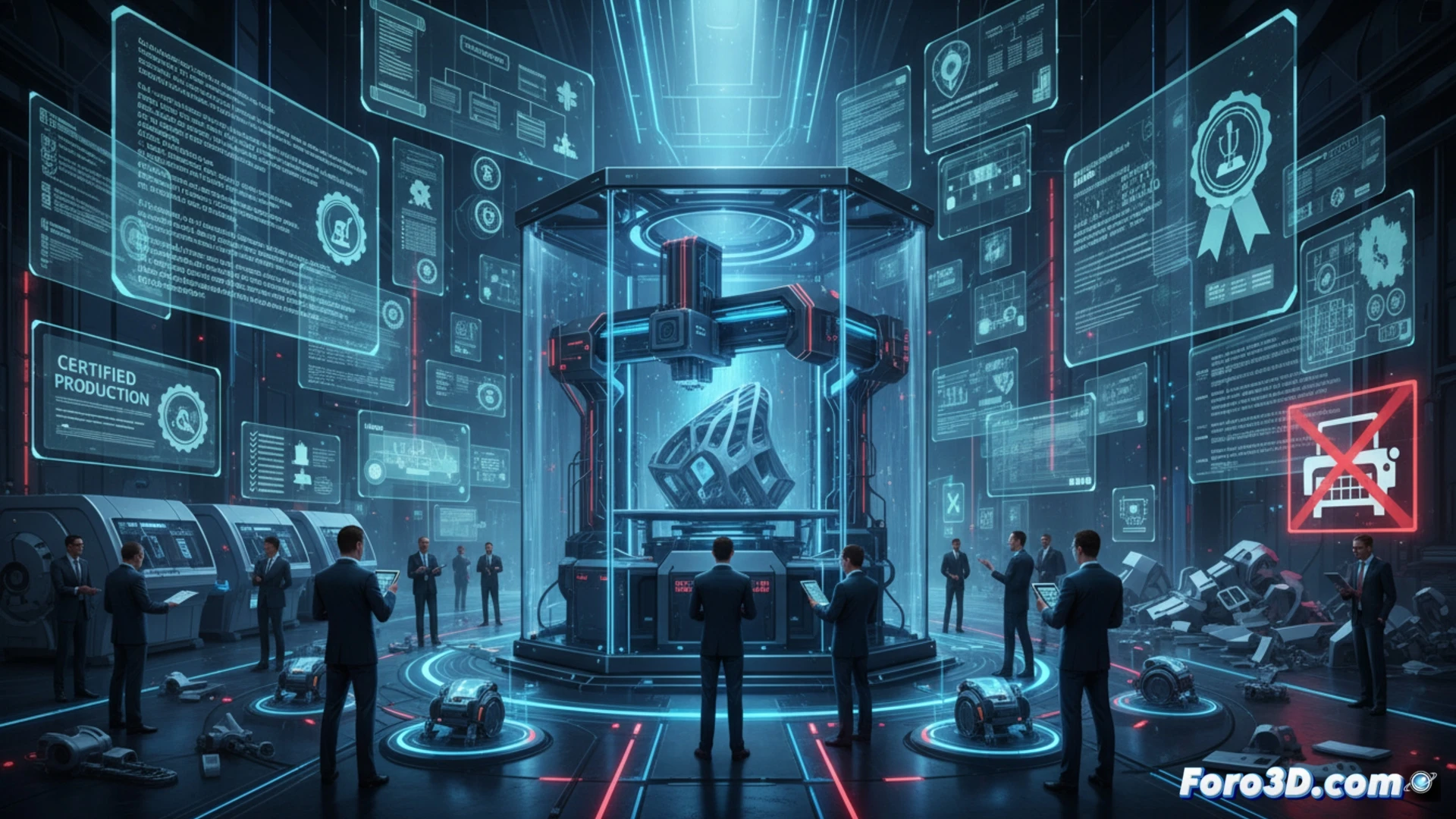
Beyond the Certified Part: Validation of the Entire System ⚙️
The evolution of certifications marks a turning point. The focus is no longer solely on validating an isolated part, but on certifying the entire process: from design and slicing software, through the machine and material, to post-processing. This turns the digital workflow into a critical element. Control over this software, especially support generation and parameter management, becomes strategic, as it determines repeatability and overall traceability.
Welcome to the Game of Thrones (of .stl files) 👑
Get ready for a world where your software license decides if your factory operates. Updates could be blocked due to geopolitical incompatibilities and you'll have to prove the ethical origin of every filament spool with a family tree. The question will no longer be what resolution does it print at? but does your technology stack have a diplomatic passport?. A cloud error from your provider and your production line becomes an expensive paperweight.