The human hand, with its long thumb and its capacity for precision grip, is a central element in our evolutionary history. Its development is as determinant as that of the brain. Recent fossil findings are beginning to reveal how this anatomical tool was formed and its link to the emergence of capabilities such as language and the complex use of tools.
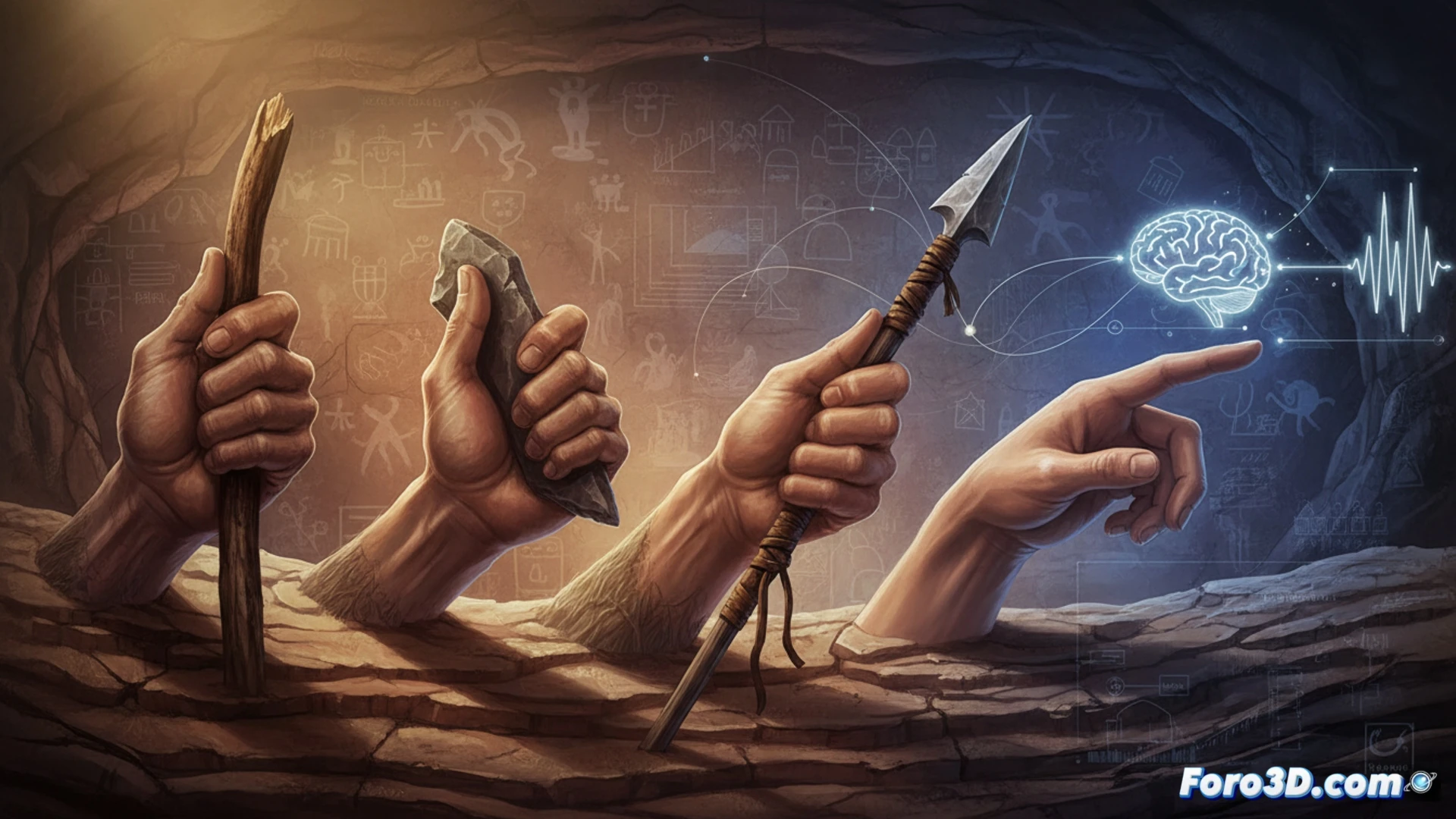
Biomechanics and motor control: the hardware and software of precision ⚙️
The bony architecture of the hand, with joints that allow firm opposition of the thumb, acts as the hardware. This design enables pinching forces and power grips. The parallel development of motor and association brain areas constitutes the software, integrating visual and tactile signals for dexterous movements. This coevolution enabled the cultural transmission of lithic knapping techniques, where the shape of the hand and brain complexity fed back into each other.
From carving stones to typing memes: progress or loop? 🔄
Our ancestors spent millennia perfecting the precision grip to create tools that ensured their survival. Today, that same anatomical and neurological heritage is mostly used to swipe a finger across a glass screen tapping like. Evolution gave us the hand that sculpted the Acheulean hand axe, and we use it to scroll. Perhaps future fossils will show a permanent curvature in the thumb from holding smartphones.