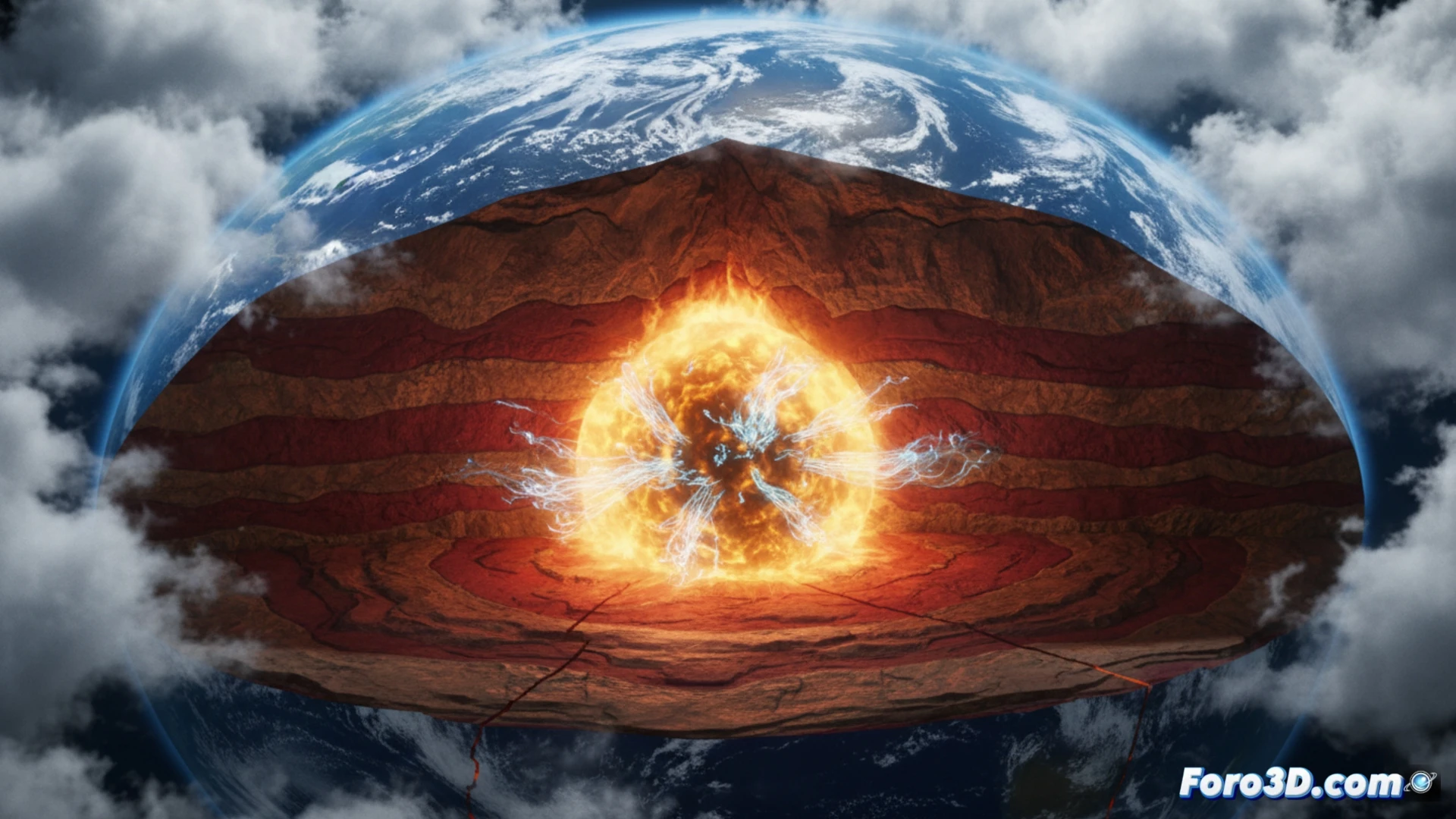
The Earth's Core Hides More Hydrogen Than Previously Believed
The vision of the center of our planet as a sphere composed only of iron and nickel needs to be updated. A recent study reveals that it harbors a hidden hydrogen reservoir much larger than any model had predicted. 🌍
The Journey of Water to the Depths
To understand this phenomenon, we must go back to the period of accretion and intense bombardment that the primitive Earth experienced. Asteroids and comets, rich in ice, impacted the young surface. The energy released broke down that ice into its elements: hydrogen and oxygen.
Key Absorption Process:- The molten iron that permeated the young planet acted as a chemical sponge.
- This liquid metal showed a great affinity for capturing hydrogen atoms.
- During planetary differentiation, the heavy iron, loaded with hydrogen, sank to the center forming the core.
The core thus preserves a chemical record of the volatile materials that arrived in the planet's infancy.
Rewriting the History of Water on Earth
This discovery has profound implications. If a significant fraction of the primordial hydrogen remained trapped in the core, calculations about the total amount of water brought by celestial bodies may be underestimated.
Consequences of the Finding:- The theory of the origin of Earth's water must be reconsidered to include this deep reservoir.
- It explains part of the water "budget" that seemed to be missing in geochemical models.
- It shows that planetary formation processes are more complex than imagined.
A Deep Memory of the Planet
The next time you gaze at the ocean, think that its origin might be linked to processes that occurred in the extreme depths. The core, far from being an inert mass, holds the chemical footprint of the violent events that shaped the blue world we inhabit. 🔵