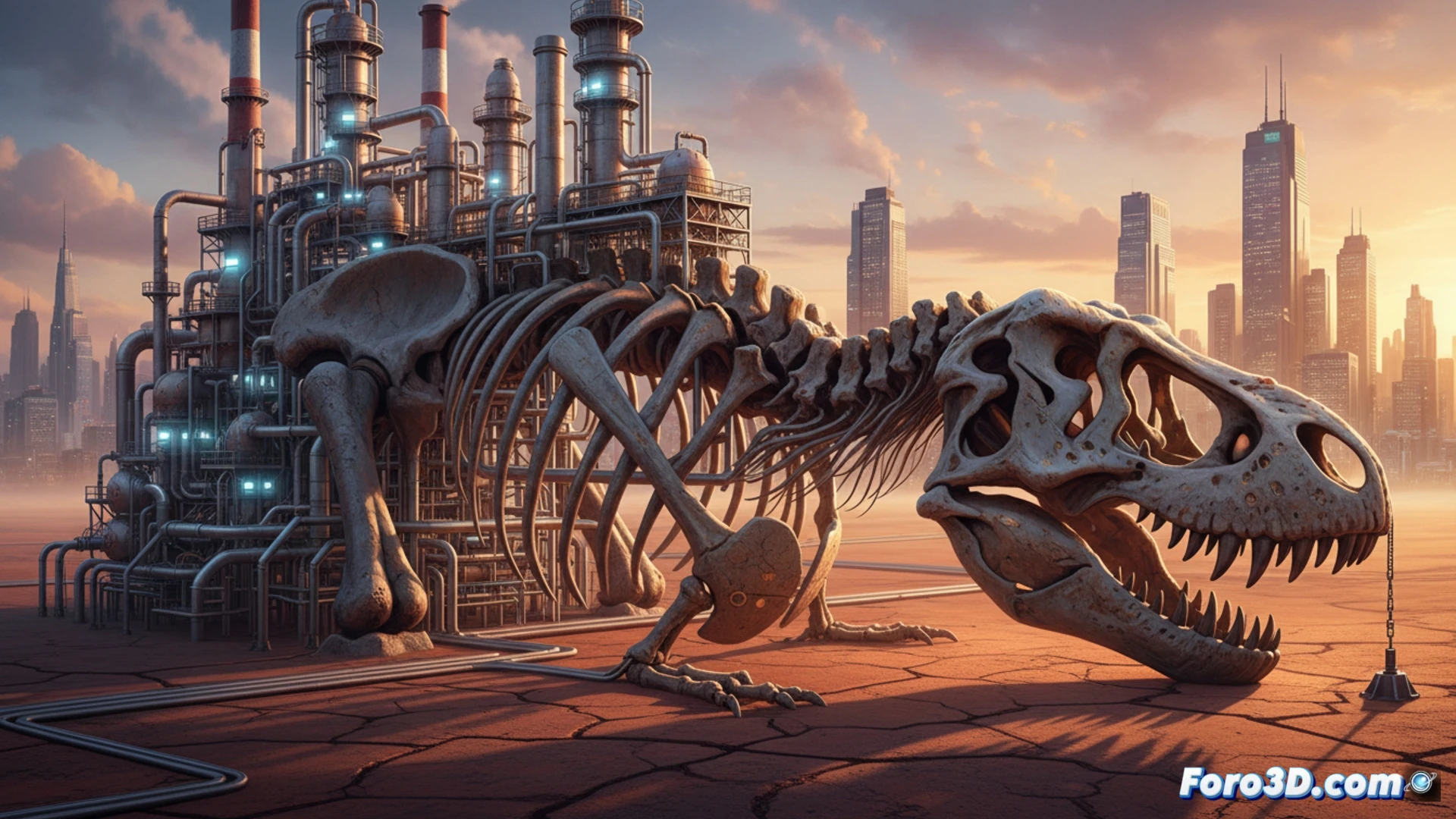
Dinosaur Fuel in Your Tank
Think of a Tyrannosaurus rex in its prime, a dominant predator that consumed vast amounts of energy. That power, originated in plants and other living beings, became trapped in its body upon death. Buried under immense layers of sediment, those remains endured extreme pressures and temperatures for eons, transforming into the hydrocarbons we extract today. 🔥
A Journey of Millions of Years to the Pump
This geological process is the slowest recipe that exists. It required organic ingredients, an almost unimaginable time (tens of millions of years), and specific planetary conditions. The result is not a visible fossil, but a dense crude oil. The sun's energy, fixed by primitive vegetation and transferred through the food chain, is the same that your engine releases when burning fuel in a fraction of a second.
Main components of fossil fuels:- Ancient biomass: Organic matter from plants, land animals, and mainly marine organisms.
- Geological time: Millions of years are necessary for the transformation process.
- Extreme conditions: High pressure and heat beneath the Earth's surface are key factors.
Our modern lifestyle runs on the fossilized energy of a lost world.
The Microscopic Origin of Energy
A common but imprecise idea is that all oil comes from giant dinosaurs. In reality, most of it was generated from trillions of marine microorganisms, like plankton, which settled in the beds of ancient oceans. The scale is monumental: immense accumulations of microscopic life that, decomposing in the absence of oxygen, began the path to form hydrocarbons.
Raw material sources for hydrocarbons:- Plankton and algae: The predominant source for oil.
- Land vegetation: Main origin for coal formation.
- Animals: Contribute to the general mix of organic matter.
A Cosmic Irony with a Gasoline Smell
Therefore, every time you refuel, you're using the chemical legacy of a prehistoric planet. It's a cycle that turns slow eons into instantaneous power, allowing energy captured millions of years ago to propel our present. A tangible paradox every time the fuel gauge reads full. ⛽