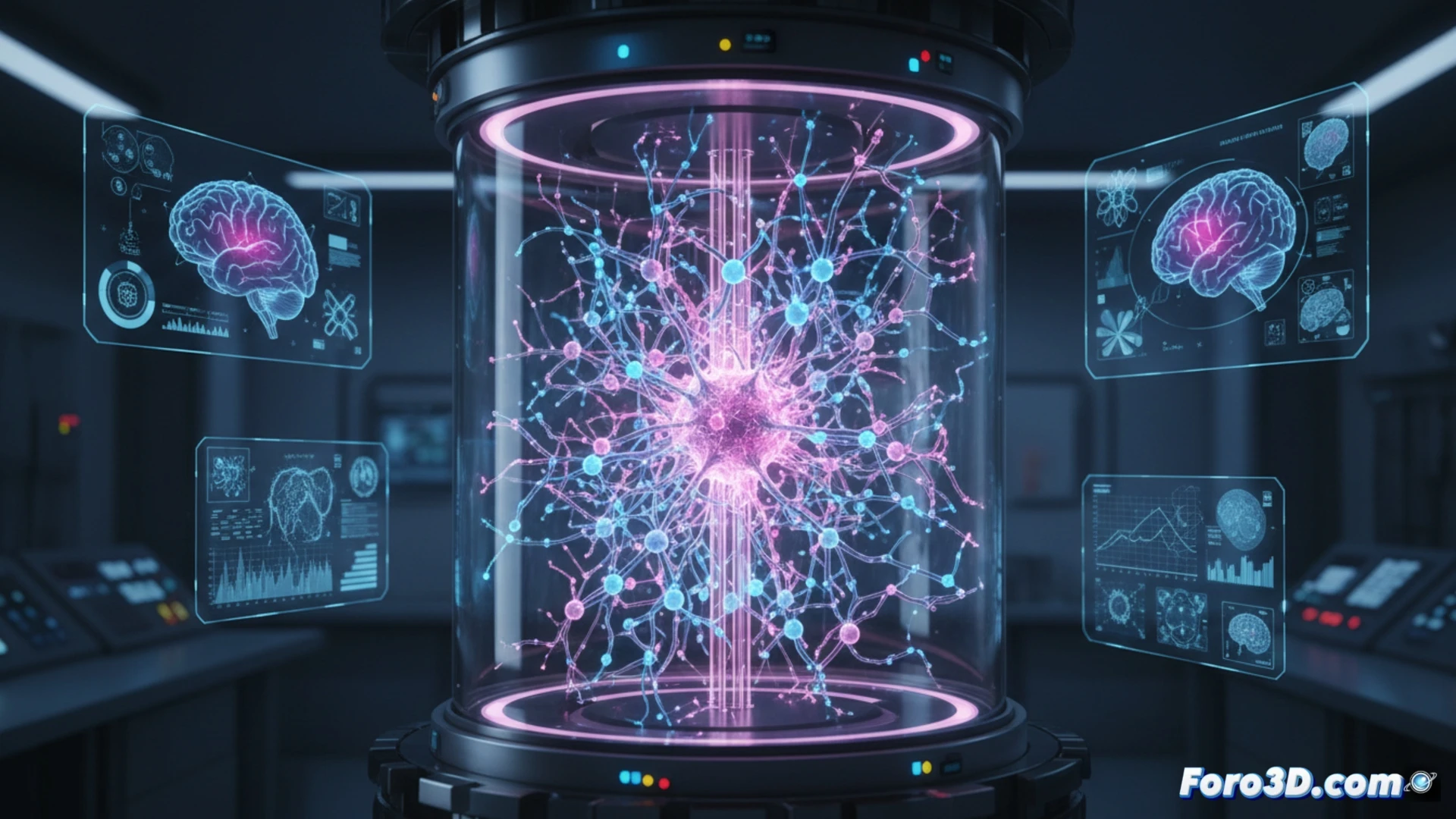
How to Spy on Neurons in Their Miniature Laboratory
How do researchers manage to decipher the mysteries of the brain? The key lies in a revolutionary strategy that fuses miniature brains created in the laboratory, detailed maps of their circuits, and the ability to listen to thousands of nerve cells at the same time. It's like installing a surveillance center inside a cellular universe in action. 🧠
Recreating Brains and Mapping Their Internal Highways
Experts can now grow brain organoids, three-dimensional structures that mimic key aspects of neural tissue. To decipher how they exchange data, they create connectomes, which are comprehensive maps of every synaptic connection. Think of the blueprint of a digital metropolis, revealing every fiber and route through which electrical signals travel.
Key tools in this process:- Organoids: Three-dimensional cellular models that simulate specific brain regions.
- Connectomes: Maps that detail all physical connections between neurons within a network.
- Hybrid technologies: Combination of optical and electrophysiological methods to obtain multidimensional data.
Listening to thousands of neurons dialoguing at once is like deciphering the murmur of a packed stadium, isolating each individual conversation.
The Power of Recording the Neuronal Symphony
The most revealing aspect is the ability to record massive activity. Using optical sensors and microelectrode arrays, scientists can capture the simultaneous chatter of legions of neurons. This ability to process large-scale information is propelling neuroscience at an extraordinary speed.
What this allows to discover:- Communication patterns between large populations of nerve cells.
- The dynamics of complete networks during simulated cognitive tasks.
- The first signs of malfunction linked to pathologies.
From Fiction to Tangible Hope
It may sound like futuristic narrative, but these advances represent a promising avenue for understanding complex conditions like Alzheimer's. It's astonishing that part of the solution may be growing in a Petri dish, under the watchful eye of modern science. 🔬