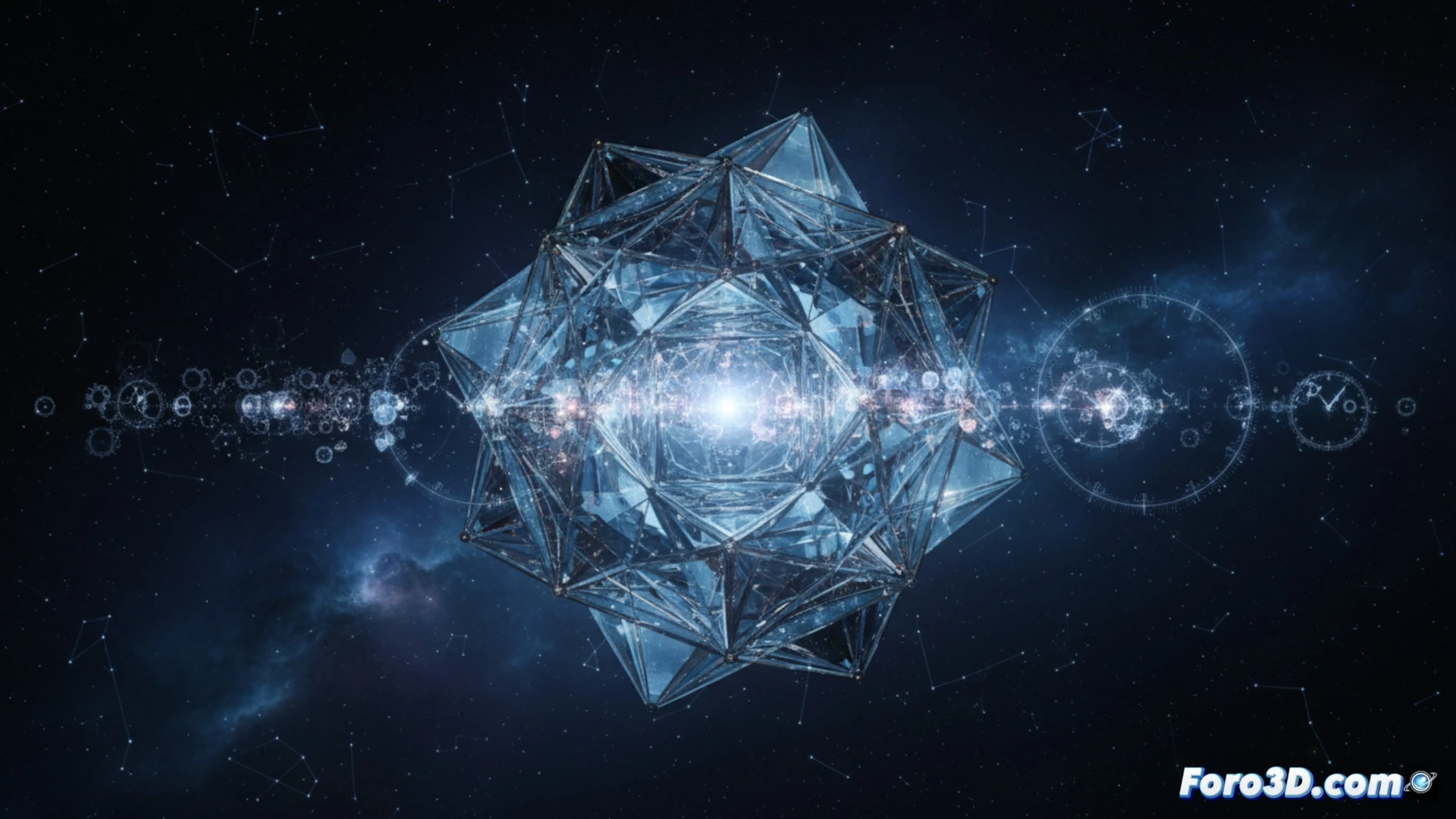
Temporal Crystals: The Basis for Clocks That Don't Need Winding
Imagine a mechanism that marks time eternally without ever needing to be wound or having its battery changed. What seems like a science fiction dream is approaching reality thanks to a fascinating rarity of quantum physics: temporal crystals. These systems, previously only theoretical, are now emerging as serious candidates for building devices with extraordinary accuracy. ⏳
Understanding the Universe's Perpetual Beat
A common crystal, like quartz, organizes its atoms in a spatial pattern that repeats. A temporal crystal does something analogous, but in the dimension of time. Its internal structure oscillates or beats at regular intervals, continuously and without consuming net energy. It's as if it possessed a fundamental tick-tock inscribed in the laws of physics.
Key differences with a conventional clock:- No energy input: It does not require an external power source to maintain its oscillation.
- Quantum stability: Its rhythm arises from a special state of matter, not from a mechanical mechanism.
- Intrinsic precision: The period of its beat is extremely regular and resistant to perturbations.
The secret to measuring time with extreme precision might lie in a crystal that dances to the rhythm of time itself.
From Theory to the Laboratory and Beyond
Research has advanced from the purely conceptual plane. Recent calculations outline how to use these systems to manufacture real instruments. A medical sensor could detect tiny variations in biomarkers, and an improved atomic clock would transform the accuracy of systems like GPS.
Potentially revolutionary applications:- Ultra-precision metrology: Create time and frequency standards more accurate than current ones.
- Advanced medical diagnostics: Develop sensors capable of identifying diseases in very early stages.
- Robust quantum computing: Provide a stable rhythm to synchronize operations in quantum processors.
The Future Beats to the Rhythm of a Crystal
These quantum entities are transitioning from being an academic curiosity to becoming technological building blocks. Their ability to maintain a perpetual and stable rhythm promises to lay the foundation for a new generation of devices where precision is no longer limited by wear or the need for energy. The beat of time, captured in a crystal, could be the next great revolution in how we measure and interact with the world. 🔬