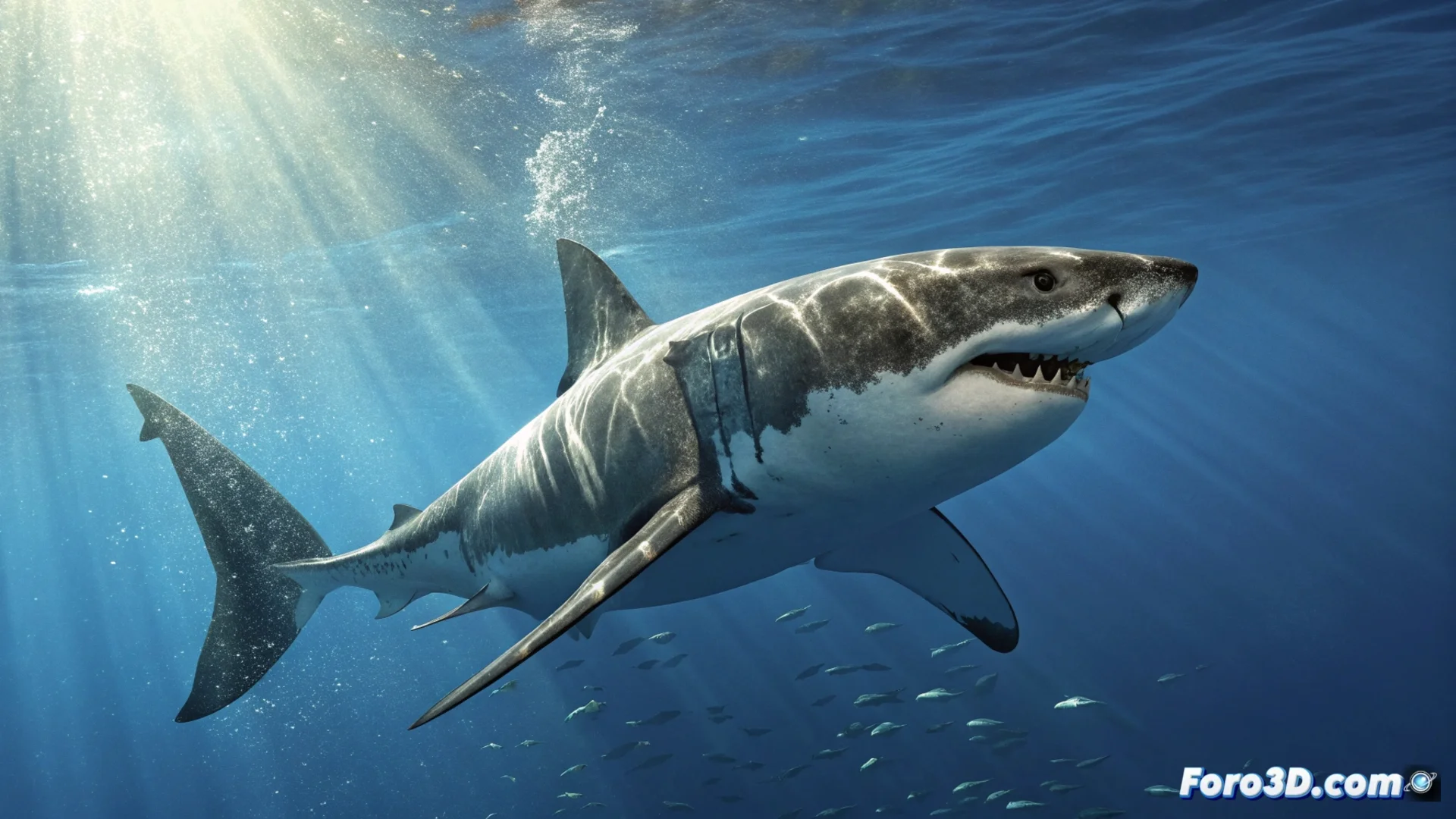
Techniques for Animating a Shark in Blender
Bringing a marine predator to life in Blender involves integrating multiple 3D animation techniques. The process starts with the model and extends to simulating its movement through the water in a believable way 🦈.
Prepare the Model and Bone System
The first step is to have a shark mesh, whether modeled or imported. Over it, a rig or digital skeleton is built whose bones mimic the real anatomy of the animal. It is crucial that the spine and fins are well defined, as this internal framework is what will deform the mesh naturally when moved.
Key initial steps:- Model or import the shark's geometry.
- Create a chain of bones that follows the curvature of the spine.
- Add secondary bones for the pectoral, dorsal, and caudal fins.
A well-designed rig is the foundation for any organic and fluid animation.
Set Up Animation Controls
To manipulate the shark efficiently, different systems are used. For the fins and tail, using inverse kinematics (IK) is ideal, as it allows animating an entire segment (like the tail whip) with a single controller, instead of rotating each bone one by one. Additionally, empty controllers are added to govern parts like the main body, jaw, and eyes, making the animation more intuitive.
Essential control elements:- IK chains for the fins and tail.
- Custom empty controllers for the body and head.
- Null objects to handle the jaw and eye movement.
Create Movement and Simulate Water
The basic swimming cycle is achieved by animating a sinusoidal undulation along the spine. To make this movement smooth and repetitive, the Graph Editor is used to refine the interpolations and mark the cycle. To move the shark through the scene, the entire rig can be animated along a path, or for greater realism, particle or fluid systems can be used to generate the water and integrate the animal's movement visually into it. Remember that a shark does not stop abruptly; animating its turns and decelerations gradually takes time, but prevents it from looking like a simple projectile 🏊♂️.