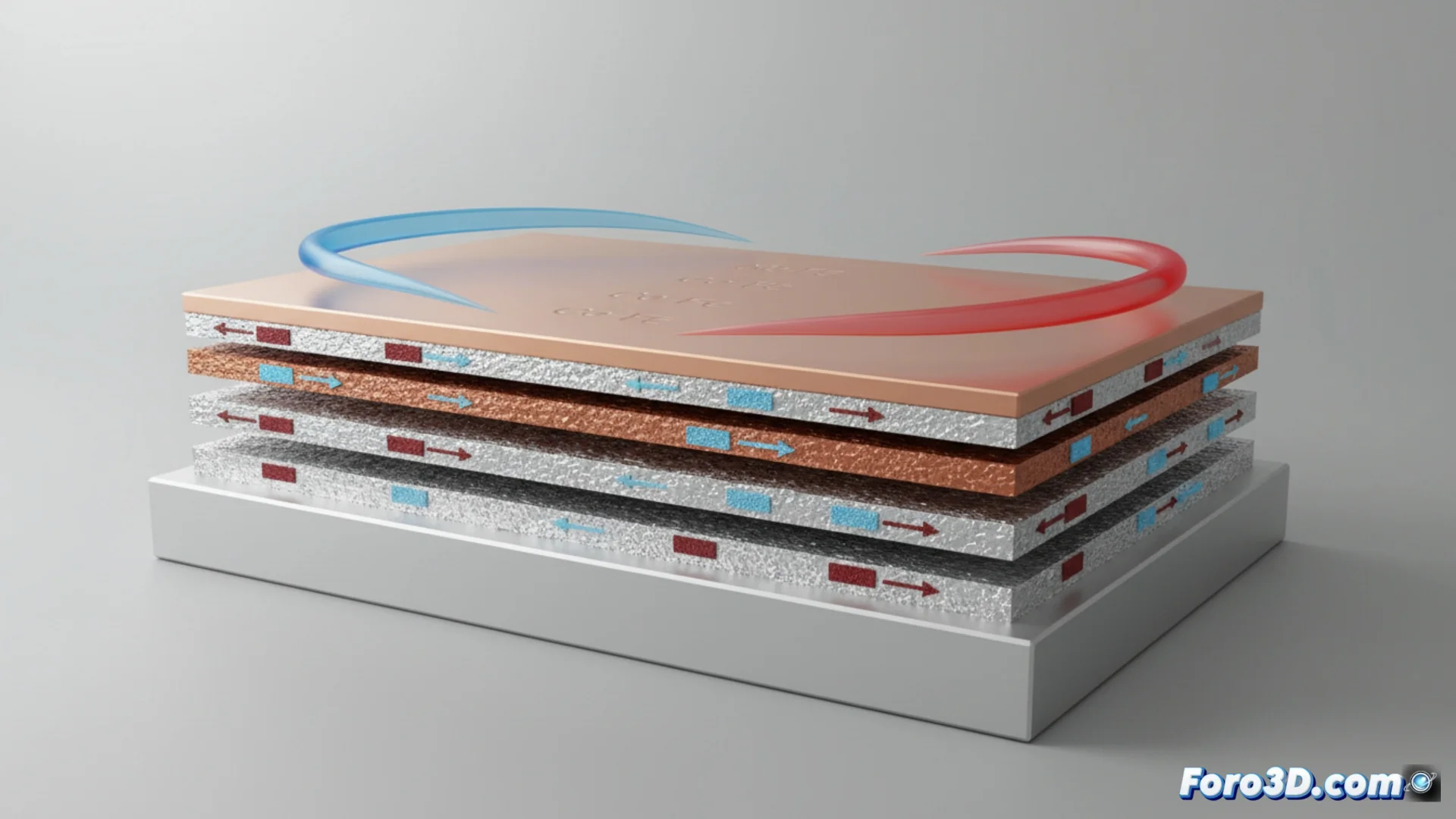
Study on Planar Hall Effect Sensors and Their Magnetic Anisotropy
The research focuses on magnetic sensors that employ the planar Hall effect to detect magnetic fields with a very high sensitivity level. These components are fundamental in areas such as biotechnology, medical diagnostics, and navigation systems. To increase their sensitivity, efforts are made to reduce the magnetic anisotropy field, although this action can facilitate the appearance of magnetic domains during magnetization reversal, generating unwanted hysteretic responses. Therefore, precisely controlling the anisotropy and the magnetization reversal process is essential to achieve an optimal balance between fine detection and maintaining stability. 🧲
Divergent Behavior in NiFe and CoFe Multilayers
In the experimental work, thin multilayers fabricated with Nickel-Iron (NiFe) and Cobalt-Iron (CoFe) alloys are examined. These are deposited on various metallic layers that act as substrates, under conditions where an external magnetic field is sometimes applied during their growth. NiFe films predominantly exhibit uniaxial anisotropy, whose direction is mainly governed by the magnetic field applied at the time of deposition. Their anisotropy constant remains around 3 kerg/cm³, showing little dependence on the material of the underlying substrate layer.
Key Findings in NiFe Structures:- They present primarily uniaxial magnetic anisotropy.
- The anisotropy direction is defined by the field applied during film growth.
- The anisotropy constant is ~3 kerg/cm³ and is quite stable.
Precisely controlling how magnetization reverses is key to avoiding hysteresis and achieving stable sensors.
The Decisive Influence of the Substrate on CoFe
On the other hand, CoFe alloy films show a radically different behavior. In this case, the substrate layer on which they are deposited largely defines their magnetic properties, leading to a biaxial magnetic response. This phenomenon is particularly intense when Silver (Ag) layers are used as substrates and combined with the application of an external field during deposition, achieving anisotropy values that can reach up to 14.88 kerg/cm³. Additionally, by analyzing how the coercive field varies with angle, the specific mechanism by which magnetization reverses in these materials can be inferred.
Main Characteristics of CoFe Multilayers:- Their magnetic anisotropy is dominated by the nature of the substrate layer.
- They exhibit a biaxial type magnetic response.
- They achieve high anisotropies (up to ~14.88 kerg/cm³) with Ag substrates and applied field.
Balance Between Sensitivity and Magnetic Memory
The main conclusion emphasizes the need for a careful design. Seeking maximum sensitivity in a planar Hall effect sensor involves reducing magnetic barriers (anisotropy), but an "excessively compliant" material may retain memory of its previous states, causing hysteresis. Therefore, the technological challenge lies in optimizing growth parameters and material selection (such as choosing between NiFe or CoFe and their corresponding substrate) to fabricate devices that detect with great precision without sacrificing the reliability and stability of their response. ⚖️