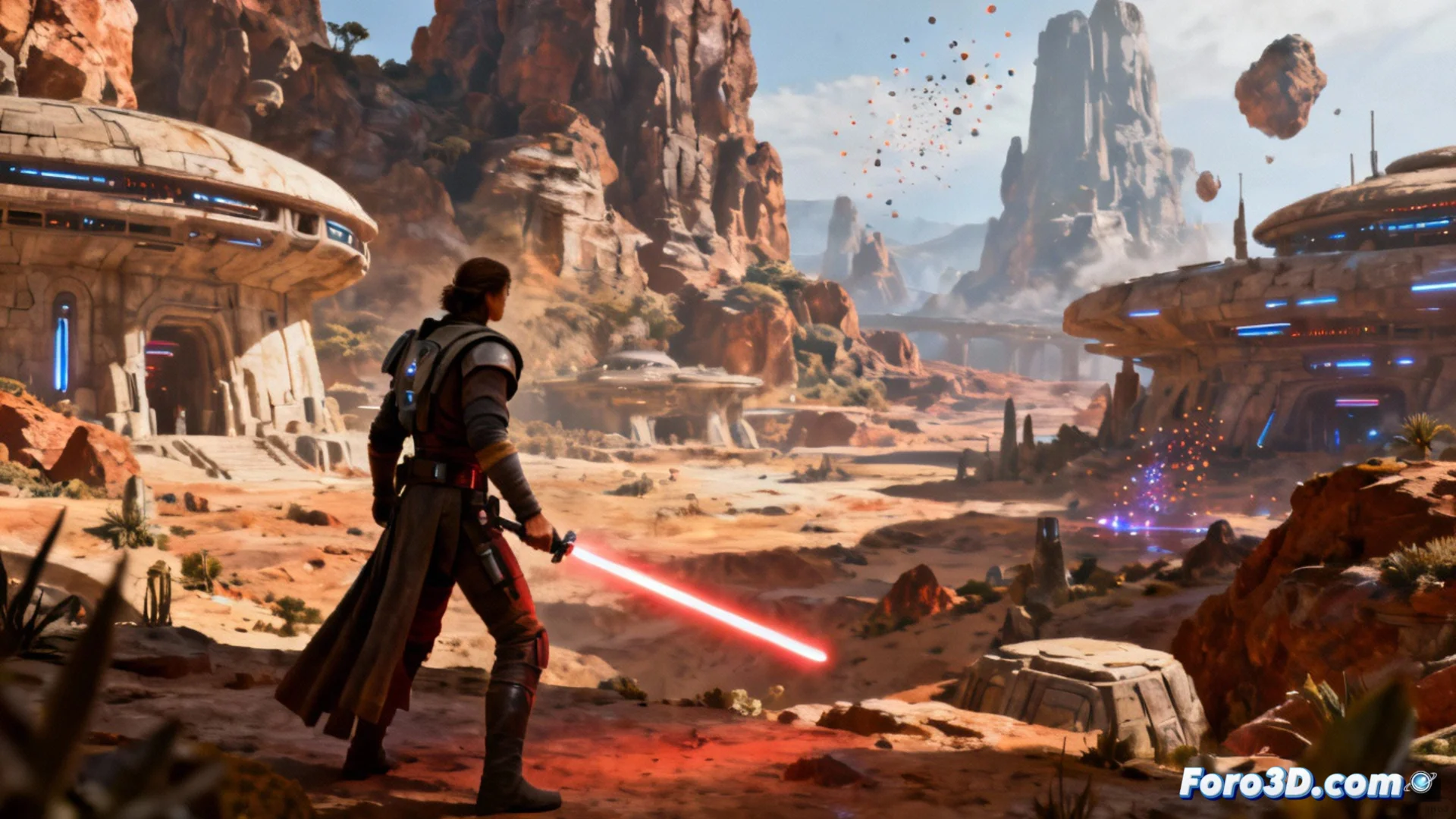
Star Wars Jedi: Survivor Runs on a Highly Customized Unreal Engine 4
Respawn Entertainment's title, Star Wars Jedi: Survivor, does not use the standard graphics engine. To achieve its ambition, the studio deeply modified Unreal Engine 4, adapting it to handle larger scenarios and a visual style faithful to the saga. This change was key to evolving from its predecessor. 🎮
The Adapted Graphics Engine and Its Visual Impact
Respawn transformed the base engine to build semi-open worlds of superior scale. The main goal was to achieve a realistic and consistent aesthetic across all explorable planets. To accomplish this, a PBR (Physically Based Rendering) rendering system was implemented, giving surfaces and light believable physical behavior. On next-generation consoles, global illumination and reflections calculations were refined, increasing environmental detail. However, this complexity initially came at a performance cost. ⚙️
Key Technical Points of Rendering:- A PBR system is used to achieve realistic materials and lights.
- Environments are more extensive and have a higher level of detail.
- The launch showed issues maintaining a stable frame rate, requiring several subsequent patches.
Developing such large worlds has a cost, and sometimes frames per second pay the price initially.
Development Pipeline and Software Used
Producing a game of this magnitude requires a robust AAA development pipeline. It is very likely that Respawn Entertainment used standard industry tools for modeling, sculpting, and animating. Sound management is also a fundamental pillar for creating an immersive experience. 🛠️
Probable Tools in Production:- Maya: For modeling objects and animating characters.
- ZBrush: For sculpting high-resolution 3D models with great detail.
- Houdini: For generating and simulating complex visual effects procedurally.
- Wwise: For designing and managing audio, enabling surround and dynamic sound.
Conclusion on Technology and Performance
The decision to customize Unreal Engine 4 allowed Star Wars Jedi: Survivor to take a leap in scale and visual fidelity. Although the path was not perfect and required additional work to optimize performance, the use of a professional pipeline with tools like Maya or Houdini underpins the final quality. The Force is strong, but stabilizing frames per second demanded patience and several updates. ✅