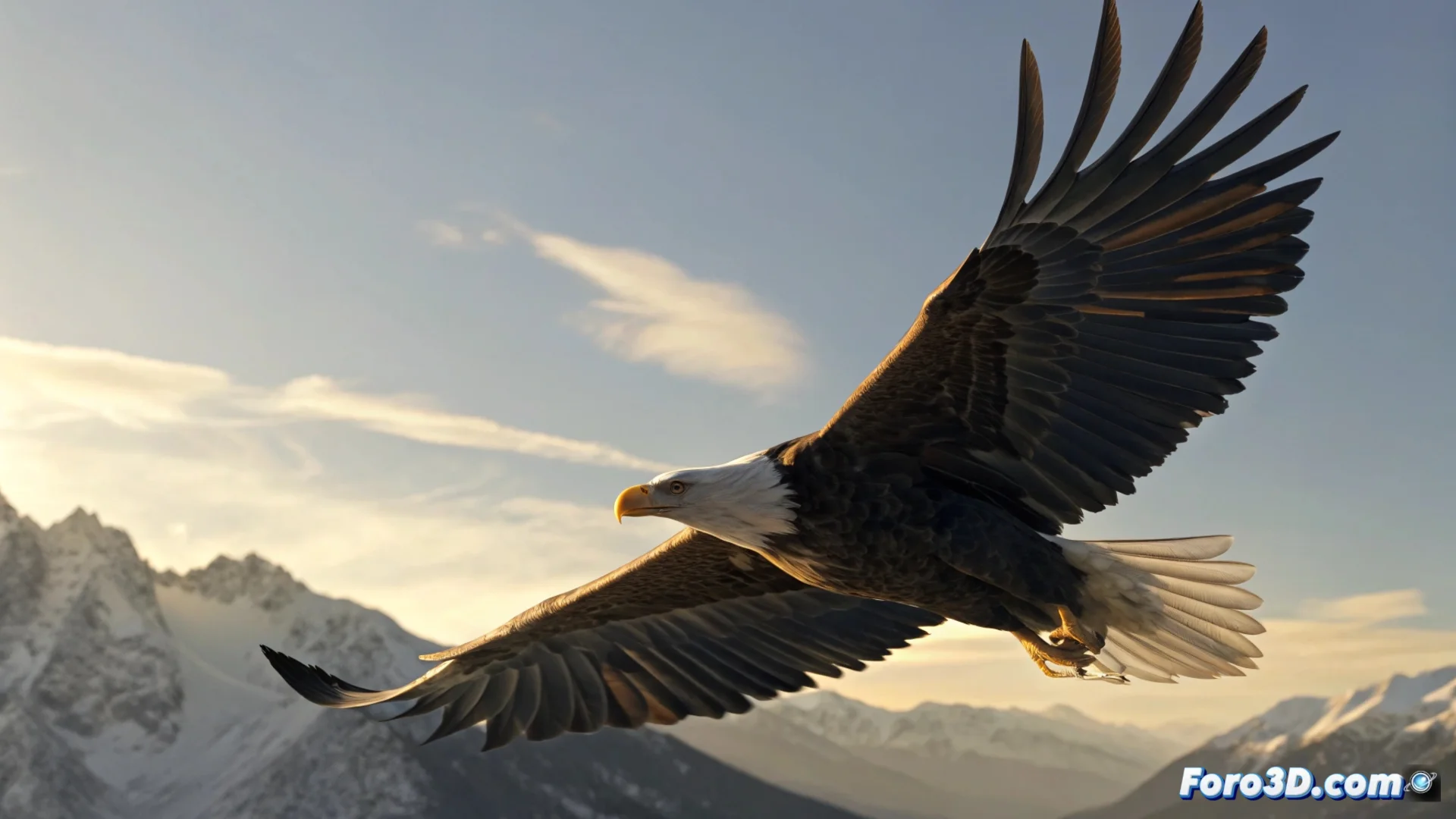
Simulating Bird Wing Flapping in Blender
Creating the illusion of a bird flapping its wings requires a specific technique in Blender. The most effective method combines the use of an armature skeleton with animation controllers that automate the movement. This approach allows generating a believable and repetitive flight cycle without the need to manually animate each frame. 🕊️
Setting up the base with armature and controllers
The first step is to have a bird model with its bone structure prepared. Apply an Armature modifier to the mesh so it follows the bones. The main animation focuses on rotating the key wing bones. To avoid doing it manually, F-Curve animation curve controllers are used. By adding a modifier like Cycles or a wave function, an automatic up-and-down pattern is generated.
Steps to set up the cycle:- Select the wing bone and go to the graph editor.
- In the Modifiers tab of the rotation curve, add a Cycles modifier.
- Adjust the amplitude to define the range of motion and the phase to change the cycle start.
- You can shape the wave form within the modifier to avoid a movement that is too perfect and symmetrical.
The key to natural flapping lies in adjusting the wave curve, not in using a perfect sine wave.
Adding layers of realism to the movement
To make the movement more organic, it's useful to go beyond basic rotation. Implementing inverse kinematics (IK) at the wing tip helps make the folding more natural by following a target bone. Additionally, feathers are not rigid. To simulate their reaction, you can apply a Soft Body simulation to the secondary geometries. This makes the feathers ripple with the airflow generated by the main flapping.
Elements to refine the animation:- Set up an IK chain from the base to the wing tip for automatic folding.
- Apply Soft Body smoothing with low stiffness to the objects representing the feathers.
- Combine this secondary physical simulation with the main bone controller.
Final considerations for the animation
Achieving a believable result depends on fine-tuning the speed and scale parameters. A common mistake is not adapting the cycle speed to the bird's size, resulting in an unnaturally fast or slow wing beat. Always review the timeline scale and cycle duration in relation to the model. A hummingbird and an eagle have very different flight rhythms that must be reflected in the animation. Remember to test and adjust until the movement feels organic and weighted. 🦅