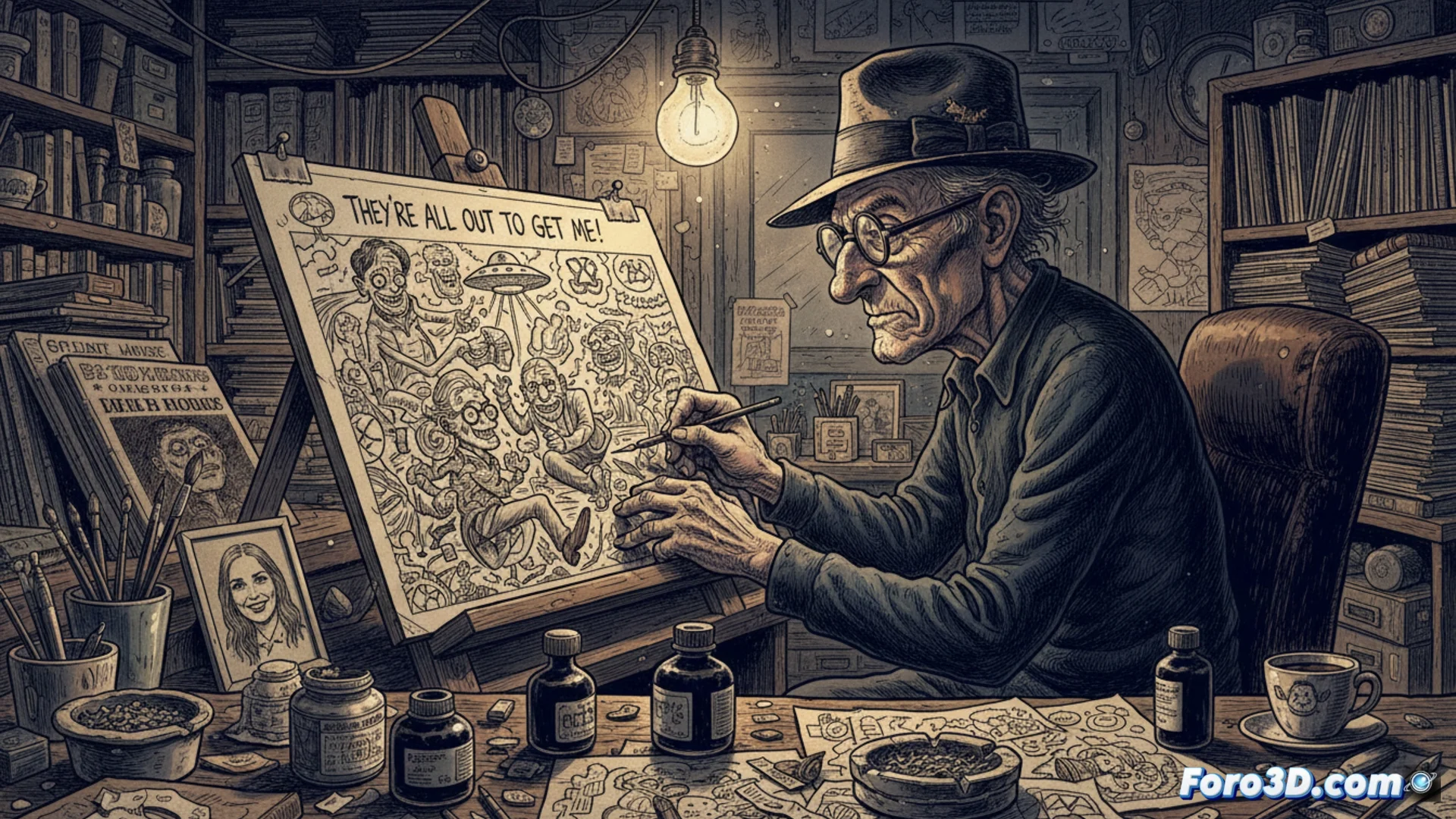
Robert Crumb presents his new graphic work after twenty years
The iconic comic book author Robert Crumb, at eighty-two years old, breaks a creative silence of more than twenty years with 'Tales of Paranoia'. This work serves as a deep immersion into his personal anxieties and a skeptical look at the modern world, maintaining his unique and challenging voice. 🎨
A graphic exploration of inner fears
The book does not seek to promote the conspiracy theories it addresses, but to use them as a lens to examine the human psyche. Crumb portrays himself laughing at his own paranoia while touching on thorny topics like censorship or distrust of vaccines. His stated goal is to provoke thought, not validate ideologies.
Central features of the work:- Combines black humor with raw emotional honesty to dissect contemporary phobias.
- The narrative alternates between the personal and the social, creating a complex portrait of the artist's mind.
- Includes intimate and melancholic memories about his late wife, adding emotional depth.
The author suggests that, in an increasingly strange world, having a bit of paranoia might not be so irrational.
Reflections on a legendary life and career
Beyond paranoia, these pages serve as a graphic diary where Crumb confronts his ghosts with pencil and ink. It evokes key moments from his career, processing his legacy and his place in culture. After decades, his line remains potent and his perspective, uncomfortably lucid.
Elements that define this return:- Acts as a visual logbook where the author confronts his darkest thoughts.
- Maintains a distinctive tone that invites the reader on a fascinating, though disturbing, journey.
- Presents an uncompromising social critique, mixed with autobiographical anecdotes.
The legacy of a comic underground master
With 'Tales of Paranoia', Robert Crumb demonstrates that his ability to question reality remains intact. The work consolidates his method of using drawing as a tool to understand and question the world, offering an uncomfortable but essential reading on the fears that define us. His conclusion seems to be that, sometimes, laughter is the only response to uncertainty. ✏️