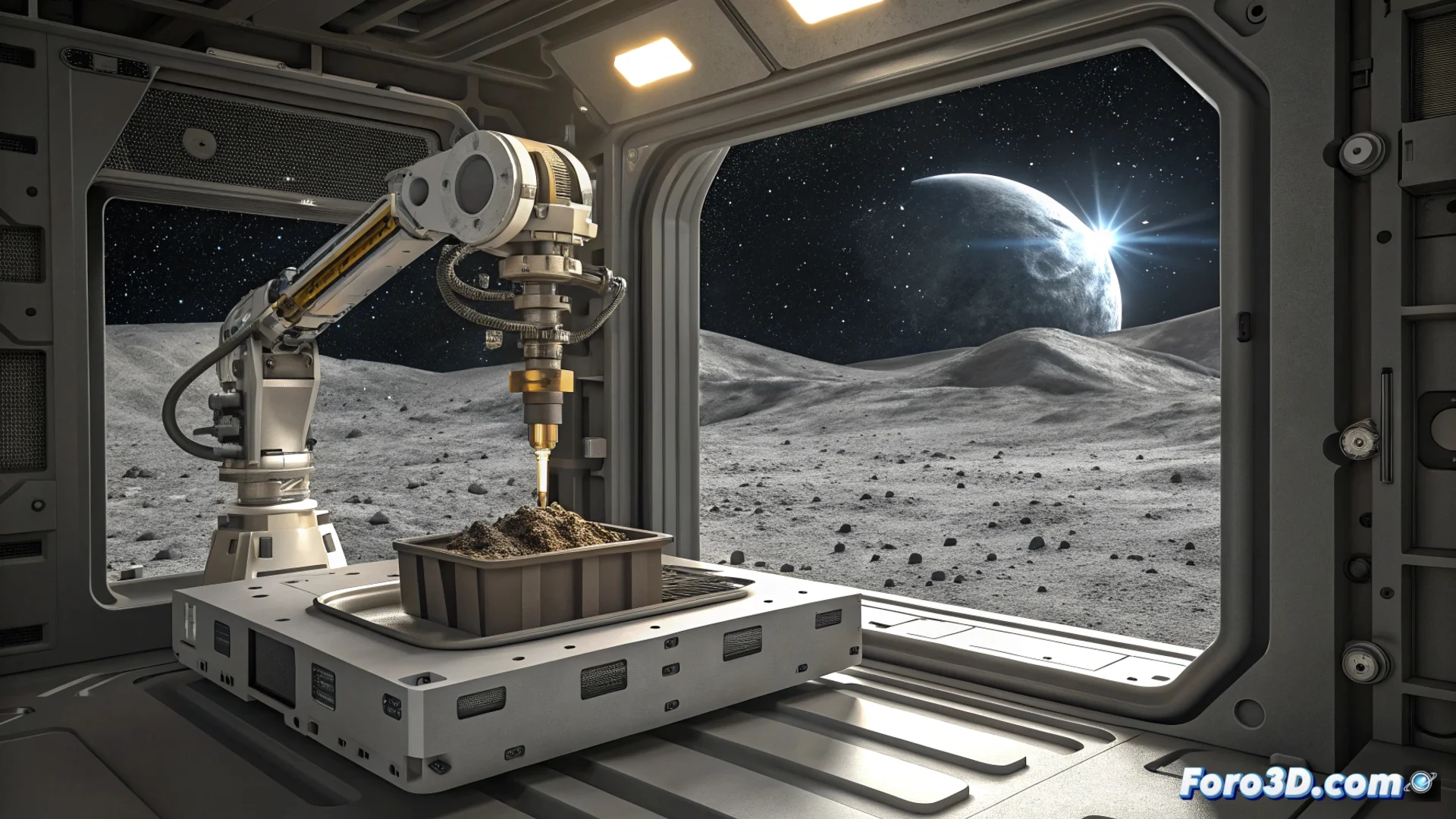
Researchers Turn Lunar Dust into Materials for Manufacturing on the Moon
A group of scientists is developing methods to use lunar regolith, the layer of dust and rock covering the surface of our satellite, as a source of materials to build directly there. The goal is to process this local resource to obtain vital elements and raw materials, drastically reducing dependence on Earth supplies. 🚀
From Lunar Dust to Conductive Ink
The core of this technology lies in a process that separates oxygen, which makes up nearly half of the regolith. What remains after this extraction is a residue composed of various metallic alloys and other compounds. This residual material is not discarded but is transformed into the base for manufacturing.
Products Derived from Lunar Residue:- Conductive Inks: Ideal for printing circuits and electronic components directly on the Moon.
- Powders for Additive Manufacturing: Suitable for techniques like 3D printing, allowing the creation of solid parts and structures.
- Versatile Raw Material: From it, antennas and cables to supports and tools could be produced.
Manufacturing in place reduces the mass that must be launched from our planet and increases the resilience of expeditions.
Autonomy for Future Lunar Bases
This approach aligns with the concept of in-situ resource utilization (ISRU), key for sustainable and long-duration space missions. By manufacturing what is needed with what is available, missions gain autonomy and become more economically viable.
Key Advantages of In-Situ Manufacturing:- Reduction in Launch Payload: There is no need to transport all materials from Earth, which makes missions cheaper and simpler.
- Greater Operational Resilience: A lunar base can repair or manufacture equipment without waiting for shipments from Earth.
- Long-Term Sustainability: It allows for establishing a more permanent and less dependent human presence.
A Future Printed in Lunar Dust
This research lays the foundation for a new era of exploration. The next time you look at the Moon, imagine that its characteristic gray dust could be forming the next generation of habitats or the communications antenna of a colony. It represents a fundamental advance to make the Moon a place where we can live and work, using its own resources. 🌕