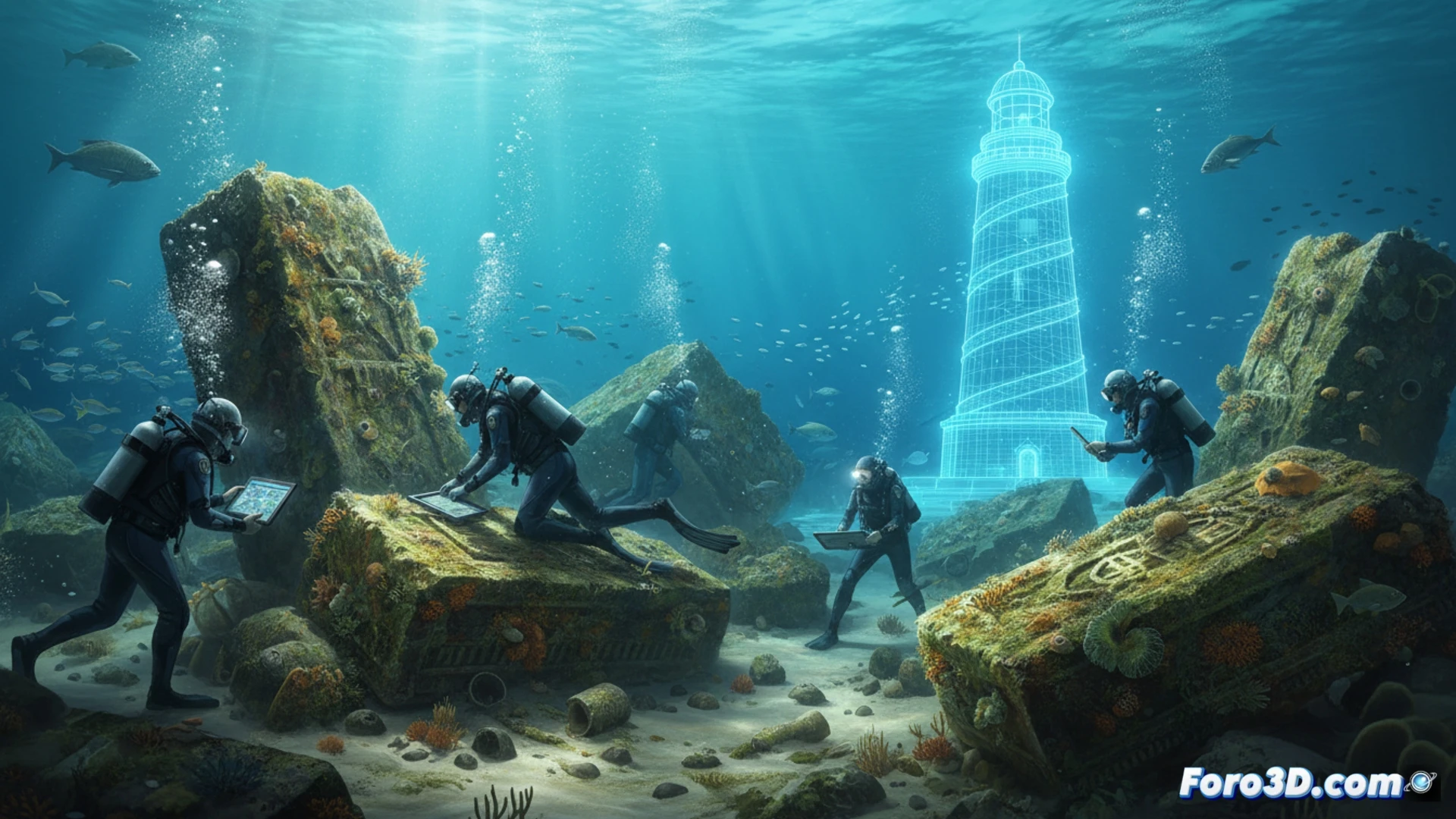
Rescuing the Lighthouse of Alexandria with 3D Technology
Can you imagine being able to digitally reconstruct one of the Seven Wonders of the Ancient World? 👷♂️ This is what a group of experts from France and Egypt is achieving by recovering and digitizing the enormous remains of the legendary Lighthouse of Alexandria.
The technique that captures every millennial detail
Instead of just analyzing the stones with traditional methods, the team applies 3D photogrammetry. This process consists of capturing thousands of high-resolution photographs from all possible angles so that specialized software assembles them and generates an exact digital replica. It's similar to performing a full body scan, but applied to a monumental rock that has remained submerged for centuries. 🪨
How is the complete virtual model built?:- All the stone blocks already recovered from the seabed are scanned in 3D.
- The data from those scans are integrated with information from fragments that are still underwater.
- These models are cross-referenced with ancient historical descriptions and documents about the lighthouse.
The resulting 3D model offers unprecedented precision for studying the complete structure, revealing hidden aspects of its design and the method used to build it.
A bridge between the past and the digital future
This project does not only seek to preserve; its goal is to understand. The fusion of archaeology and digital technology allows researchers to examine the architecture with a level of detail that was previously impossible. 🧐
Impact and possibilities of digital reconstruction:- It facilitates the analysis of ancient construction techniques with millimeter accuracy.
- It allows visualization and study of the entire structure, even the parts that were lost.
- It opens the door to immersive experiences, such as virtual walks around the base of the lighthouse.
Conclusion: a new era for archaeology
It's fascinating to observe how tools associated with video game development and visual effects, such as 3D scanning, are transforming the way we explore our heritage. This work demonstrates that we can now open a window to the past with astonishing clarity, almost as if we could touch history. ✨