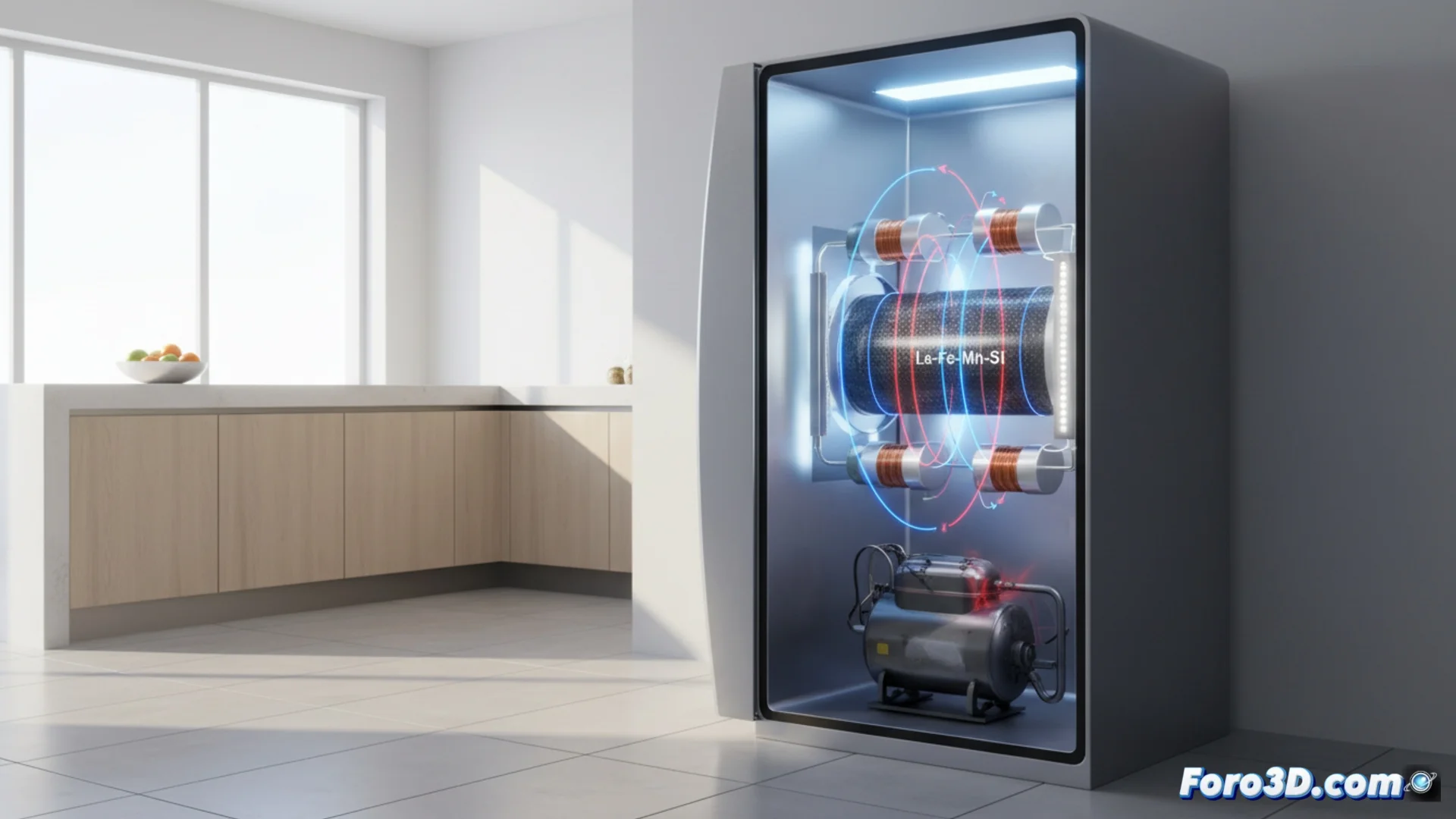
La-Fe-Mn-Si Alloys Drive Magnetic Refrigeration
A new scientific discovery indicates that combining lanthanum, iron, manganese, and silicon in a specific alloy could revolutionize how we cool our food. This advancement focuses on perfecting magnetic refrigerators, devices that operate under a physical principle different from the traditional one. 🧲
Practical Advantages for the Consumer
For the end user, this innovation materializes in appliances with a very reduced consumption profile. Without needing a mechanical compressor or refrigerant gases, these units would be noticeably quieter and have fewer components prone to wear. This increases their lifespan and reduces the frequency of repairs. A crucial factor for their commercial viability is that the materials respond to magnetic fields of moderate intensity, around 0.6 teslas, which reduces the cost and simplifies the design of the necessary magnets.
Key Benefits of the Technology:- Lower Electricity Costs: They optimize energy use, reducing the electricity bill.
- Silent Operation: They eliminate the characteristic noise of traditional compressors.
- Minimal Maintenance: With few moving parts, they are more reliable and durable.
The future of refrigeration may depend less on making noise with a compressor and more on silently rotating a magnet.
The Basis of the Magnetocaloric Effect
This technique does not compress gases to generate cold. Instead, it uses a special solid material that changes its temperature when exposed to an external magnetic field. By rotating or alternating this field in a controlled manner, a continuous thermal cycle is established: the material absorbs heat from the refrigerator's interior and then dissipates it to the outside. This mechanism completely avoids the use of hydrofluorocarbons (HFC) and other fluids that damage the atmosphere.
How the Basic Cycle Works:- Magnetization Phase: When the field is applied, the alloy heats up and releases that heat to the external environment.
- Demagnetization Phase: When the field is removed, the material cools below its initial temperature, absorbing heat from the refrigerator's interior.
- Continuous Cycle: Rotating the magnet or the material repeats this process, maintaining a constant cold environment.
A Step Toward Sustainability
Adopting magnetic refrigeration with alloys like La-Fe-Mn-Si represents a double advancement. On one hand, it drastically optimizes energy consumption in a massively used appliance. On the other, it eliminates a direct source of greenhouse gases, contributing to mitigating climate change. It is a technological transition that promises to make our homes more efficient and our environmental impact much smaller. 🌍