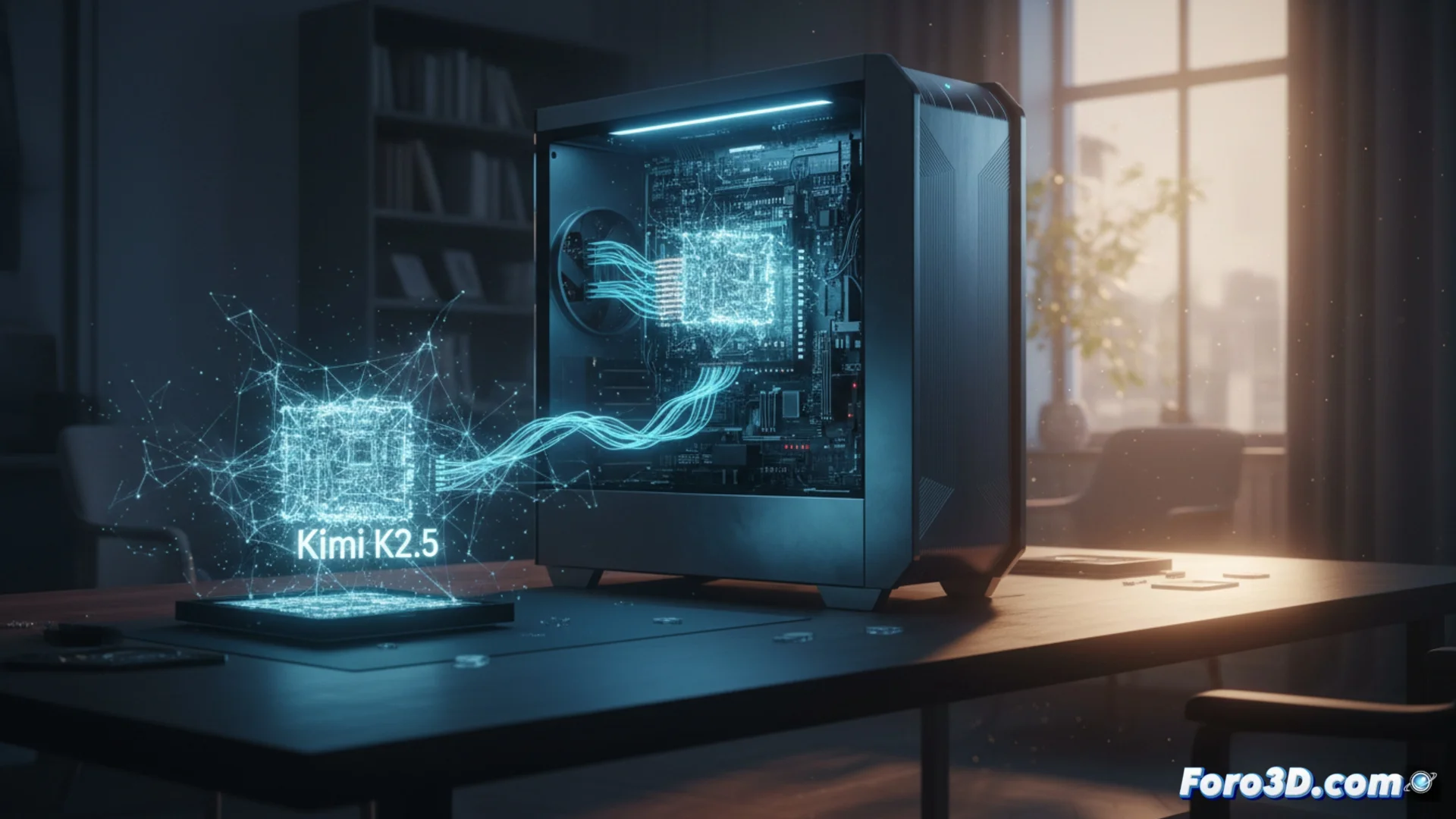
Kimi K2.5 Seeks More Compact Versions for Home Users
The artificial intelligence model Kimi K2.5 marks a milestone in the open source field. However, its extreme size poses a real obstacle for many. Operating a system of such magnitude requires equipment that goes beyond what a common PC has. This limit restricts who can test the technology and hinders its spread. The response comes from the grassroots: users and creators demand practical solutions 🛠️.
The Community Pushes for Lighter Models
In specialized forums and GitHub repositories, a collective movement is growing. The arguments point out that a reduced model is not only necessary but entirely feasible. Methods such as quantizing weights, removing superfluous neurons, or adopting architectural designs that consume fewer resources are being explored. These modifications aim to drastically cut memory and computing power needs without degrading performance too much. The open nature of the project drives this process, allowing anyone to take the base and adapt it.
Technical Ways to Reduce the Model:- Quantization: Reduce the precision of the model's parameters to save space and speed up calculations.
- Network Pruning: Identify and remove connections or neurons that contribute little to the final result.
- Efficient Architectures: Implement neural network designs that achieve more with fewer operations.
The future is not in a single giant in the cloud, but in a family of models that anyone can run on their own equipment.
Towards an Ecosystem of Scalable and Accessible Models
The logical trajectory for projects like this points to a diversified ecosystem. Instead of a monolith, a range of tailored versions is envisioned. A full edition for data centers, an intermediate version for powerful workstations, and a very compact mode for modest personal computers. This strategy connects the project with the real needs of end users. Being able to run a model locally on a laptop radically expands options for integrating and customizing it. The advantage of processing data locally, ensuring privacy and control, is a key driver in this direction.
Benefits of Local and Compact Models:- Democratize Access: Anyone with a home computer can experiment with the technology.
- Foster Customization: Users can adjust and modify the model for their specific needs.
- Ensure Privacy: Data does not leave the user's device, eliminating security risks.
The Silent Revolution on Your Own Computer
While some anticipate the next big innovation from remote servers, a growing part of the community prefers to have that capability operating discreetly in their own tower. For this to be possible, the original model must undergo a rigorous "parameter diet". This distributed effort, typical of the open source philosophy, can accelerate innovation and generate multiple variants optimized for different hardware levels. The ultimate goal is clear: break through the hardware barrier and allow advanced artificial intelligence to be something anyone can test, modify, and use directly 🔓.