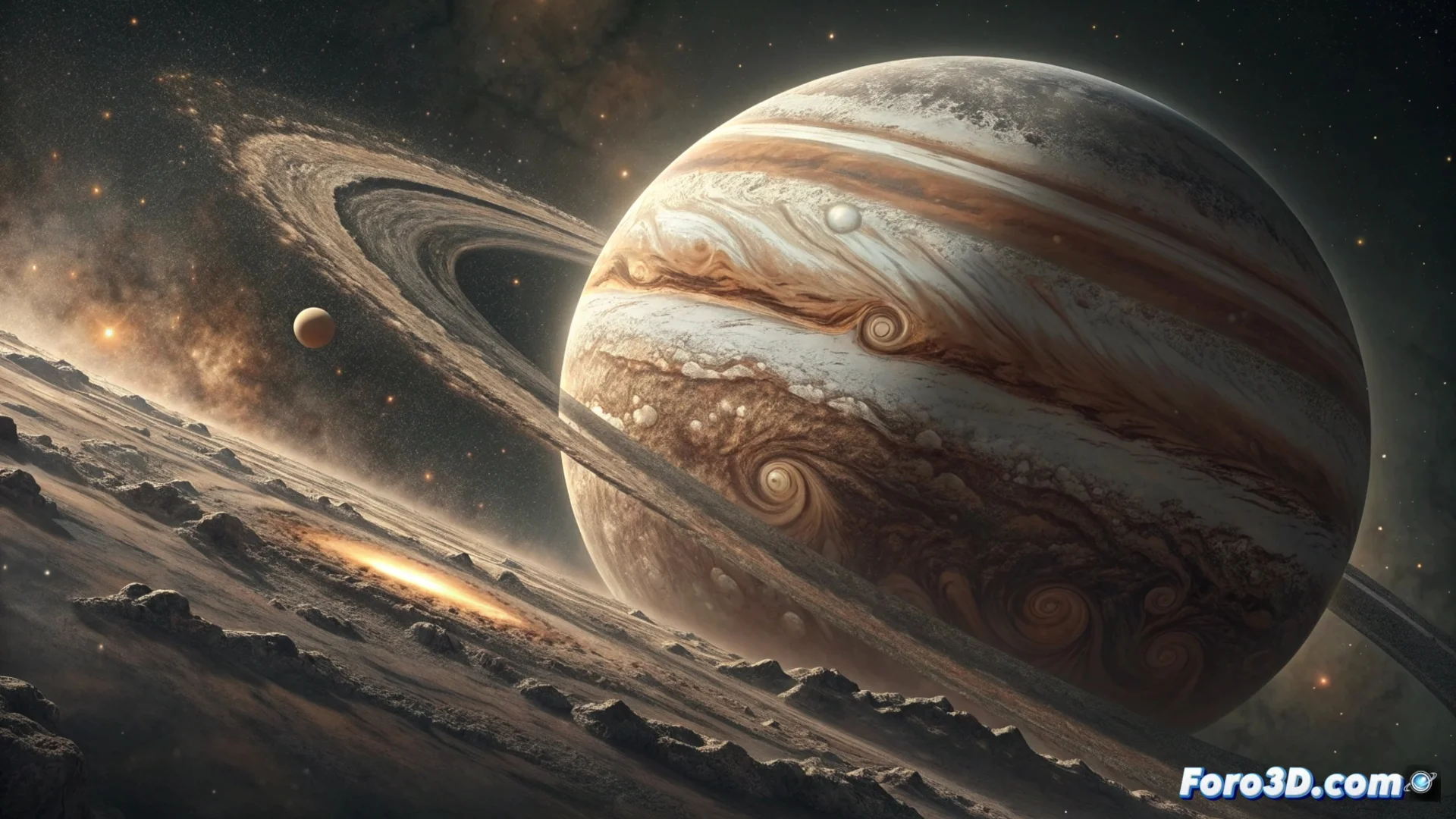
Jupiter Has Gotten a Little Smaller: Here's How We Know
How do you determine the size of a gaseous colossus hundreds of millions of kilometers away? 🤔 NASA's Juno mission acts as an orbital detective, and its high-precision measurements reveal that Jupiter's diameter is slightly smaller than estimated. The difference is as tiny as the thickness of a sheet of paper on a two-meter sphere, but its scientific implication is enormous.
The Importance of Precisely Measuring a Dynamic Planet
Jupiter is not a static world. It is a turbulent sphere of gas with a complex core and colossal atmospheric phenomena. Knowing its exact dimensions is fundamental for modeling its internal functioning. Researchers use this data to understand how its atmosphere flows, how its powerful magnetic field is generated, and to unravel clues about how planets formed.
Key data on the measurement:- The Juno probe does not measure a solid surface, but the boundary where the dense atmosphere meets space.
- The technique uses the delay and distortion of radio signals when the spacecraft passes behind the planet.
- This precision allows refining models of Jupiter's structure and evolution.
Measuring a giant at 800 million kilometers with such finesse is a mind-blowing technical achievement.
A World Without a Defined Surface
A fascinating aspect is that Jupiter lacks a solid crust like Earth. It is a gas giant, so defining its "radius" is a challenge. It is established at the atmospheric layer where the pressure equals one Earth atmosphere. Determining this point accurately requires advanced instrumentation and very precise orbits around the planet.
Characteristics that complicate the measurement:- The atmosphere is deep and compresses gradually inward.
- The planet's rapid rotation flattens it at the poles.
- Storms and massive atmospheric flows constantly alter its "external shape."
A Small Change with Major Repercussions
This slight adjustment in the measurements of the largest planet in the Solar System underscores how continuous space exploration refines our knowledge. The next time you observe that bright spot in the sky, remember that it is a little thinner than we thought. Science never stops fine-tuning the details, even for cosmic titans. 🪐