In the 18th century, ocean navigation was a lottery. Without being able to determine longitude, ships got lost, shipwrecked, and thousands of lives were lost. The solution did not come from royal astronomy, but from the workshop of John Harrison, a self-taught carpenter and clockmaker. His obsession with mechanical precision shaped the marine chronometer, an instrument that changed navigation forever.
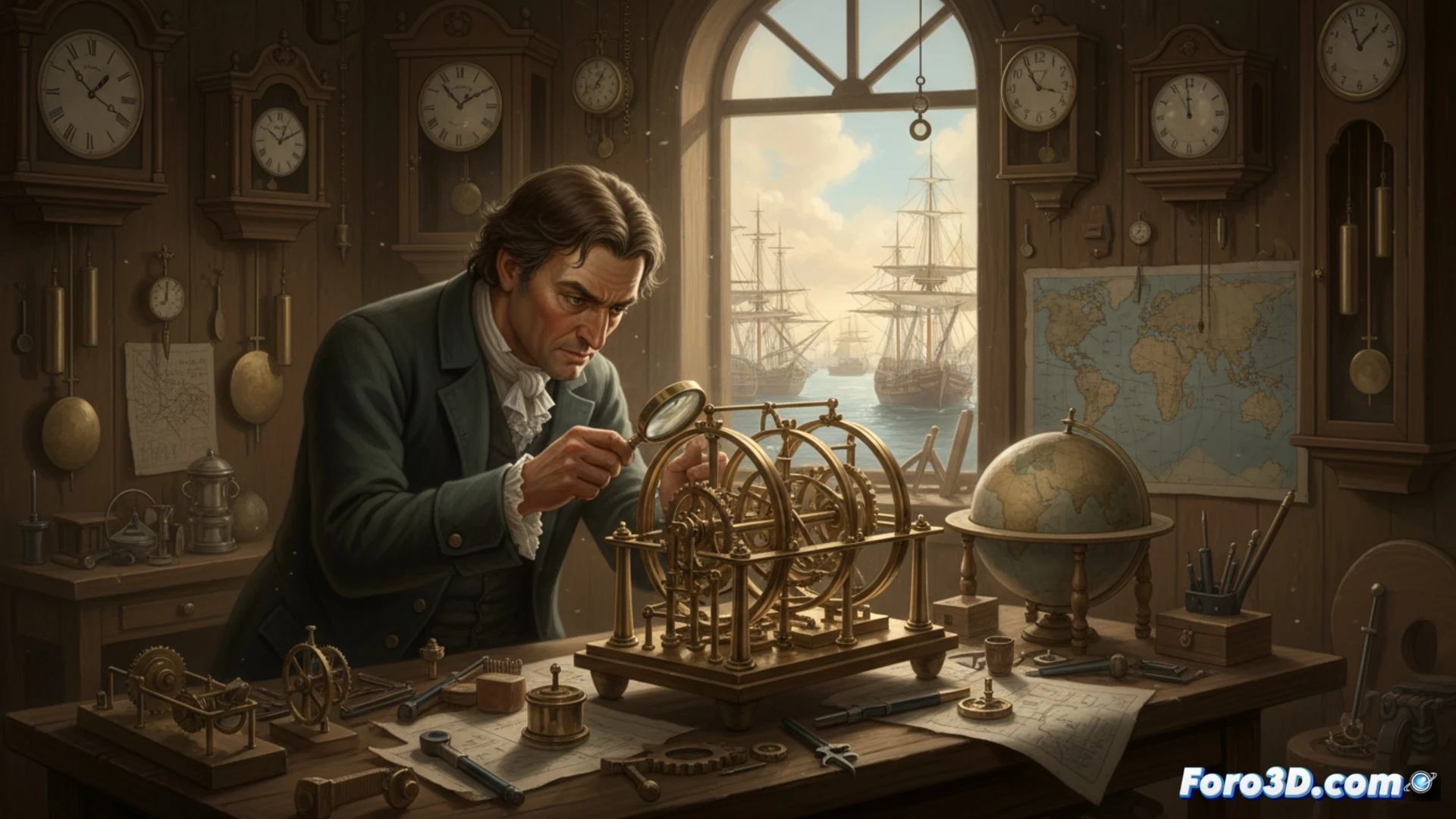
From H1 to H4: the evolution of a precise machine ⚙️
Harrison did not build a single clock, but a series of prototypes that refined the concept over decades. The H1, large and complex, already demonstrated key principles such as the use of counterweights to compensate for the ship's rocking. The H2 and H3 models incorporated improvements, but it was the H4, a chronometer of manageable size similar to a large pocket watch, that achieved the required precision. Its secret lay in a spring detent escapement and a bimetallic compensation mechanism that neutralized the effects of temperature.
When astronomers prefer to look at the stars rather than a clock 🔭
The Longitude Board, dominated by celestial scientists, put up more obstacles than a rusty mechanism. For years, they doubted that an artisan without a title could solve with gears and springs what they pursued with lunar tables and telescopes. Harrison, with the patience of a clockmaker, had to fight not only against the physics of the sea, but against academic arrogance that saw his solution as too... mechanical. In the end, the constant ticking of his H4 carried more weight than all their theories.