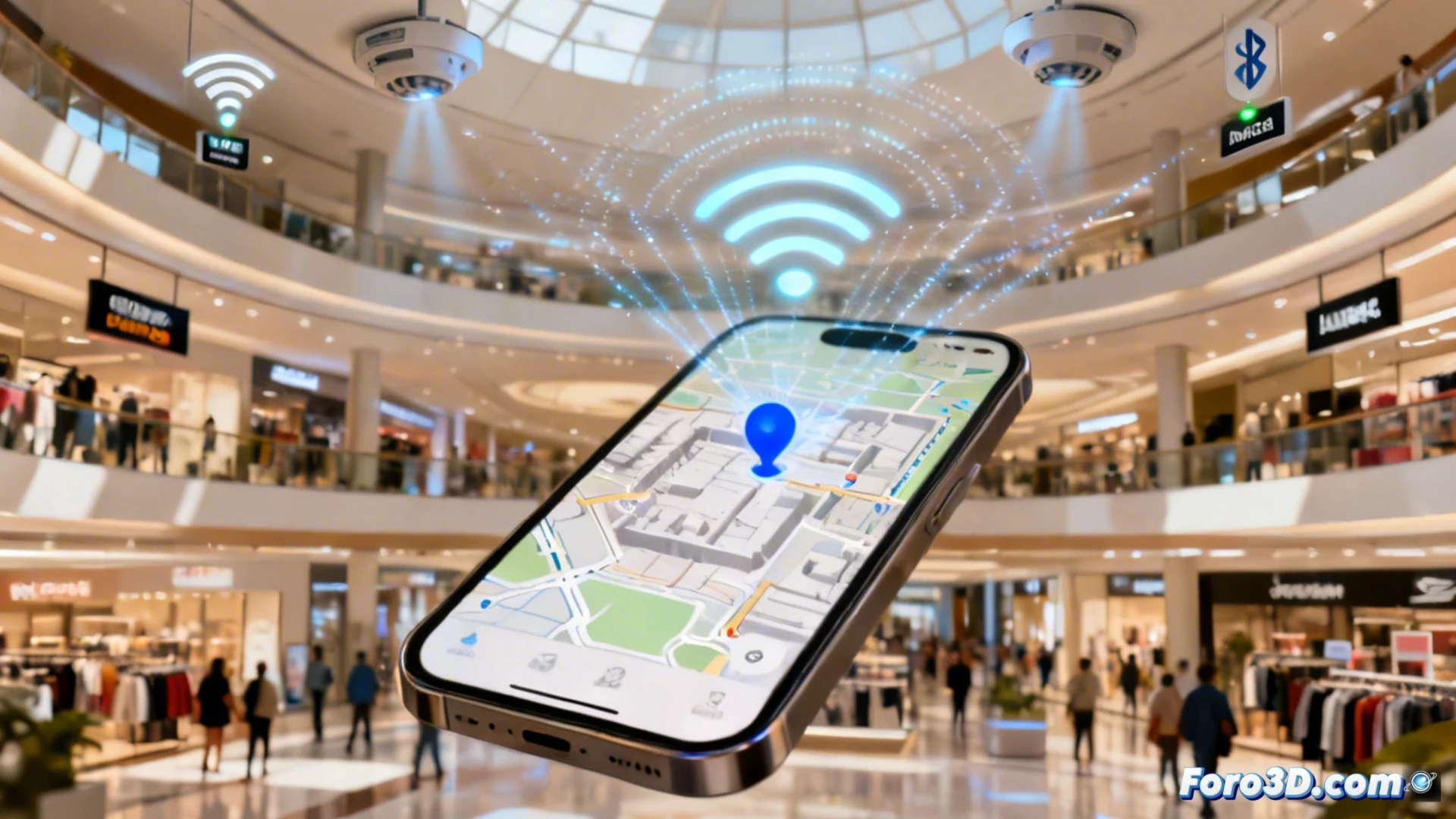
How Your Mobile Precisely Locates You Inside Buildings
Have you ever stopped to think how map applications manage to guide you to the exact door of a store inside a large shopping mall? 🕵️♂️ The key is not only in conventional GPS, but in a much more complex and intelligent collaborative system.
The Signal Detective in Your Pocket
Your device acts as a receiver that collects clues from multiple sources. In addition to satellites, it captures signals from mobile phone towers and, crucially, the unique identifiers emitted by WiFi access points and Bluetooth. By measuring the signal strength from several of these "beacons," the phone can calculate your position.
The Pillars of Indoor Localization:- Triangulation by Signal Strength: Compares the strength with which the signal is received from different known routers.
- Reference Signal Maps: Rely on databases that correlate network identifiers with physical locations.
- Sensor Fusion: Combines this data with the phone's digital compass, gyroscope, and accelerometer to refine the result.
Accuracy can reach less than half a meter, transforming your mobile into a hyper-detailed compass for enclosed spaces.
Offline Functionality and the Power of UWB
A fascinating aspect is that this process does not require you to connect to the WiFi network. The device only needs to listen to the public identifiers that routers constantly emit. UWB (Ultra-Wideband) technology takes this concept to the next level, using very short-duration radio pulses to measure distances with centimeter accuracy.
Advanced Use Cases:- Finding lost objects at home, like keys or remotes, with extreme precision.
- Enabling secure contactless access to vehicles or rooms.
- Creating contextual augmented reality experiences in museums or warehouses.
The Invisible Magic of Location
Thus, when your browser indicates the correct path in an airport or hospital, it is the fruit of a collective technological effort. Satellites, cell antennas, and the café router collaborate so you never lose your way. The most effective technology is usually the one that operates silently in the background. 🧭