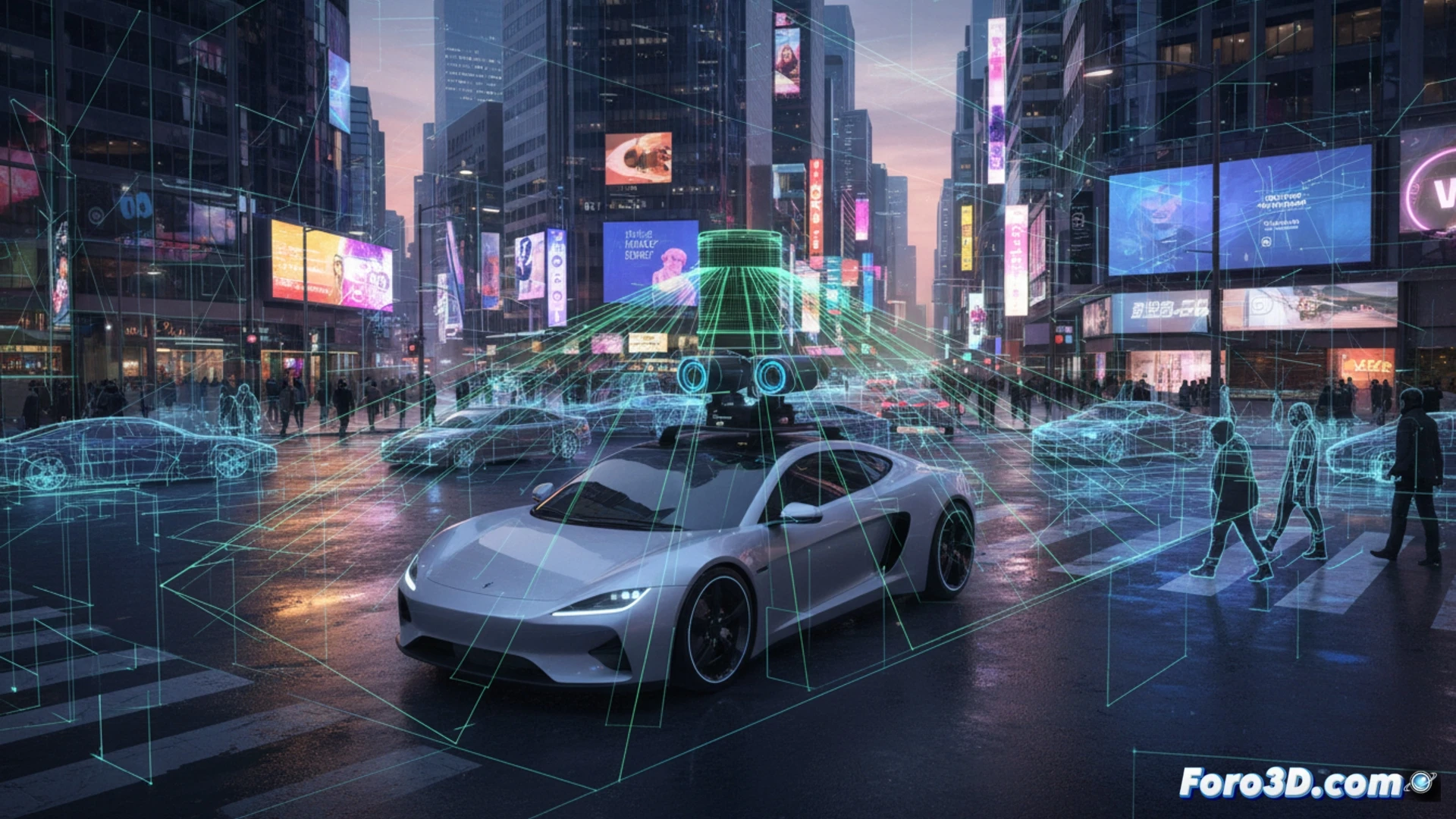
How Robots Perceive the Environment: The Fusion of LiDAR and Stereoscopic Vision
For an autonomous vehicle or drone to move safely, it needs to perceive the world in three dimensions with great precision. This goes beyond what a conventional camera achieves. Technologies like LiDAR and stereoscopic vision systems act as the enhanced senses of artificial intelligence, allowing the creation of detailed maps of the environment 🤖.
A Strategic Union to See Better
Recently, Ouster, a leading company in manufacturing LiDAR sensors, acquired Stereolabs, a specialist in 3D vision with twin cameras. This operation fuses two complementary approaches: LiDAR, which measures distances with laser pulses very precisely, and stereoscopy, which imitates human binocular vision to capture depth, texture, and color. Together, they generate a much more robust and reliable representation of the environment.
Key Advantages of Each Technology:- LiDAR: Works optimally in low light or at night, and measures distances with millimeter accuracy.
- Stereoscopic Vision: Provides rich information on visual details, such as the color and texture of surfaces, at a potentially lower cost.
- Data Fusion: Combining both sources allows autonomous systems to understand complex scenes and make more informed decisions.
The key question is no longer which sensor to use, but how to integrate all the data so that AI understands the world around it.
Applications Beyond the Autonomous Car
These perception systems are not limited to future transportation. Today, they are already fundamental in multiple industrial and commercial sectors.
Current Uses of 3D Perception:- Logistics Robots: Move through warehouses avoiding collisions with people and shelves.
- Agricultural Drones: Analyze crop conditions, estimate yields, and detect pests.
- Topography and Construction: Perform precise measurements and monitor construction progress in real time.
The Future of Artificial Perception
The clear trend is to integrate multiple types of sensors. The ultimate goal is to equip machines with a set of senses so complete and reliable that they can operate in any condition, without needing to philosophically interpret what they perceive 🧠. The fusion of LiDAR and stereoscopic vision marks a decisive step on this path.