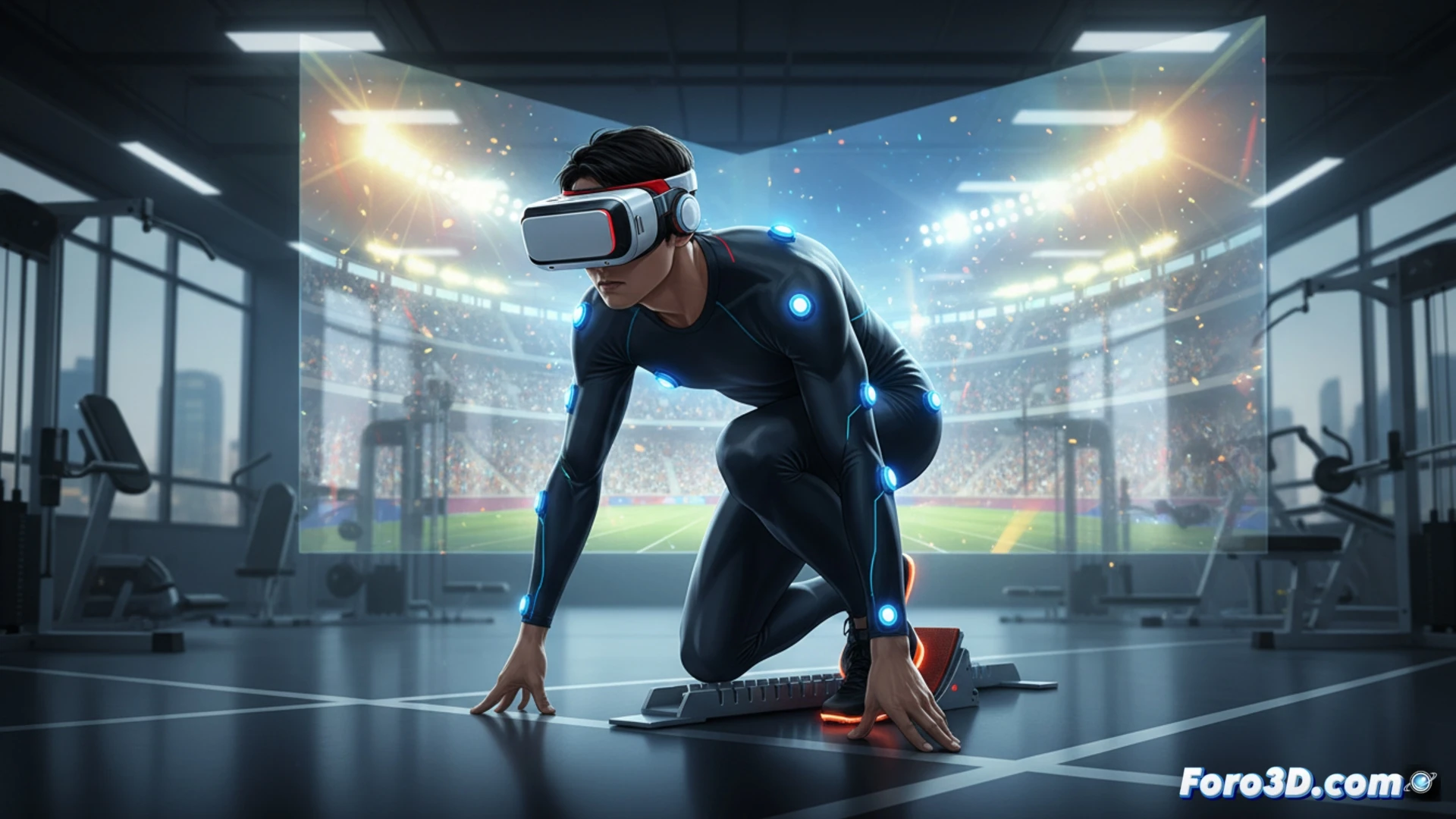
How Athletes Train with Virtual Reality
Can you imagine being able to rehearse in the Olympic stadium without leaving your training center? 🏟️ This is already a reality for many high-level athletes, who use virtual reality systems to recreate the experience of competing under extreme pressure.
Preparing the mind is as crucial as the body
The main goal is not just to improve physical records, but to manage stress effectively. By putting on special glasses, the competitor immerses themselves in a scenario identical to the competition, with thousands of virtual spectators. This practice allows repeating the pre-competitive routine, getting used to the sensations and reducing uncertainty, transforming an overwhelming moment into something manageable. 🧠
Key advantages of this method:- Total immersion: The athlete can turn their head and observe the environment from any angle, which increases the sense of presence.
- Environment control: Variables such as the intensity of the crowd noise or the appearance of the sports facility can be adjusted.
- Unlimited repetition: Allows practicing the start or race strategy countless times without additional physical wear.
VR technology turns the unknown into something predictable, offering an invaluable psychological advantage.
Customization beyond the basics
These platforms go beyond reproducing a 360-degree video. Specific parameters can be configured for each user, modifying the virtual time of day, weather conditions, or even the arrangement of the stands. The athlete's brain perceives these scenarios as authentic, which enhances the effectiveness of mental training. 🥽
Advanced features:- Individual adaptation: Each athlete experiences a simulation tailored to them.
- Interaction with the space: It is not passive content; the user can interact with elements of the virtual stadium.
- Preparation for unforeseen events: Distraction elements can be introduced to train concentration.
The future of sports preparation
The next time you see an athlete at the starting line, remember that they may have already lived that moment hundreds of times in a digital space. The boundary between physical training and preparing the psyche blurs, giving way to an era where technology is just another teammate. Sporting excellence is now also built with bits and pixels. 💻