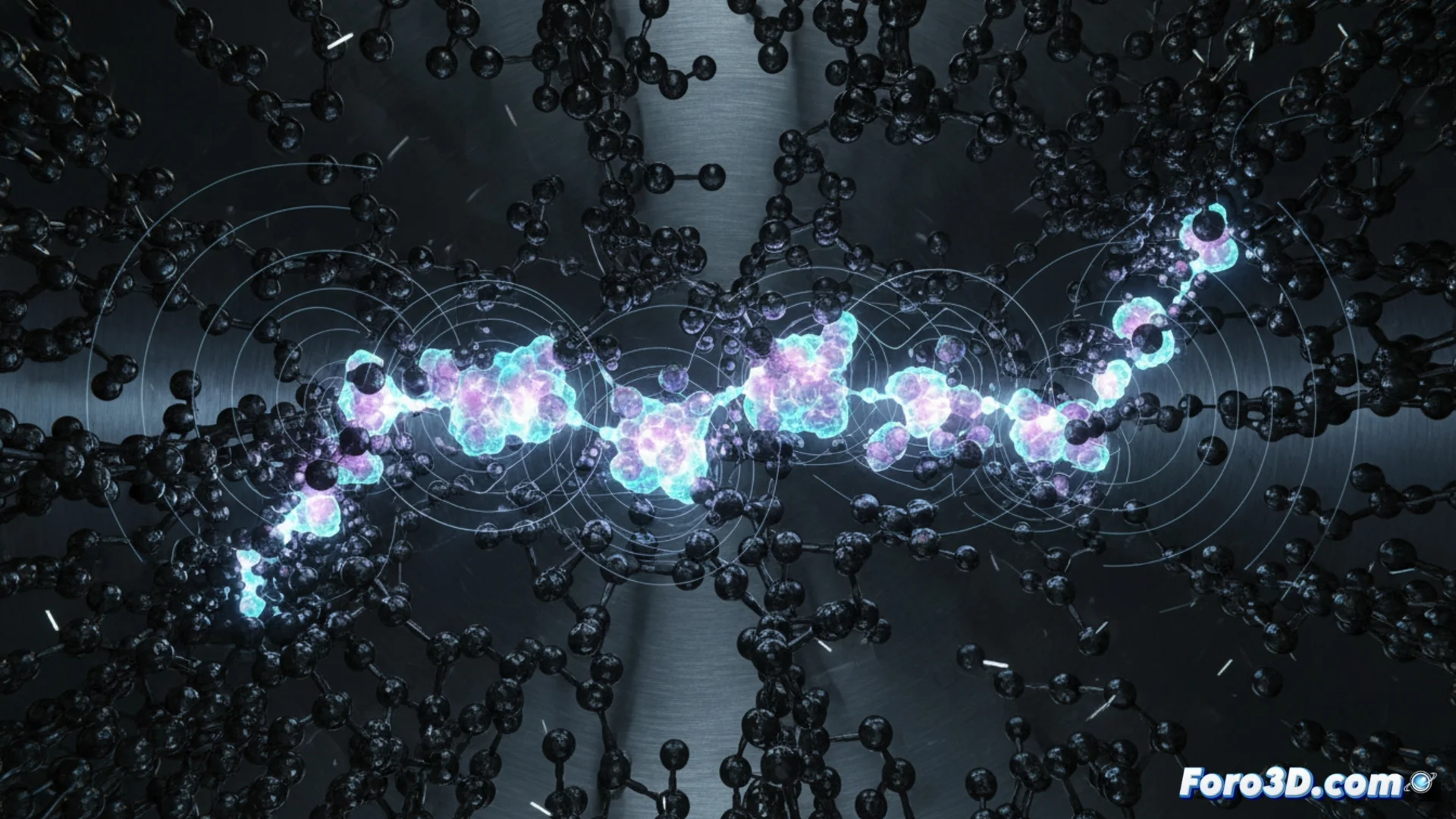
How Amorphous Solids Deform: Beyond Dislocations
Materials without a crystalline structure, such as glass or amorphous carbon, do not bend like metals. Their plastic and irreversible deformation follows a different path, governed by mechanisms at the atomic scale very different from those of crystals. 🧊
The Key Mechanism: Shear Transformation Zones
In crystalline materials, dislocations allow entire planes of atoms to slide. In contrast, in amorphous solids, deformation is focused in tiny regions called shear transformation zones (STZ). These are clusters of several tens of atoms that, when the material is subjected to stress, reorganize locally and non-uniformly.
Main Characteristics of STZ:- They are the place where plastic deformation begins in materials without crystalline order.
- They involve a cooperative regrouping of a small number of atoms.
- Their activation marks the transition between the elastic and plastic behavior of the material.
STZ are not isolated defects, but the protagonists of a complex choreography of deformation.
Structural Avalanches: When Zones Cooperate
These zones do not work alone. They communicate through long-range elastic fields. When an STZ is activated, it can induce the activation of others in its vicinity, triggering a chain reaction. This phenomenon generates structural avalanches, which are cascades of deformation events that propagate coordinately throughout the solid. Research focuses on analyzing the dynamics, energy, and how these avalanches organize during the material deformation process.
Dynamics of Avalanches:- They are the result of elastic interaction between multiple STZ.
- They propagate like a wave of atomic reorganization through the material.
- Their study helps predict the strength and fracture of amorphous materials.
Simulations that Unveil the Energy Landscape
To track this intricate dynamics, advanced simulations are used that employ interatomic potentials trained with machine learning, along with numerical methods like pseudo-arclength continuation. This technique allows precisely following each avalanche event, without results depending on the chosen time step for simulation. What they reveal is the existence of a latent structure of local and separated energy minima, which the system explores just before an avalanche occurs.
So, if you ever wondered why glass scratches easily but doesn't bend like metal, the answer lies in its atomic architecture: its atoms prefer to organize local riots rather than an orderly parade. 🔬