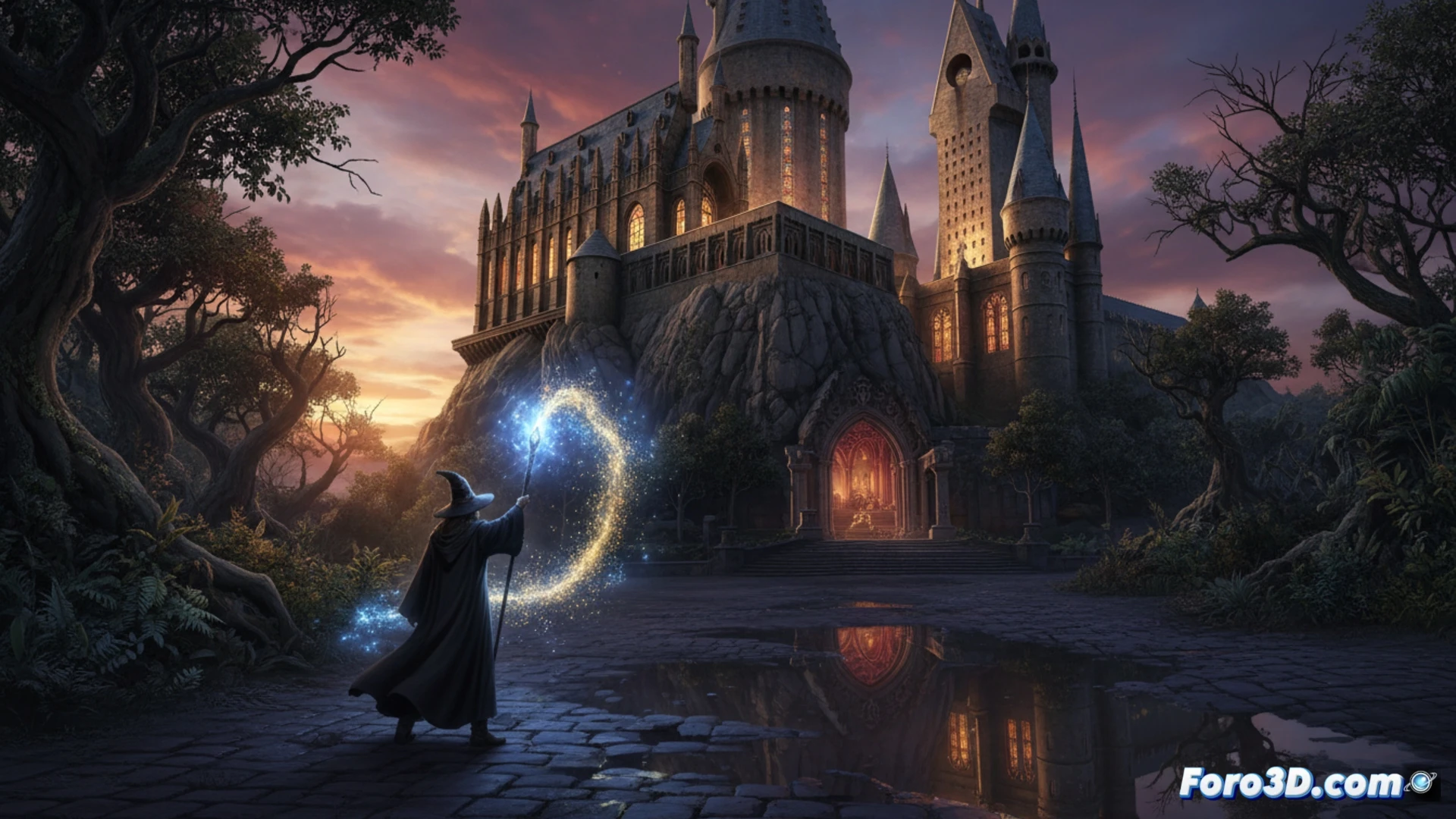
Hogwarts Legacy was built with a customized version of Unreal Engine 4
The magical adventure of Hogwarts Legacy took shape thanks to a deep adaptation of the popular Unreal Engine 4 engine. This technological base was specifically modified to bring to life the extensive game world, which focuses on the iconic castle and its surroundings. The main challenge was adjusting the engine to manage a massive amount of visual elements and run sophisticated graphical effects, all to honor the Harry Potter legacy. 🧙♂️
The supreme technical challenge: recreating Hogwarts
Undoubtedly, the greatest milestone of the project was rebuilding Hogwarts castle with an unprecedented level of detail and scale. To achieve this goal, the team used ultra-high-definition textures and a volumetric lighting system that produces immersive and believable environments, especially in interior spaces. On platforms like PC and next-generation consoles, Ray Tracing technology was incorporated to calculate reflections and shadows, significantly increasing the realism of the scenes.
Key technical solutions implemented:- Adapt the engine to manage an extremely high asset density without compromising performance.
- Implement volumetric lighting to create dense and magical atmospheres in hallways and common rooms.
- Integrate ray tracing (Ray Tracing) on compatible hardware for more precise shadows and reflections.
Optimizing performance was a constant challenge due to the asset streaming necessary in such a dense and visually rich environment.
The development toolkit arsenal
In addition to the Unreal Engine 4 core, the creative process involved a suite of specialized software. For modeling objects and characters, applications like Blender and Maya were used, while fine detail sculpting was done with ZBrush. All texturing was carried out using the Substance 3D Suite. The vegetation surrounding Hogwarts and Hogsmeade was generated procedurally with SpeedTree, seeking an organic and natural result. For the sound layer, the Wwise middleware was integrated.
Workflow and software used:- 3D Modeling: Blender and Maya to create the base geometry of the assets.
- Digital Sculpting: ZBrush to add micro-details and complexity to the models.
- Texturing and materials: Substance 3D Suite to produce and apply realistic textures.
- Procedural vegetation: SpeedTree to design dynamic and believable forests and foliage.
Balance between fidelity and performance
One of the most constant efforts during development was optimizing the data flow so that the dense world loaded seamlessly. Asset streaming was fundamental to allow smooth transitions between areas like the castle and the village of Hogsmeade, even during high-activity moments. Sometimes, casting a Descendo spell to bring down a floating object can seem easier than making the game run without stutters in a crowded Hogsmeade on a Saturday afternoon. The final result demonstrates how adapting an established engine can unlock the creation of incredibly detailed fantasy worlds. ⚡