Inio Asano's magnum opus, Goodnight Punpun, stands as a benchmark of contemporary manga. Its raw narrative and visual style, where a protagonist drawn as a simple bird inhabits realistic backgrounds, create a dichotomy that defines the experience. The absence of an anime adaptation is not a shortcoming, but a logical consequence of its nature. Some works are so tied to their medium that transferring them means losing their essence.
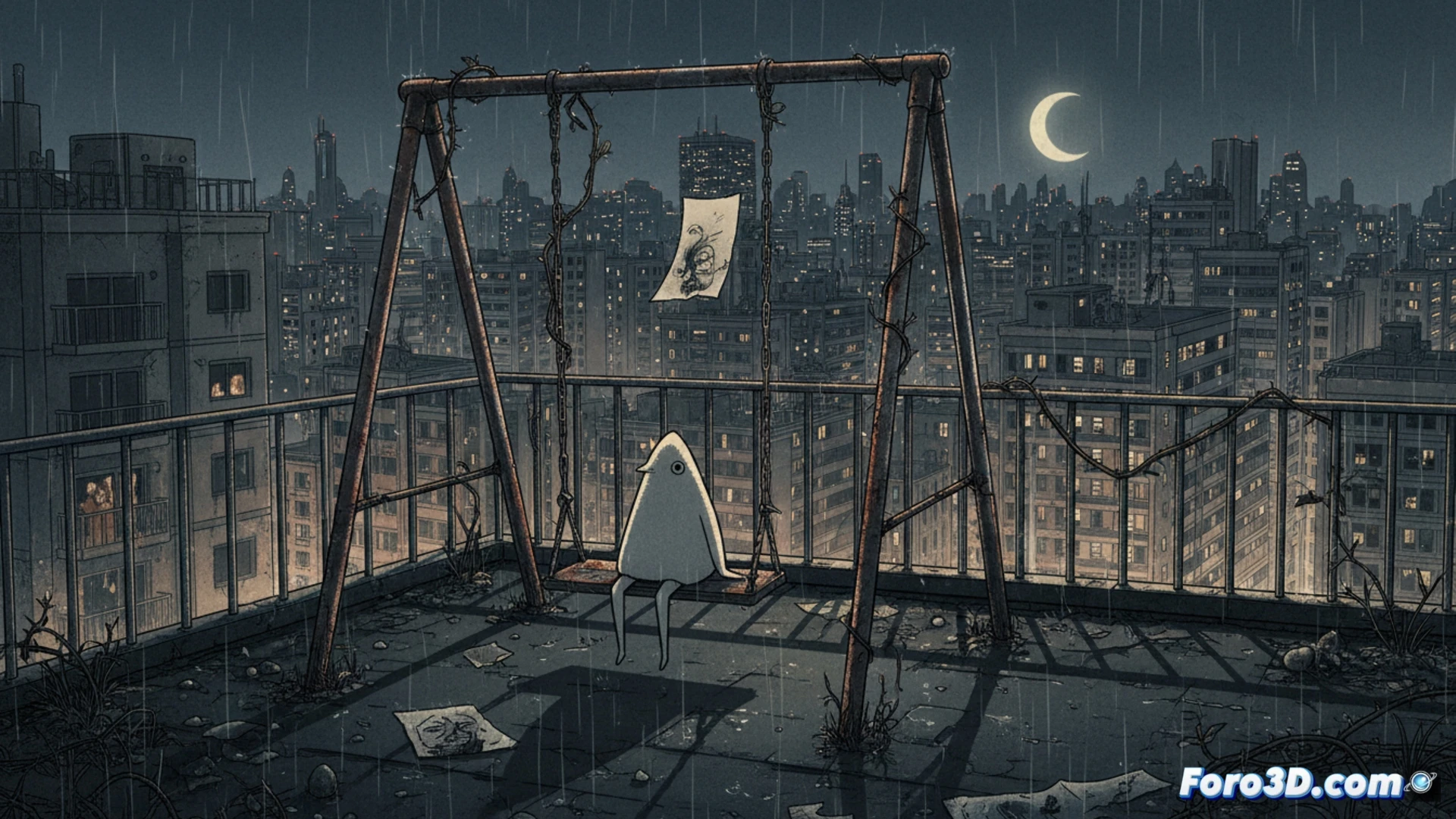
Graphical Contrast as a Narrative Engine: A Lesson in Composition 🎨
Punpun's visual device is not merely a style. It is a system of representation. The schematic bird acts as the reader's emotional avatar, a projective blank space over a world drawn with photographic detail. This technical contrast manages identification and distancing. In animation, homogenizing the style or rendering the character in 3D would break that tension. The strength lies in the coexistence of two graphic languages within the same static frame, something that conventional animation would tend to unify.
The Day Punpun Got Its Generic Anime 😬
Imagine the result: Punpun modeled in CGI with dynamic feathers, bouncing in hyperrealistic scenarios while a J-pop opening plays. His abusive aunt would have a moe design and the most sordid moments would be softened with a warm lighting filter. The Kagoshima trip sequence would be a montage of static backgrounds with particle effects. We would lose Asano's raw linework for a pastel color palette and a soundtrack that tells us exactly how to feel. A triumph of faithful adaptation.