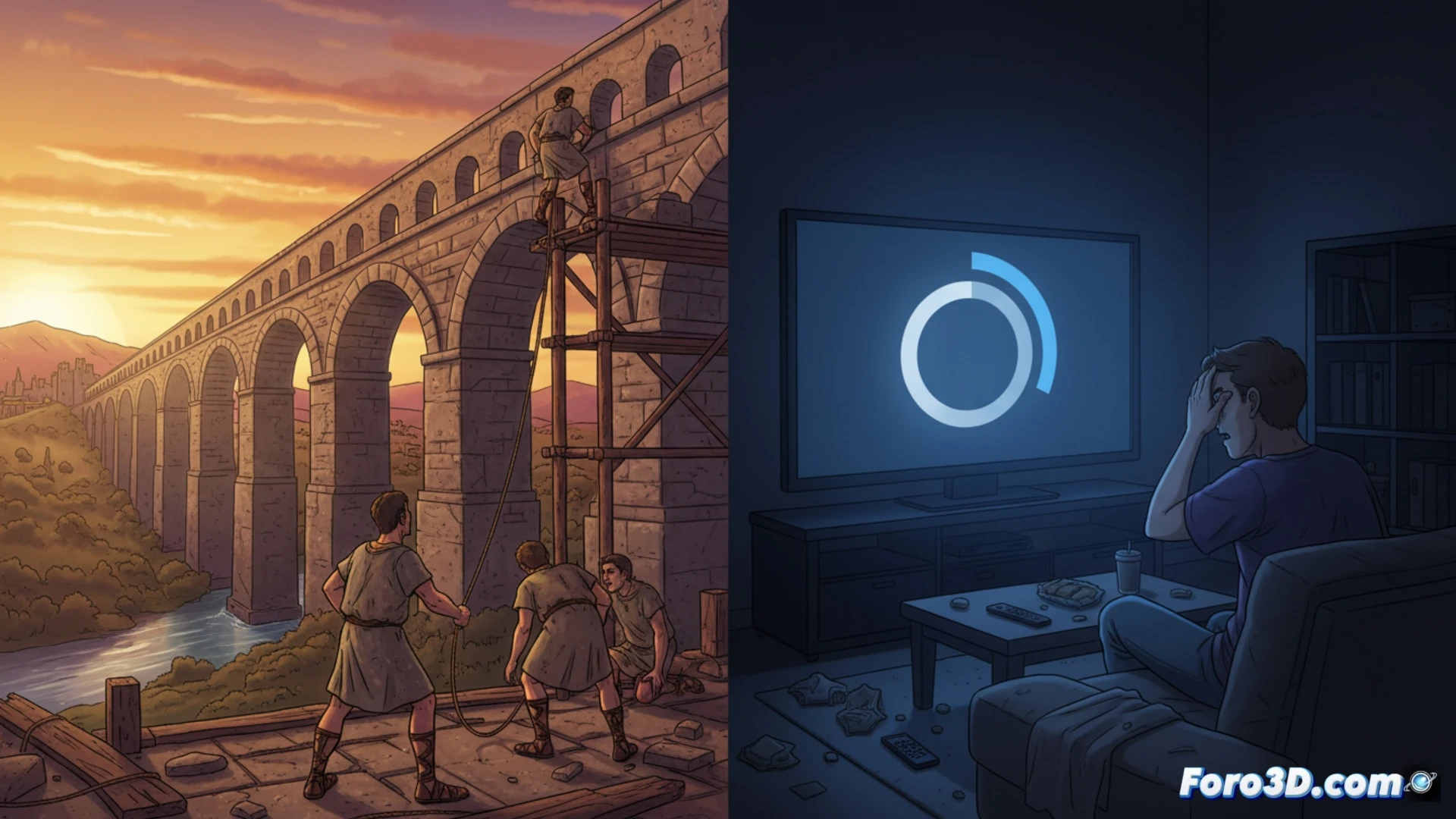
From Roman Patience to Buffer Syndrome: How Technology Reconfigures Our Mind
Have you ever compared the time it took to build an empire with how quickly you lose your patience if a video pauses? 🏛️⚡ The ancient Romans built their dominion over centuries, with constant effort. In the digital age, however, our tolerance runs out in seconds. This paradox clearly shows how devices and the network have altered our perception of time and our ability to wait.
The Brain Addicted to Immediacy
Our patience threshold has plummeted. Where we once waited weeks for communication, today a minimal delay in a message causes unease. The internet and smartphones have conditioned us to seek and receive instant responses. Each quick notification triggers a release of dopamine in the brain, reinforcing a reward cycle that makes us dependent on speed. The simple act of waiting is now perceived as an inefficiency or a system failure. 🧠
Key Mechanisms of Instant Gratification:- Neurological Reward: The brain associates speed with a reward, releasing dopamine with each quick interaction.
- Digital Conditioning: Platforms are designed to minimize any delay, training users to expect less.
- Time Perception: What was once normal (waiting) now feels like a loss or a technical failure.
We have access to all human knowledge in a second, but we've lost the ability to wait for almost anything.
What Really Defines Online Speed
The browsing experience doesn't depend solely on your connection's bandwidth. Two technical factors are decisive: latency (the delay in data travel) and the geographical location of servers. Major services like Netflix deploy data centers worldwide to shorten this distance. If the nearest server to you is overloaded, you'll see the loading icon no matter how powerful your fiber optic is. It's a complex global information exchange ecosystem. 🌐
Factors Influencing Web Content Loading:- Network Latency: The physical time it takes for a data packet to go and return.
- Distance to Server: The physical proximity of the data center hosting the content.
- Server Load: How many requests that server is processing simultaneously.
Recovering the Value of Waiting
The irony is profound: we have tools to access vast amounts of information instantly, but we've unlearned how to be patient for everything else. Perhaps there's a lesson in Roman persistence: some things of value, whether a stable network connection or a long-term project, require and deserve their own time. Reflecting on this can help us recalibrate our relationship with technology and recover a more human pace. ⏳