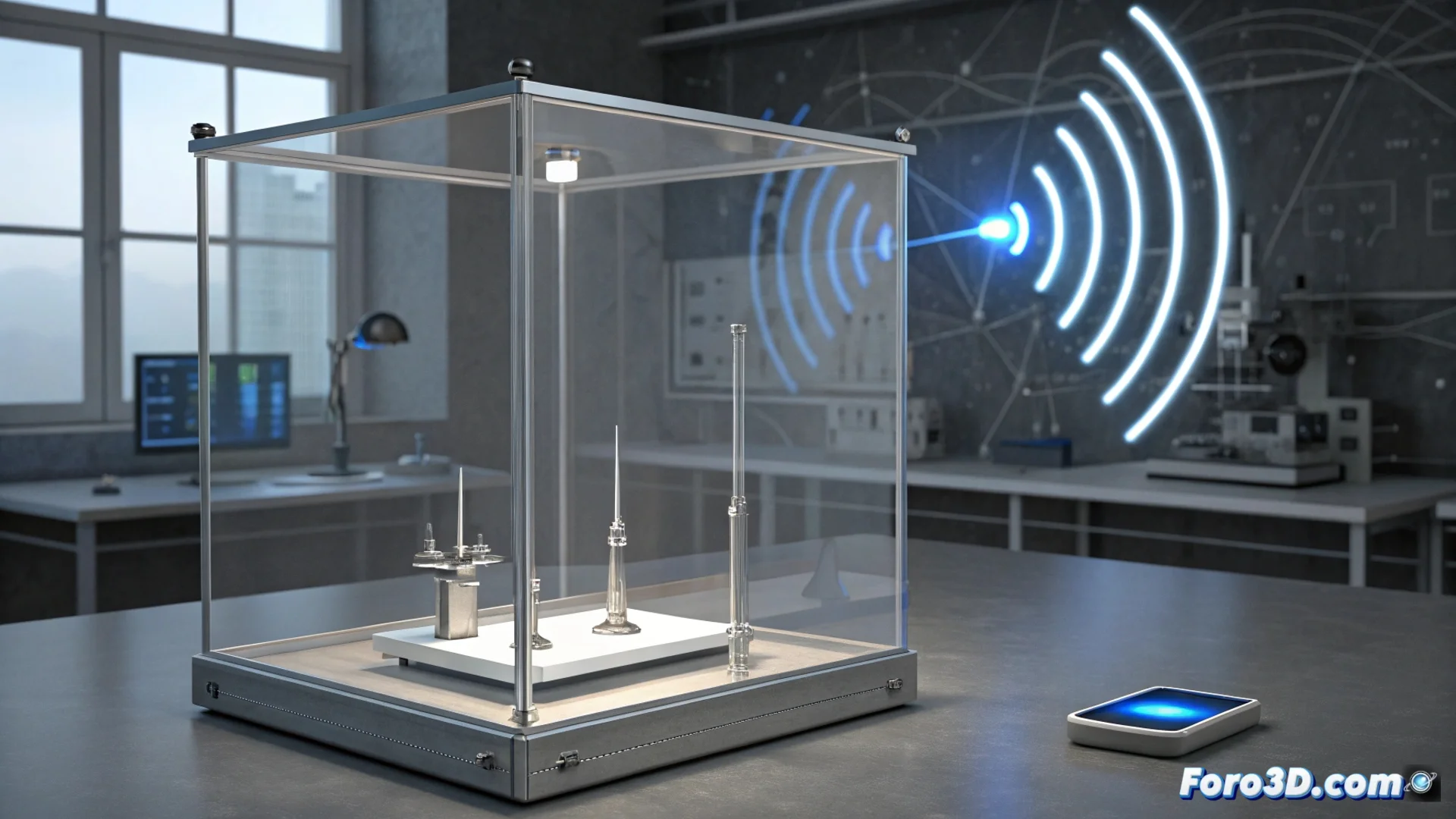
Finnish Scientists Transmit Electricity Wirelessly with an Innovative Method
A group of experts from Aalto University in Finland has presented a revolutionary approach to send electrical energy through the air. This procedure is based on producing two current waves with opposite frequencies, which enables channeling power efficiently between two locations without using a material support. The experiment validated that electricity can be sent to small-sized electronic devices, such as various sensors, without plugs or cables. 🔋
The Basis of the New Wireless Technique
The method used is clearly distinct from the magnetic induction charging incorporated in many modern chargers. Instead of using short-range magnetic fields, dipole antennas are implemented to radiate radio waves that carry the energy. By mixing two channels with inverted frequencies, power circulates in a directional and controlled manner toward the receiving point, which greatly reduces losses and prevents energy from dispersing into the environment.
Key Features of the System:- Uses radio waves instead of near-field magnetic induction fields.
- Combines two opposite frequencies to create a directional and controlled power flow.
- Minimizes energy loss and its dispersion in the surrounding space.
This technology could free us from batteries and cables for a multitude of small devices, although the road ahead is still long.
Future Applications and Pending Challenges
This progress opens the door to powering extensive networks of sensors for the Internet of Things, eliminating the need to use batteries or run cables. However, the development is still in a laboratory phase and the amount of electricity that can be transferred is limited. Researchers are now focusing on increasing the range and optimizing efficiency, as elements like solid obstacles in the path pose a significant challenge to overcome. 📡
Areas of Use and Current Limitations:- Potential to supply power to IoT sensors permanently and without maintenance.
- The amount of energy transmitted is low and the effective distance is limited at this stage.
- Physical objects in the path interrupt the transfer, a problem that must be solved.
Medium- and Long-Term Prospects
It is possible that in the not-too-distant future we may be able to recharge mobile devices simply by staying in a room equipped with this system. However, for now, the practical recommendation would be not to stray too far from the emission point. Work continues to transform this promising experiment into an applicable and safe technology for everyday use. 🚀