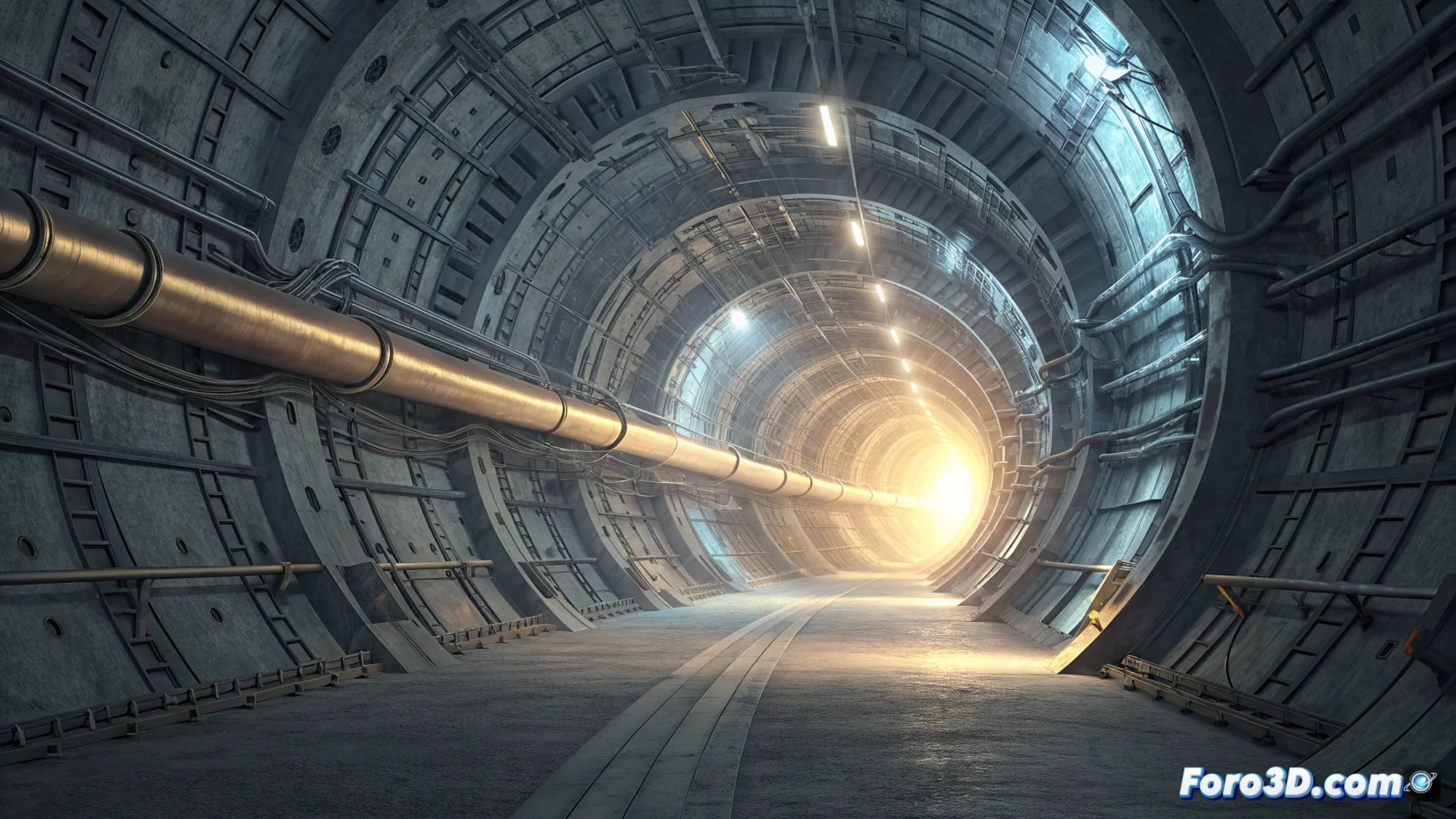
Farewell to a Giant That Recreated the Baby Universe
Have you imagined what matter was like in the initial instants of the cosmos? 🧪 For a quarter of a century, the RHIC collider in New York has done exactly that: smashing heavy nuclei at extreme speeds to reproduce the conditions of the newborn universe. In 2026, this titan of physics executed its last collision.
From a Hammer to a Precision Scanner
The RHIC's work does not end. Think of this machine as a hammer that struck atoms to discover their composition. Its successor, the Electron-Ion Collider, will function as an ultra-high-resolution scanner. It will employ electron beams to examine protons and neutrons with unprecedented detail, unveiling their fundamental mysteries. 🔬
The scientific legacy of RHIC:- Simulated the state of matter present microseconds after the Big Bang.
- Generated a volume of data so vast that researchers will analyze it for years.
- Its technology and findings pave the way for the new collider.
The Hottest Plasma in the Lab
The state most investigated at RHIC is the quark-gluon plasma. It's not an interstellar drink, but the densest and hottest matter that can be generated in a controlled environment, analogous to the cosmos in its first instant. Although the machine shuts down, its legacy of data will drive future science.
This is the cycle of science: a legendary tool retires to make way for a more precise instrument.
The Future: Dissecting Matter
RHIC celebrated its farewell party with the primordial universe. Now, the focus shifts toward scanning the basic components of all visible matter. The new collider will not smash heavy ions, but will use electrons to map the interior of protons with revolutionary clarity. 🚀
Features of the new project:- Employs electron beams as a high-precision probe.
- Focuses on revealing the internal structure of protons and neutrons.
- Promises to deliver a detailed map of the particles that form everything we know.
Thus evolves scientific exploration. An era culminates with RHIC's last experiment, but another begins with the promise of observing nature's most intimate secrets. The journey to understand what we are made of enters an even more exciting phase.