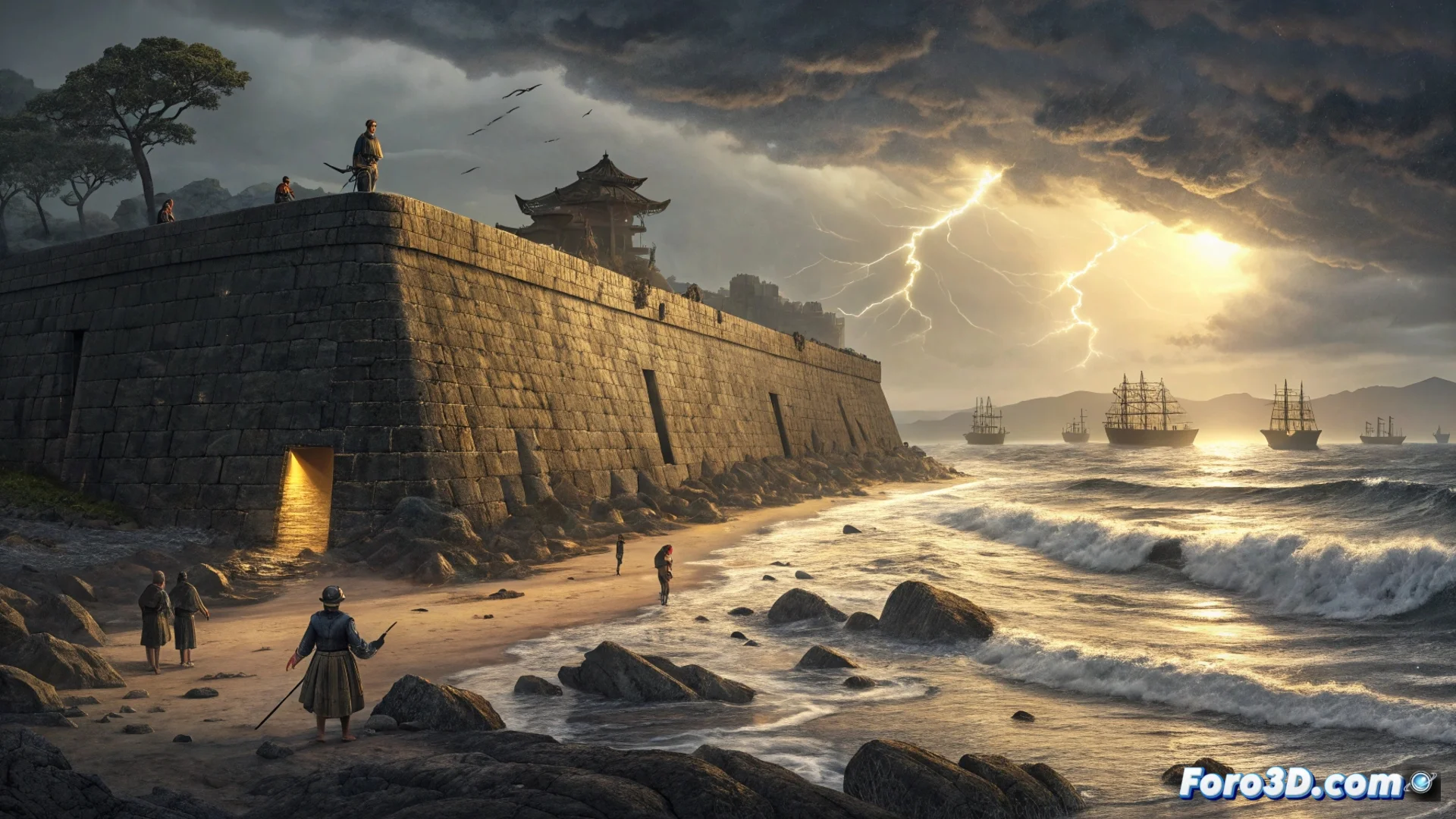
Discover the Wall That Stopped the Mongols in Japan
Can you imagine how a country prepares to stop the largest army of its time? 🏯 In the 13th century, the Mongol Empire turned its gaze toward the Japanese islands. The response was a monumental defensive construction, whose ruins in Fukuoka now seek to be transformed into an educational space so that we can all learn about this epic.
An Emergency Barrier Against a Colossus
This structure was not an ordinary work. It was erected urgently after two invasion attempts by the Mongol hordes. It was something like building their own Great Wall, but in a very short time and concentrated only on the Fukuoka coastline. It consisted of a stone and earth barrier that stretched approximately 20 kilometers, created specifically to prevent enemy vessels from landing. It represented the main line of defense of the archipelago at that crucial moment.
Key Features of the Defense:- Accelerated Construction: It was built in record time as a direct response to the imminent threat.
- Coastal Design: Its layout followed the coast to block any potential landing point.
- Mixed Composition: It used local materials like stone and compacted earth to form a solid wall.
The wall, combined with the elements, wrote one of the most decisive chapters for Japanese sovereignty.
The Climatic Factor That Changed History
The most astonishing fact is that Japan avoided conquest by a very narrow margin, where meteorology was a decisive ally. 🌀 The Mongol warriors were invincible on firm land, but their powerful fleets met their end before violent typhoons, remembered as the famous "divine winds" or kamikaze. The wall, reinforced by the destructive power of these storms, constituted the perfect formula to protect the territory. Without this combination of human strategy and natural phenomenon, the historical course of Japan would have taken a completely different path.
Elements That Defined the Outcome:- The Kamikaze: Legendary typhoons that scattered and sank the invading armada on two occasions.
- Complementary Strategy: The wall forced the ships into risky situations, where the storms reached them.
- Turning Point: This event strengthened the belief in divine protection over Japan.
From Forgotten Ruin to Living Legacy
It is extraordinary how a fragment of history, literally buried under the sand, can narrate an epic of resistance that seems taken from a cinematic script. 🎬 Who would think that ancient stones on the seashore witnessed the moment that could have redefined a nation. The project to convert these vestiges into a learning facility will allow future generations not only to read, but to experience and understand the engineering and sacrifice behind this monumental defense. A piece of coast thus transforms into a tangible bridge with the past.