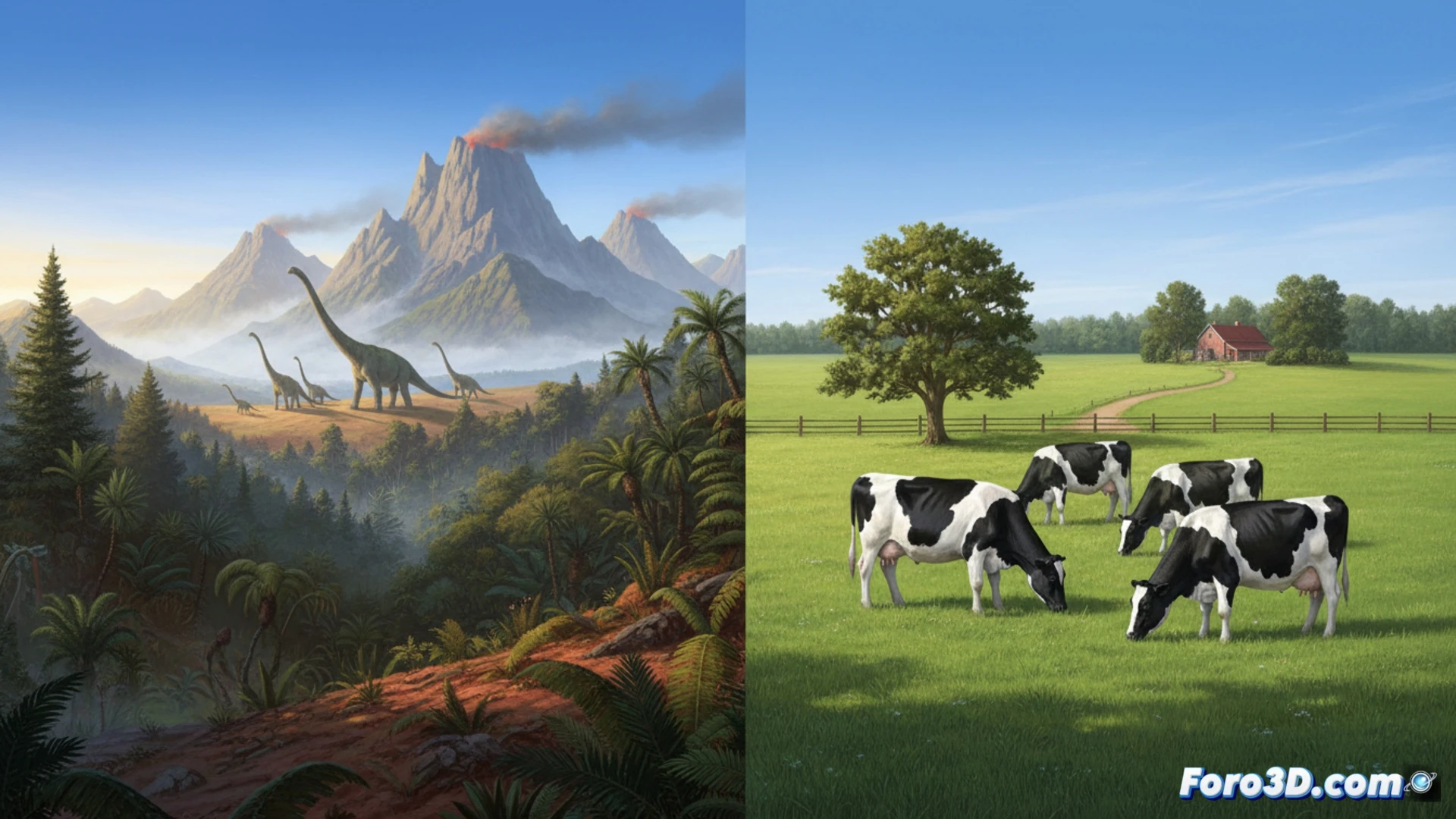
Did Dinosaurs Pollute More Than Cows? The Key Is Speed
Think about dinosaurs dominating the planet for an immense period, nearly 165 million years. It's logical to wonder about the amount of organic waste they generated. The Earth processed all that material without apparent difficulty. So, why does modern livestock farming cause so much concern? The answer doesn't lie in the type of waste, but in the rate and scale at which it is generated today. 🦕🐄
It's Not What, It's How Much and How
In prehistory, dinosaur excrement decomposed in a dispersed manner in a world covered by vast expanses of flora. It was a slow and balanced ecological cycle. In contrast, current livestock farming concentrates billions of heads of cattle in reduced spaces, producing methane constantly and massively. It's the difference between an isolated bonfire and millions of engines emitting at the same point.
Key Factors of the Difference:- Concentration: Prehistoric herds were scattered, not crowded in industrial farms.
- Emission Speed: The natural cycle absorbed waste slowly, without saturating the system.
- Temporal Scale: The impact of dinosaurs was spread over millions of years, not decades.
The problem is not organic matter itself, it's the accelerated and concentrated release of gases that warm the planet.
The Power of Methane and the Current Figure
Methane (CH₄) has a much higher capacity to retain heat in the atmosphere than carbon dioxide (CO₂), although its permanence is shorter. A cow can release between 70 and 120 kilograms of this gas each year. Multiplying by the global cattle population, which exceeds 1.5 billion animals, the result is an immediate and potent climate impact.
Data for Context:- Potency: Methane is dozens of times more effective at trapping heat than CO₂ in the short term.
- Volume: Livestock farming is one of the largest anthropogenic sources of this gas.
- Historical Contrast: The ecosystems of the dinosaur era never faced such a rapid discharge of greenhouse gases.
Conclusion: A Problem of Rhythm, Not Existence
Dinosaurs did not alter the climate at a rate that overwhelmed the response capacity of their environment. Our activity, with intensive livestock farming as the protagonist, does. The lesson is not that the past was idyllic, but that the speed at which we now intervene in natural cycles makes the critical difference. The challenge is to manage that rhythm. ⏳