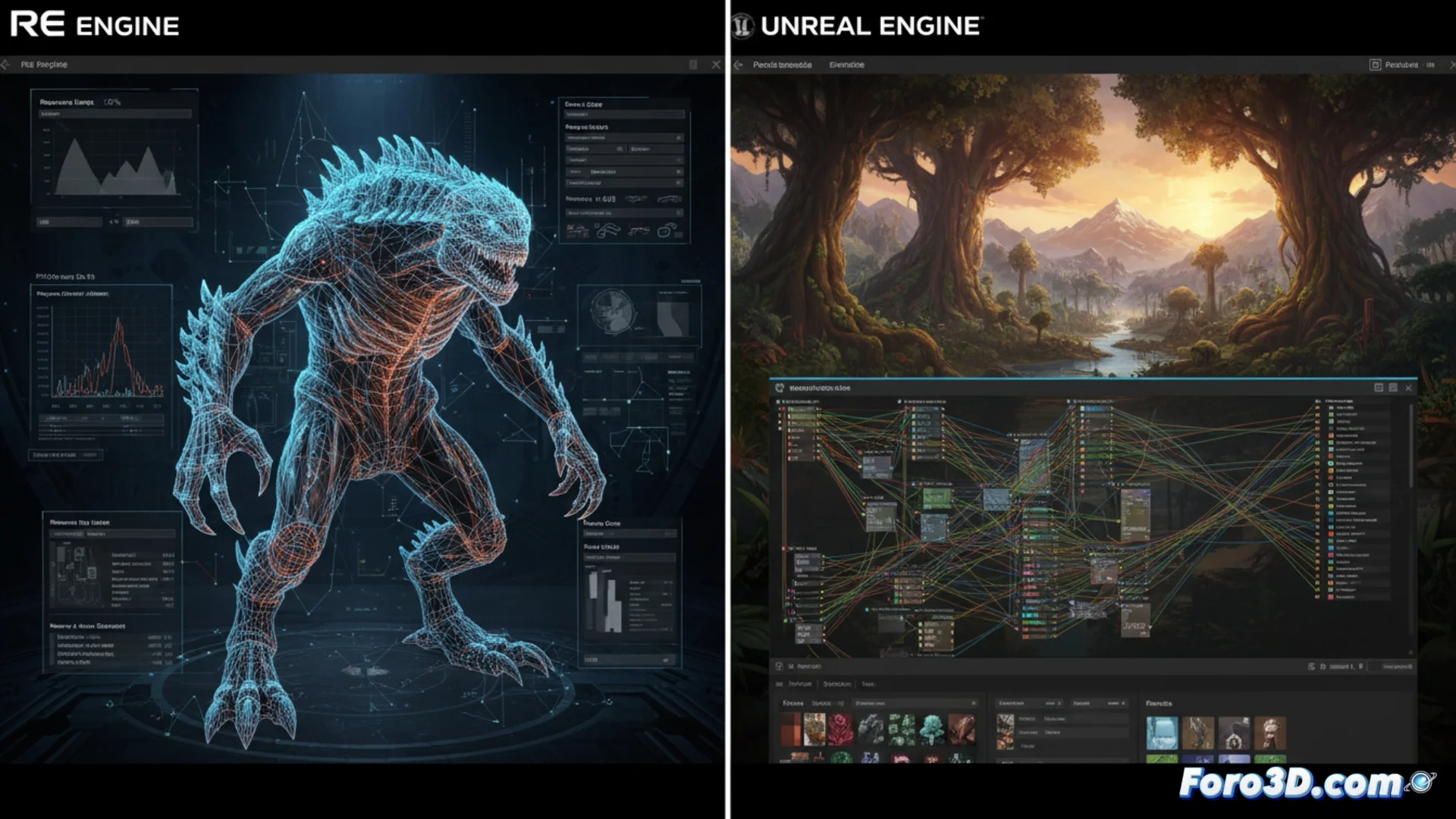
Comparison between Capcom's RE Engine and Unreal Engine
In the realm of video game creation, the choice of graphics engine defines much of the process. Two options represent almost opposing philosophies: the RE Engine, an in-house solution built by Capcom for its teams, and the Unreal Engine, a universal platform from Epic Games. This contrast between a specialized environment and an open-access one sets the stage for studying their applications. 🎮
Purpose and design philosophy
The fundamental divergence lies in their initial objective. Capcom conceived the RE Engine to squeeze the maximum out of hardware in its own projects, prioritizing a closed and highly efficient workflow. It was designed so that its internal studios could consistently produce high-fidelity graphics. In contrast, Unreal Engine was created as a multi-platform environment whose main value is flexibility and accessibility, aiming to serve anyone who wants to develop, from a hobbyist to a large studio.
Key differences in approach:- RE Engine: Optimized for a specialized pipeline. Its goal is to give Capcom absolute control to manage resources tightly and achieve maximum performance.
- Unreal Engine: Prioritizes offering a complete set of tools from the start. Its goal is for developers not to start from scratch and to prototype quickly.
- The ecosystem: RE Engine relies on Capcom's internal experience, while Unreal is supported by a massive global community and asset marketplace.
An engine like RE Engine is born to solve its creator's specific problems, while Unreal Engine exists for others to solve their own problems.
Toolset and who they are made for
When evaluating the tools, the difference widens. Unreal Engine provides a huge suite: a very powerful visual editor, a node-based material system, Blueprints for visual programming, and a store with thousands of resources. It is made so that anyone can find a base functionality or plugin to speed up their work, although they may later need to adapt it for optimization.
The RE Engine, on the other hand, has robust utilities for specific areas where Capcom needs excellence, such as animating characters or rendering scenes in real-time with great detail. However, its documentation and community support are mainly directed at its internal teams. An external developer using RE Engine might need to build more fundamental systems on their own.
Panorama for the user:- Accessibility: Unreal Engine wins with its extensive documentation, tutorials, and global forums. RE Engine is more opaque, being a corporate tool.
- Specialization: RE Engine excels in very specific technical tasks from Capcom's games, such as handling memory or assets ultra-efficiently.
- Initial productivity: With Unreal, you can progress quickly using existing plugins. With RE Engine, the path may require more custom development from the base.
Which one to choose according to your project?
The decision is not about which engine is "better," but which one fits your context. If you belong to a large studio with very specific technical needs and seek total control over performance, a proprietary engine like the RE Engine philosophy has advantages. If you are an independent developer or a team that values speed, available resources, and doesn't want to reinvent the wheel, Unreal Engine is the overwhelmingly practical option. The key is understanding whether you need a specialized tool or a universal platform to bring your vision to life. 💡