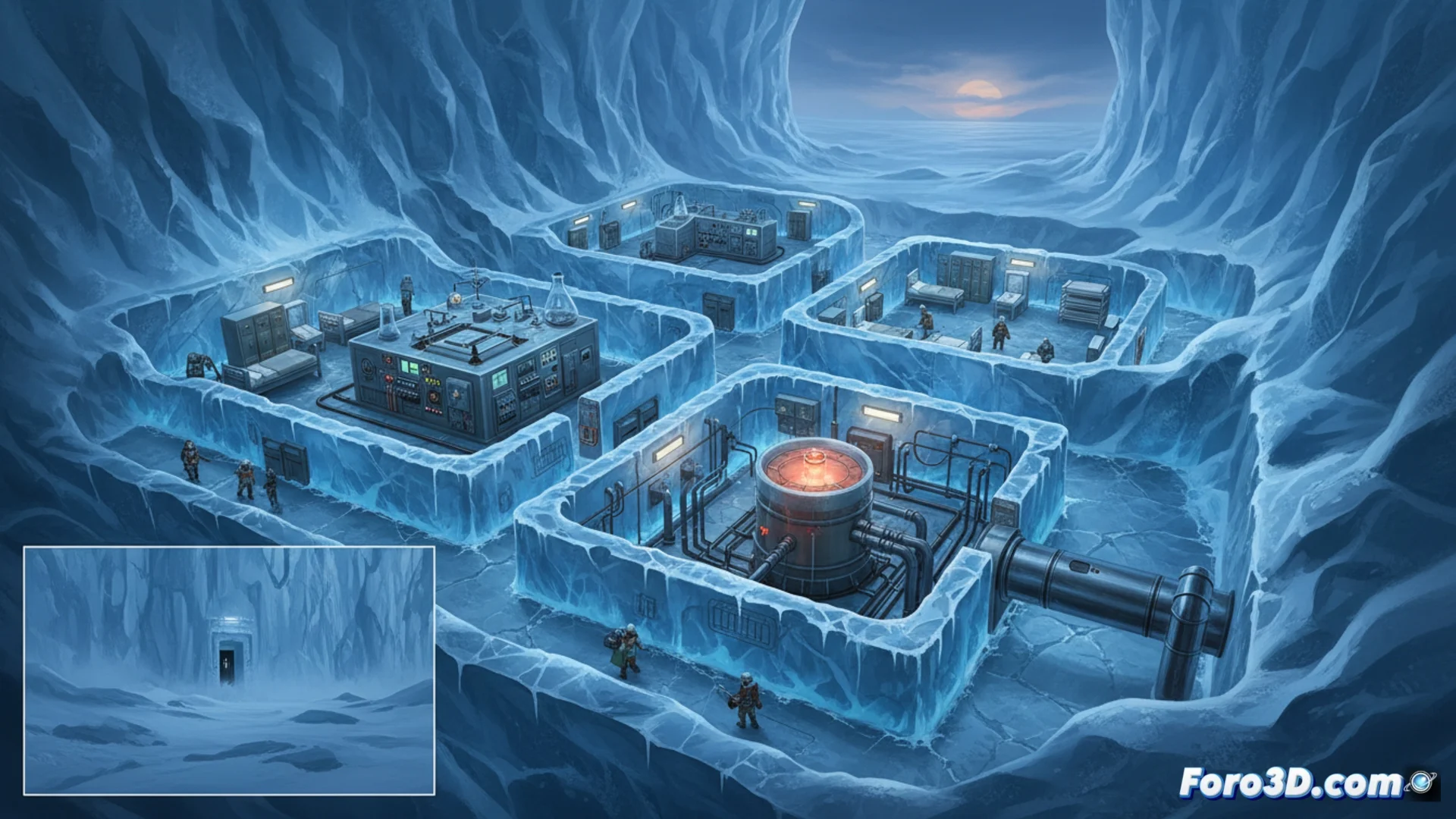
Camp Century: the secret nuclear base that the ice is returning
In the 1950s, the U.S. Army Corps of Engineers built Camp Century in northwest Greenland. 🏔️ Officially, it was a laboratory to research how to inhabit and build in the Arctic. However, its true mission was much bolder: to test the feasibility of the Project Iceworm, an ultra-secret plan to install mobile nuclear weapon launchers under the polar ice cap and direct them toward the Soviet Union. The facility featured a vast network of galleries excavated in the ice that housed everything from accommodations and a medical center to recreational spaces.
A portable reactor and a forced abandonment
To operate, the base relied on one of the army's first mobile nuclear reactors, which provided electricity and heating. However, the constant and unpredictable flow of the glacier ended up twisting and sinking the tunnels, proving that the long-term project was unfeasible. In 1967, the army evacuated the site and took the reactor, but left behind all the infrastructure and the operational waste. Over the years, snow accumulation buried it under the surface. ❄️
Key details of Camp Century:- Strategic location: Built in northwest Greenland during the Cold War.
- Hidden infrastructure: Extensive network of ice tunnels with all the amenities of a small town.
- True purpose: Serve as a testbed for Project Iceworm, a plan for mobile nuclear missiles.
The Cold War left its marks, and some are now literally melting, threatening to leak into the present the secrets that the ice was supposed to keep forever.
The rediscovery and environmental threat
Recently, scientists analyzing ice thickness with aerial radars have relocated the remnants of the base, now buried about thirty meters deep. This discovery not only reignites historical interest but also generates considerable ecological concern. The chemical, biological, and radioactive waste trapped there could be released if climate change accelerates melting in Greenland, with impacts yet to be determined for the sensitive Arctic environment. 🌍
Risks associated with melting:- Potential contamination: Release of trapped chemical, biological, and radiological materials.
- Accelerating factor: Global warming increases the risk of waste exposure.
- Vulnerable ecosystem: The consequences for the Arctic are unpredictable and concerning.
A frozen legacy that is thawing
The story of Camp Century is a tangible reminder of the bold and risky operations of the Cold War. What was designed to be a permanent secret under the ice is emerging due to natural forces, amplified by human action. The case poses a complex dilemma about how to manage the environmental legacy of past conflicts on a warming planet, where what was buried forever is no longer so secure. 🔍