Printing Metal with Binder: The Technology Revolutionizing Additive Manufacturing
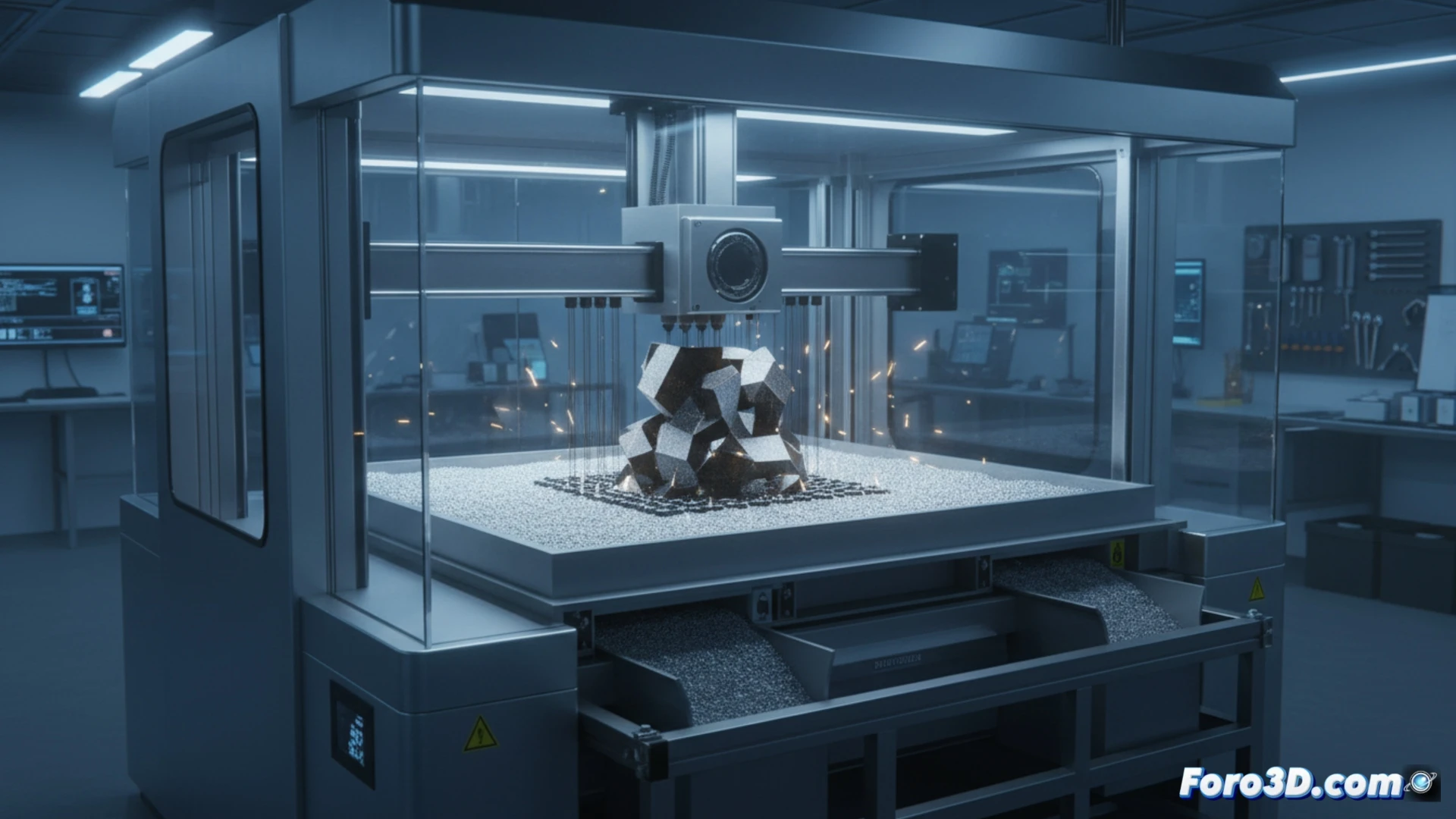
Can you imagine being able to manufacture metal or ceramic components with the same agility as an FDM 3D printer creates plastic objects? This is no longer science fiction, but the reality offered by a technique called binder jetting. Its principle is similar to that of an inkjet printer, but in this case, a head distributes a liquid binder over a thin layer of metal or ceramic powder. By repeating the process layer by layer and applying heat afterward, a solid and fully functional part is obtained. 🏗️
Key Advantages: Superior Efficiency and Speed
This approach presents significant benefits compared to other 3D metal printing systems, such as those that use a laser to melt powder. The main strength lies in its production speed and in optimizing material use. Instead of processing one part at a time, the build platform can be completely filled with multiple components, analogous to baking a tray full of cookies. Additionally, the powder that is not consolidated with the binder can be recovered and reused in subsequent cycles, achieving near-total recycling rates. This makes it a more economical process with reduced environmental impact.
Main benefits of binder jetting:- Parallel production: Allows manufacturing many parts simultaneously on the same platform, increasing productivity.
- Minimize waste: Leftover powder is recycled almost entirely, reducing costs and waste.
- No supports required: The powder bed itself acts as support during printing, simplifying post-processing.
Binder jetting technology is transforming manufacturing, moving from creating simple prototypes to producing ready-to-use final components.
Real Industrial Applications
The most notable thing is that this technique is not limited to validating designs or making mockups. Currently, it is used to manufacture final parts in high-demand sectors. For example, in the aerospace industry, they are used to create lightweight and complex components, while in the medical field, dental or orthopedic implants are personalized. The ability to transfer a digital file directly to a physical object, with high precision and without the need for expensive molds or tooling, represents a paradigm shift in how objects are produced.
Industries already adopting this technology:- Aerospace: For manufacturing lightweight structural parts with intricate geometries.
- Medical: In the creation of customized implants that fit perfectly to the patient's anatomy.
- Automotive: For producing functional prototypes and short runs of specialized components.
The Future is Already Here
Therefore, the next time you see a 3D printer, think that its scope goes beyond plastic. Technologies like binder jetting are literally "building" the elements that will define tomorrow in engineering and design, drastically shortening the path from idea to finished product. 🚀