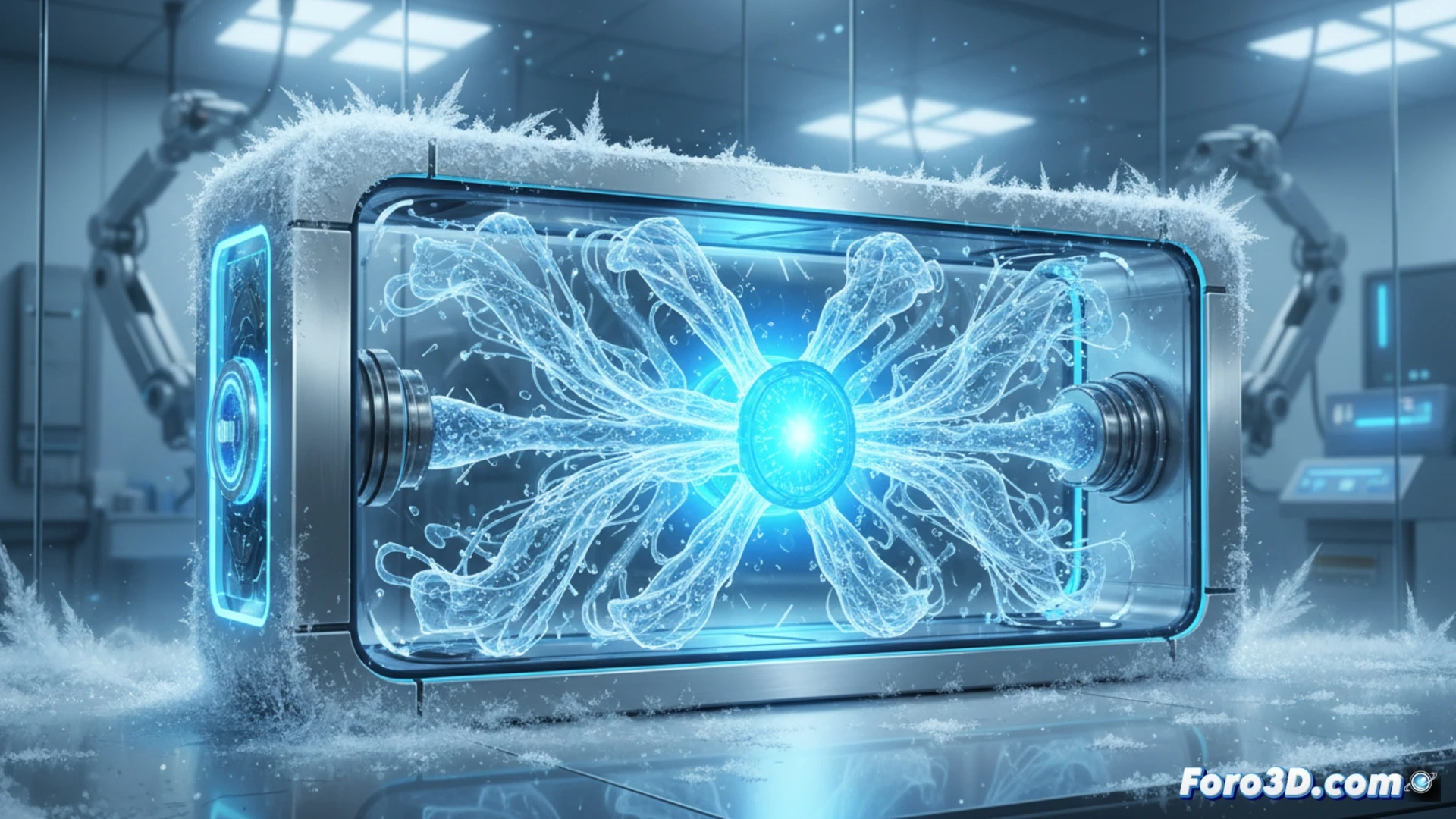
Batteries that Defy Extreme Cold with a Gel Electrolyte
Does your smartphone or drone suddenly stop working on a winter day? ❄️ This common problem has a clear cause: conventional batteries are not designed to withstand sub-zero temperatures. The good news is that science is advancing toward a radical solution, by changing the key component that fails in the cold.
The Weak Point: Liquid Electrolyte
The heart of a lithium-ion battery is the electrolyte, a substance that allows ions to travel between the electrodes. In its traditional liquid form, this component thickens and eventually freezes in the cold, completely blocking the flow of energy. While some teams investigated replacing lithium with sodium, a group of researchers in China explored a different and very ingenious path.
The Key Innovation:- Change the Texture: Instead of an aqueous liquid, they used a semi-solid electrolyte with a gel-like consistency.
- Prevent Freezing: This gelatinous structure is much more stable at low temperatures and does not solidify easily.
- Maintain Ionic Flow: Despite the cold, lithium ions retain their mobility, allowing the battery to discharge and charge.
The real breakthrough is not in changing the metal, but in modifying the medium through which it moves.
Results in Extreme Conditions
Laboratory tests with this new design have yielded surprising data. The prototypes have demonstrated operation with total normality in environments of thirty degrees Celsius below zero. To put it in perspective, this temperature is lower than that of a standard household freezer. 🥶
Potential Applications of This Technology:- Electric Vehicles in Nordic Countries: It would solve one of the biggest drawbacks to adopting electric cars in cold climates.
- Exploration and Scientific Equipment: Instruments for Antarctica, high mountains, or space missions to cold planets.
- Consumer Electronics in Winter: Phones, cameras, and wearables would stop shutting down unexpectedly during outdoor activities.
A Future Less Vulnerable to Winter
This development represents a significant leap in how we design energy storage. It's not about adding an external heater, but redesigning the internal chemistry to make it intrinsically resistant. Thus, while we need to bundle up, tomorrow's batteries could carry their own molecular protection built-in. The answer to extreme cold could be, after all, as simple as thickening the battery's "juice." 🔋