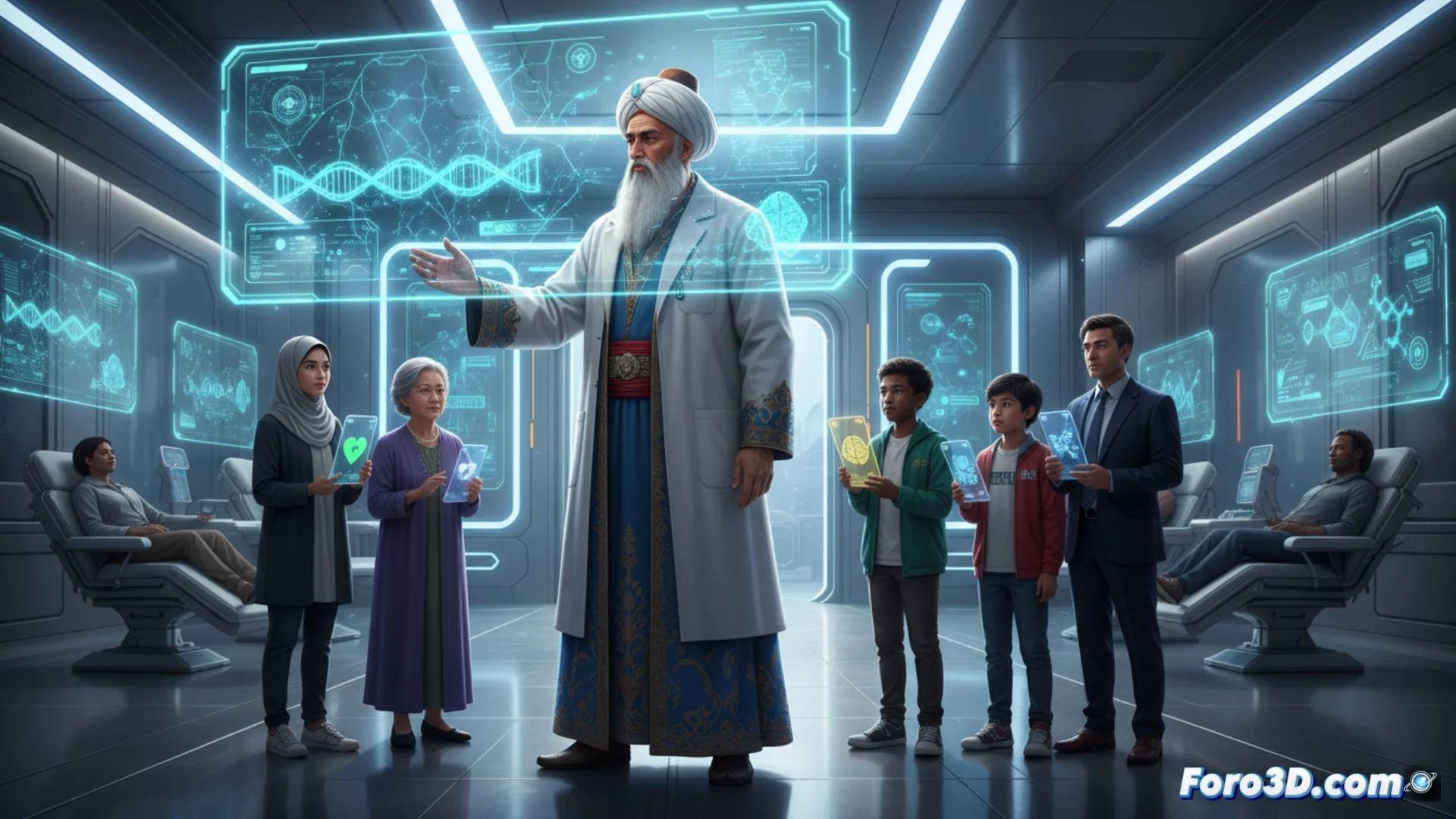
Avicenna and Artificial Intelligence in Modern Medicine
Imagine how Avicenna, the great Persian physician and philosopher, would approach today's health challenges. His analytical mind and passion for systematizing knowledge would lead him directly to adopt artificial intelligence. He would create digital systems to process large-scale medical information and assist in establishing diagnoses, with the firm goal of making healthcare accessible to anyone, regardless of their location. 🧠⚕️
A Universal Diagnostic Tool from Your Mobile
His flagship project would be a global and free platform, operable from any smartphone. On it, people could describe their symptoms, attach images of affected areas, and upload basic test results. An AI algorithm would examine this data, cross-referencing it with an extensive library of medical cases, to produce a reliable pre-diagnosis that guides the user's next steps.
Key features of the platform:- Accessible interface designed to work on low-end mobile devices.
- Ability to analyze text, images, and structured data simultaneously.
- Generation of an advisory report with a high level of accuracy.
Artificial intelligence would be the vehicle to distribute the medical knowledge he compiled, allowing anyone to access a preliminary evaluation.
AI as a Bridge, Not a Replacement
This system would not replace healthcare professionals but would operate as an intelligent first filter. Its function would be to identify situations requiring urgency and expedite their referral to specialists. Additionally, it would serve to educate the population about various health conditions, democratizing access to reliable medical information.
Main functions of the AI filter:- Classify case priority based on potential severity.
- Redirect users to the most appropriate healthcare service.
- Provide evidence-based educational information.
A Legacy that Fuses Eras
Avicenna would likely add a touch of his classical erudition, programming the AI to occasionally cite Aristotle in its reports. This peculiarity would unite ancient philosophical wisdom with modern algorithms, creating a unique bridge between logical thinking of yore and cutting-edge tools that today can transform medicine and make it truly universal. 📚🤖