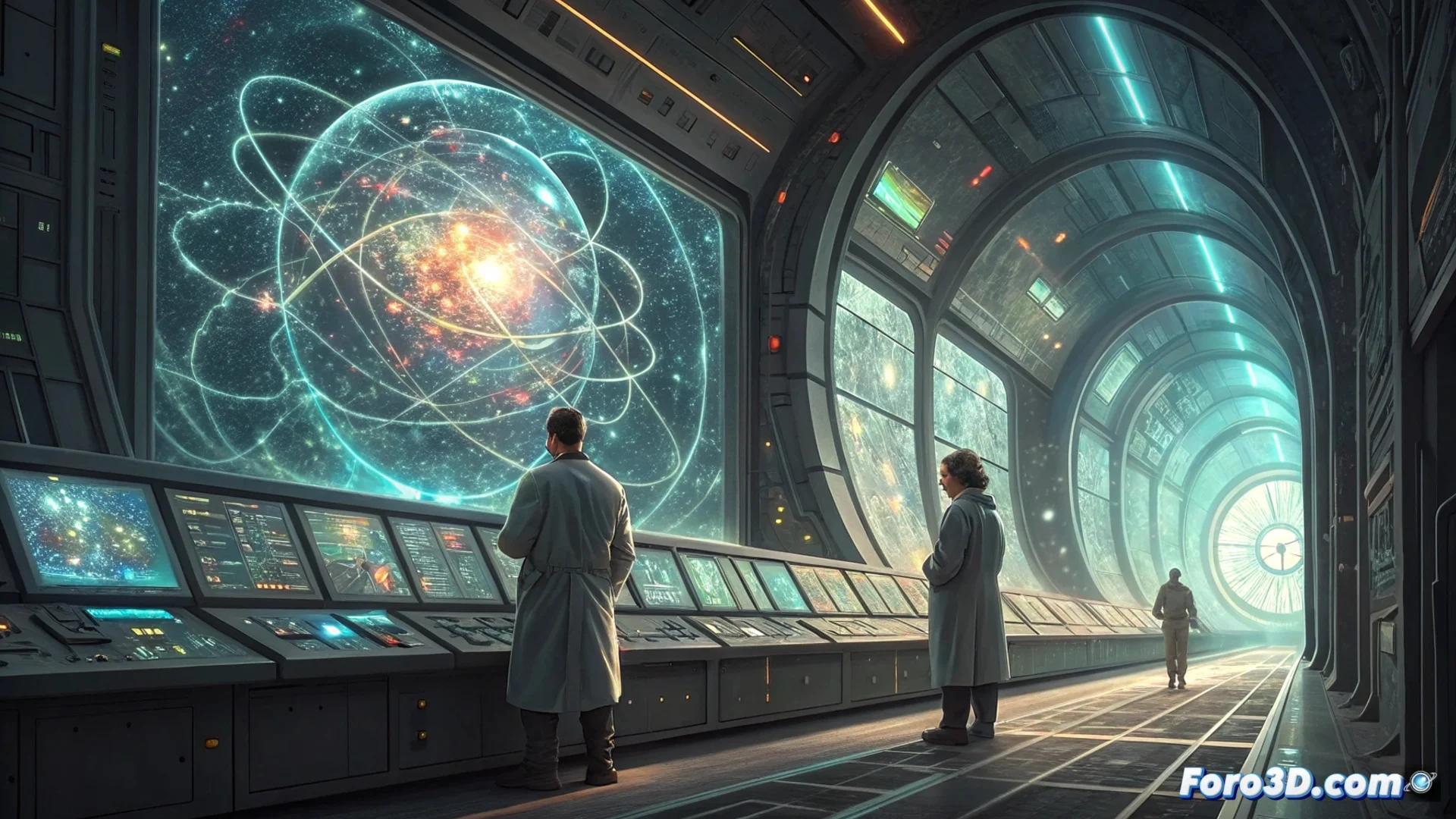
Artificial Intelligence Revolutionizes Analysis in Particle Physics
The large particle physics experiments generate amounts of information that challenge traditional methods. To handle this data deluge, researchers are increasingly turning to artificial intelligence and machine learning. These technologies enable exploring unknown territories beyond the Standard Model in ways previously unthinkable. 🔬
Neural Networks to Decipher Collisions
Deep learning algorithms directly examine the images produced when particles collide. They are capable of separating routine events from those that might hide a relevant signal with great accuracy. This intelligent filtering greatly speeds up the path to new discoveries. Additionally, generative models create simulations of physical events, which serve to calibrate detectors and better understand the limitations of each experiment.
Key Applications of AI in this Field:- Event Classification: Automatically distinguish between background signals and possible discoveries in collisions.
- Generative Simulation: Produce synthetic data to calibrate instruments and evaluate uncertainties.
- Anomaly Search: Find unexpected patterns in data that could indicate new physics.
The symbiosis between physics and computing is redefining the boundaries of how we can investigate the fundamentals of the universe.
Towards Deeper Interdisciplinary Collaboration
The community not only uses existing AI tools but also develops specific architectures to solve unique physics problems. The ultimate goal goes beyond classifying data; it seeks to create systems that can even suggest new hypotheses and theoretical frameworks.
The Near Future of this Collaboration:- Specialized Architectures: Design neural networks and algorithms tailored to the specific challenges of high-energy experiments.
- High Luminosity Handling: Future experiments, which will produce even more data, will critically depend on these tools to avoid being overwhelmed.
- Augmented Science: Implement systems that assist physicists in interpretation and theory formulation.
A New Scientific Paradigm
This integration marks a paradigm shift in fundamental research. AI-driven computational physics is not just logistical support; it is becoming a methodological pillar. It seems that, in the quantum world, even the most elementary particles prefer an efficient algorithm to interpret their fate, rather than waiting for a manual and fatigue-prone analysis. ⚛️