In colonial India in the 19th century, Anandibai Joshi broke an iron social mold. Married at nine years old, her life took a turn when she aspired to study medicine, driven by the high female mortality due to the lack of female doctors. Her journey to the United States to graduate was a personal odyssey against rejection and illness, culminating in being the first Indian woman with a degree in Western medicine.
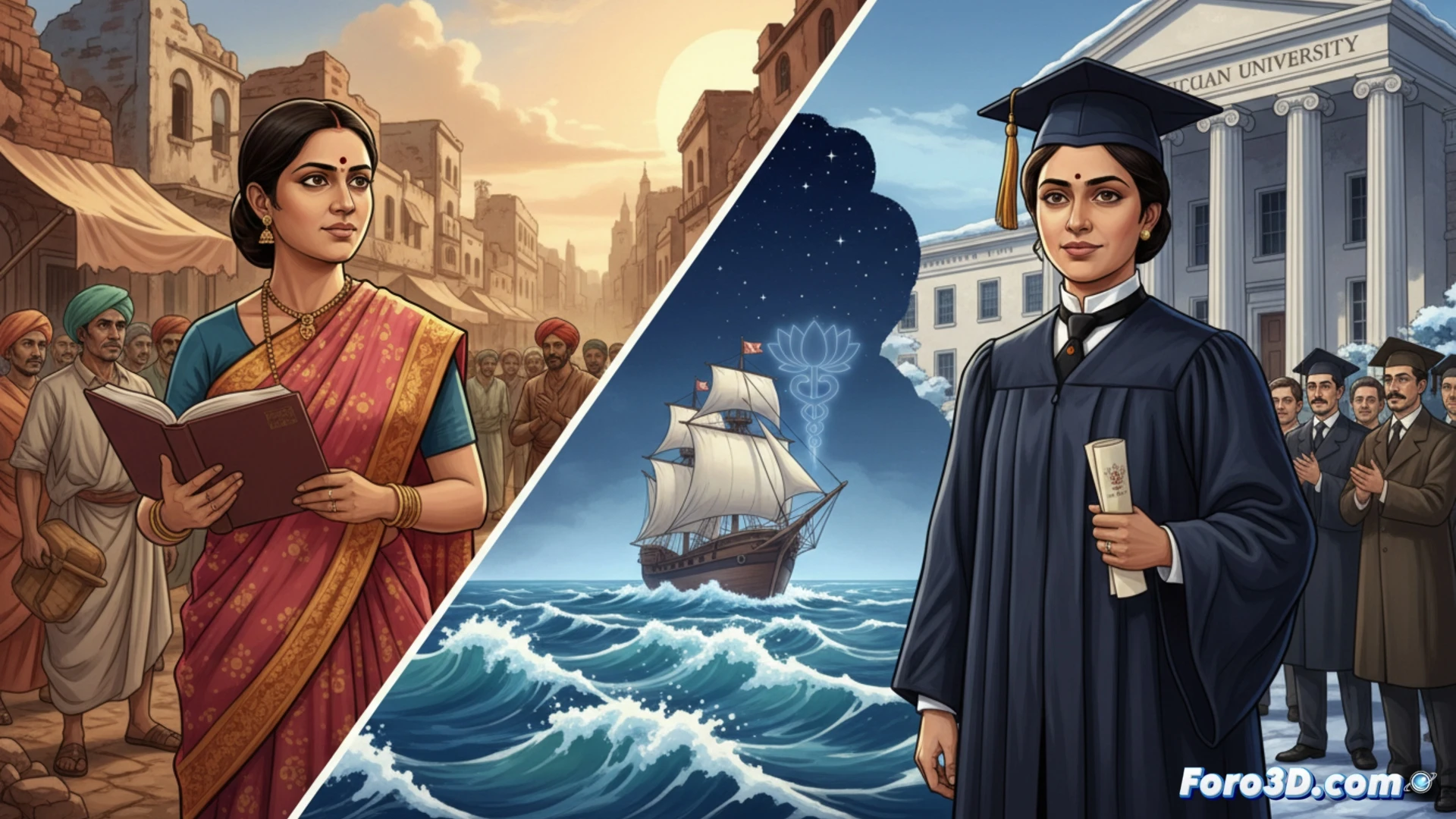
Rendering an Epic: Techniques for a Visual Biopic 🎬
A cinematic adaptation of her life would require a hybrid visual pipeline. The base would be a 3D render with textures and shaders that emulate the bidimensionality and flat colors of Mughal miniatures. For the dreamlike sequences and the journey, fluid and particle simulations would be integrated to animate the colored powders of rangoli, creating organic transitions between scenes. The palette would shift from warm ochres in India to cold blues in the US, using custom LUTs.
The 19th Century Social Compatibility Patch 🐛
Imagine the debugging process Anandibai faced. The society of the time ran code with a persistent bug: the gender variable limited access to the higher_education function. She tried to force an update by traveling to another server (the US), but the climate and customs were a hostile environment with incompatible drivers. Still, she managed to download and install the Doctor title, although the main system took decades to apply the patch on a large scale.