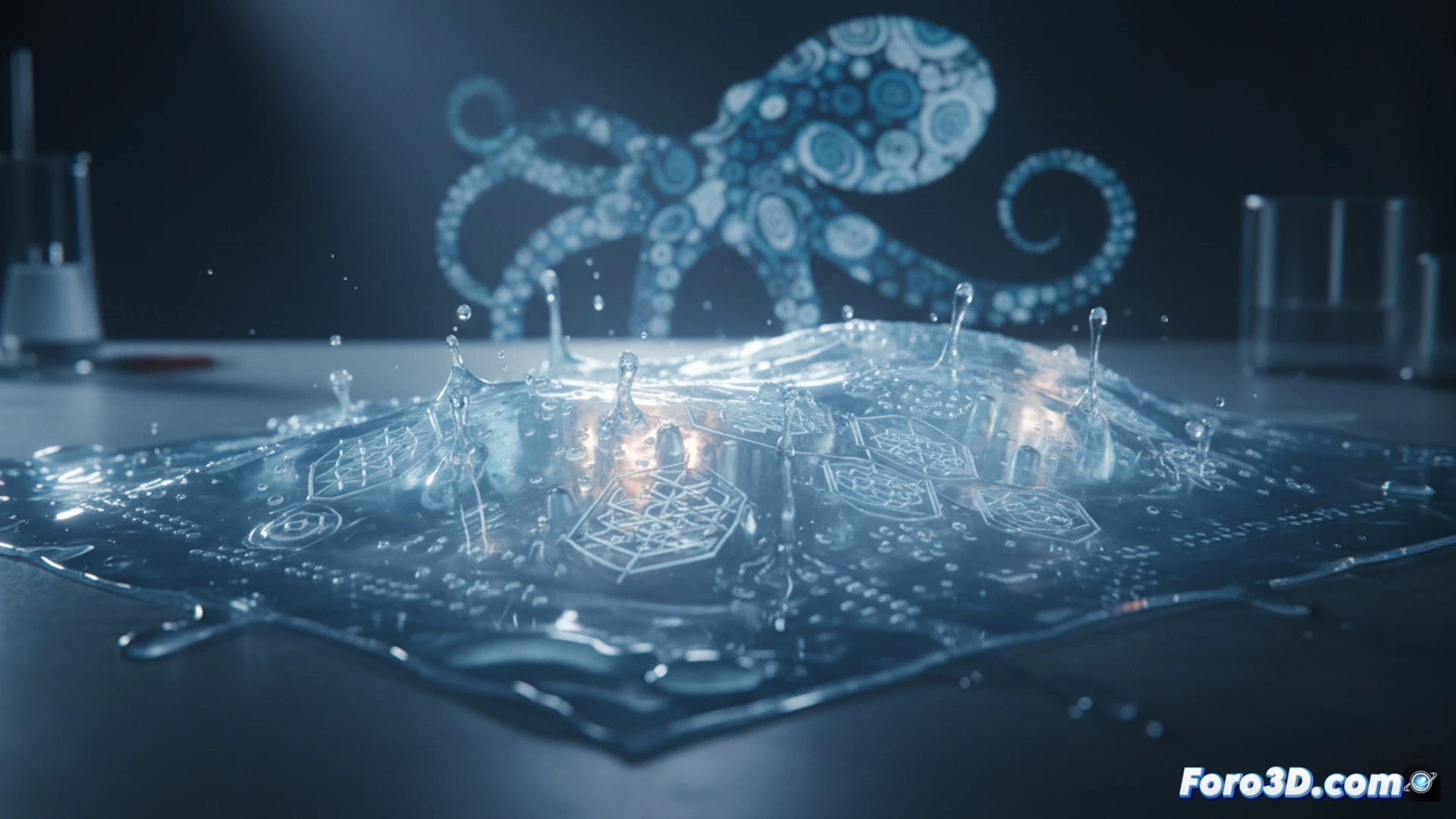
An intelligent skin that camouflages like an octopus to hide information
What if the devices you use daily could hide secret messages in plain sight? 🔍 Researchers have created a revolutionary material inspired by octopuses' ability to camouflage. It is a programmable hydrogel sheet that can alter its physical shape, taking 3D printing to a new dimension where objects transform themselves.
The mechanism behind the moving material
The basis of this technology is a temperature-sensitive hydrogel. Similar to certain thermochromic toys, this material responds to heat. However, instead of just changing its color, it undergoes a programmed mechanical deformation. By manufacturing precise patterns with 3D printing, scientists predefine how the sheet will fold or ripple when heated, generating reliefs that remain hidden until activated.
Key features of the intelligent hydrogel:- Heat activation: Responds to thermal sources like breath air or hand contact.
- Geometric programming: 3D printing patterns determine the final transformation of the surface.
- Reversible physical change: The material can return to its original state, allowing cycles of hiding and revealing.
It is a significant step toward living materials that interact dynamically with their environment.
Applications beyond the obvious
The potential of this development goes beyond the simple visual effect. It opens the door to creating impossible-to-fake security labels, where a QR code or message only appears when a gentle heat source is applied. In the field of soft robotics, it could equip robots with adaptive surfaces that modify their texture and aerodynamics, more faithfully imitating marine organisms.
Possible practical uses:- Product protection: Labels that authenticate luxury items or medications by revealing a hidden pattern.
- Interactive interfaces: Tactile surfaces that change shape to provide haptic feedback.
- Advanced biomimicry: Develop prostheses or wearables with skin that adapts to the environment.
Natural inspiration for future technology
It is fascinating to observe how a natural phenomenon, like a cephalopod modifying its appearance, drives the next generation of intelligent design. This convergence between biology and materials engineering suggests that soon, the art of hiding information on ordinary surfaces could stop being a trick and become an everyday tool for security and interaction. 🐙