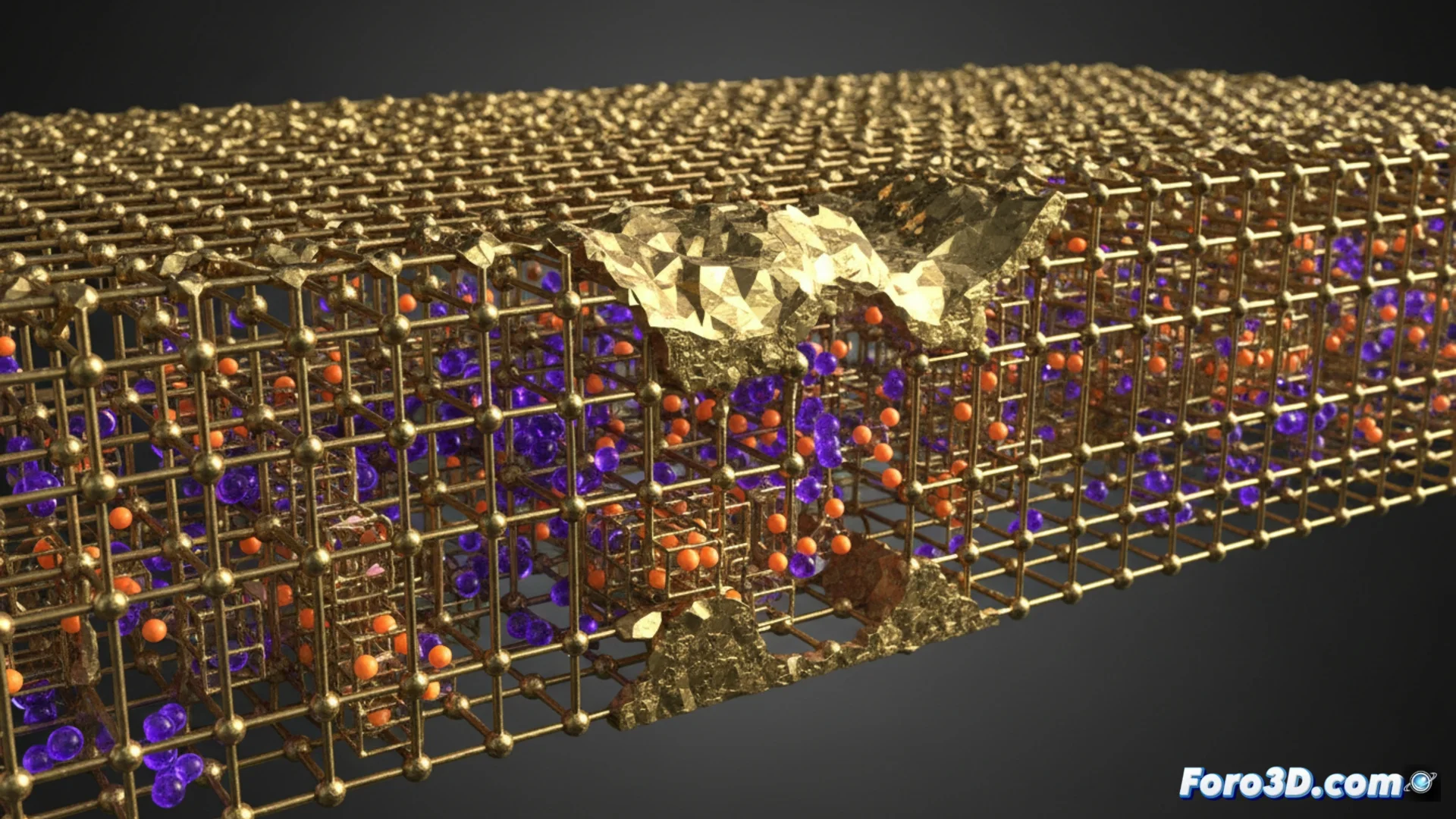
An innovative technique visualizes liquid-solid interfaces with near-atomic resolution
Analyzing the boundaries where liquids meet solids has always been a huge technical challenge, despite being vital for understanding many chemical and electrochemical processes. Now, a method based on cryogenic atomic probe tomography succeeds in freezing and scanning these interfaces with unprecedented detail, close to the scale of individual atoms. This offers a unique window to observe in real time how molecules and ions behave when interacting with a surface. 🔬
Unveiling the secrets of surface reactions
The power of this technique is demonstrated by applying it to study nanoporous gold in contact with electrolytes containing iodide and sodium ions. The researchers not only could see iodine complexes forming on the metal surface, but also detect their formation below the surface layer. This unexpected finding reveals reaction mechanisms that previously remained hidden, confirming that multiple and distinct complexes are generated between gold and iodide during the process.
Key advances provided by this technique:- Allows characterizing interfaces at the nanoscale while active electrochemical reactions occur.
- Provides three-dimensional data on chemical composition with extraordinary spatial resolution.
- Facilitates understanding and, ultimately, more precise control of these fundamental processes.
Visualizing and characterizing these nanoscale interfaces during electrochemical reactions is fundamental to better understand and control these processes.
Impact on the design of future technologies
This ability to observe reactions at nearly atomic level has profound implications for manufacturing advanced materials and advancing energy and sensing technologies. By understanding exactly what happens at these critical interfaces, scientists can design nanoporous metallic materials with optimized properties from their conception.
Potential applications derived from this knowledge:- Create more precise and selective sensors, such as those used to measure glucose.
- Develop more efficient electrocatalysts for producing green hydrogen or other sustainable fuels.
- Design batteries with better performance, longer lifespan, and higher energy density.
A future built atom by atom
In essence, this advance moves interface research from a realm of inferences to one of direct observation. The possibility of seeing the processes rather than just deducing them accelerates the innovation cycle. Thus, the next time a device fails or runs out, the final solution is likely being gestated in a laboratory, where scientists freeze and analyze atoms to build more reliable, durable, and sustainable devices for everyone. ⚛️