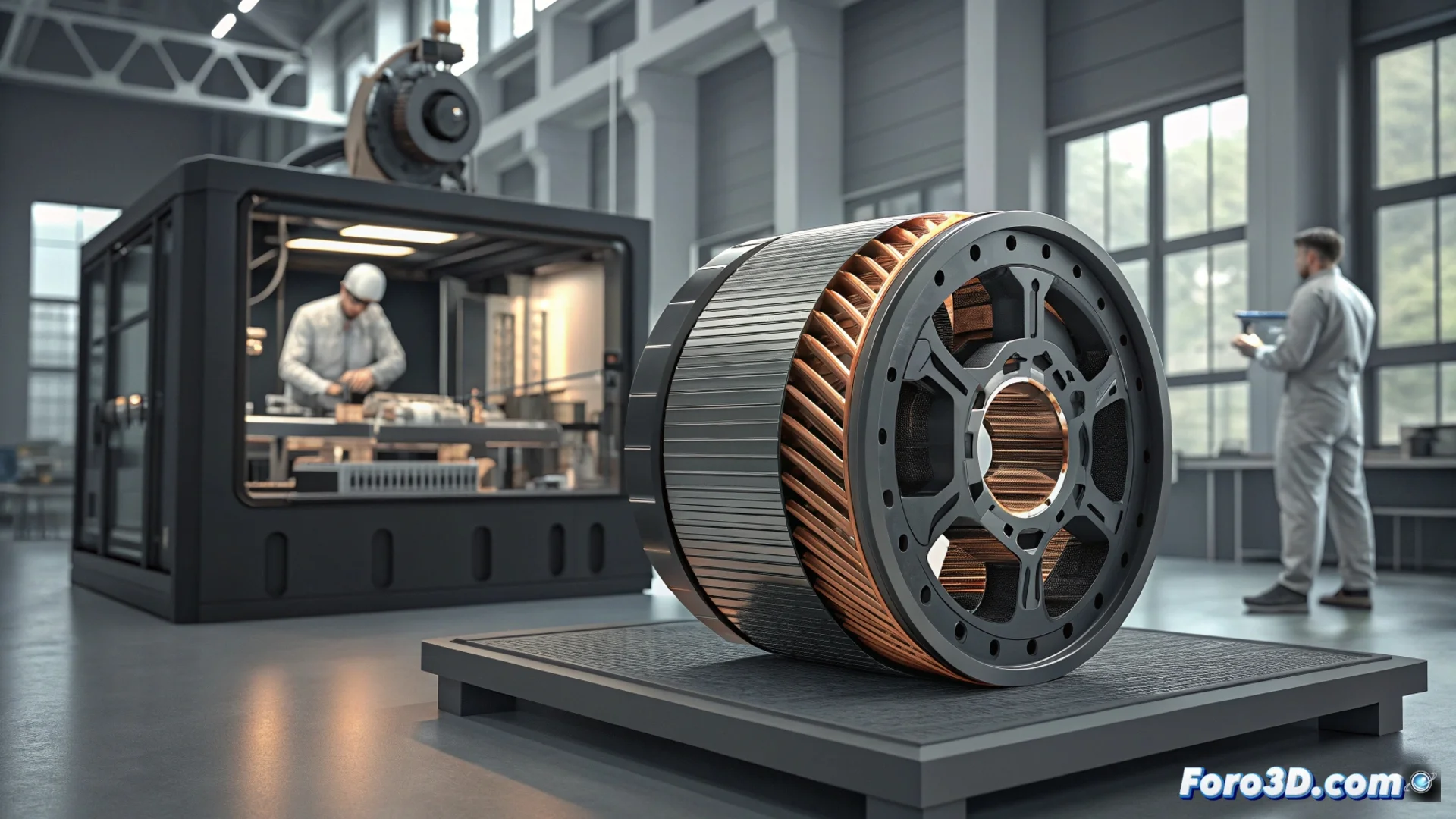
Additive Drives Raises Over 25 Million to Scale 3D-Printed Electric Motors
The German company Additive Drives has closed a significant capital injection exceeding 25 million euros. This round was led by the firm Nordic Alpha Partners and included participation from its current investor, AM Ventures. Based in Dresden, the startup plans to use this capital to scale its technology for electric propulsion manufactured using additive methods. 🚀
A Technology That Dispenses with Critical Materials
The core of Additive Drives' innovation lies in designing high-performance electric motors that do not require rare earths. These devices achieve energy efficiency close to 98%, reducing energy losses by up to 70% compared to conventional solutions. This advancement attracts industries seeking to optimize performance and be more sustainable.
Main Application Sectors:- Electric Vehicles: To improve range and reduce weight.
- Aerospace Industry: Where the power-to-weight ratio is crucial.
- Robotics and Industrial Automation: To achieve more precise and efficient movements.
The future of electric motors is not only electric, but also remarkably silent in terms of its critical materials footprint.
Clear Objectives: Produce More and Cross Borders
The funding obtained will be directed mainly toward two strategic goals: expanding production capacity and accelerating entry into international markets. The company already demonstrates the solidity of its technology by collaborating with a portfolio of top-tier industrial clients.
Current Strategic Partnerships:- Amazon: For applications in logistics and automation.
- Airbus: In the development of aeronautical components.
- Audi and BMW: To integrate this technology into the next generation of vehicles.
- Schaeffler: In solutions for the automotive and bearings industry.
A Promising Horizon for Additive Manufacturing
This financial milestone not only validates the potential of Additive Drives' technology in mission-critical applications, but also underscores the growing role of industrial 3D printing in creating high-value components. The ability to manufacture more efficient, sustainable, and powerful motors without relying on critical materials supply chains marks a turning point for sectors like electric mobility and aeronautics. The shift toward cleaner and more efficient materials engineering is a reality that is beginning to take shape. ⚙️