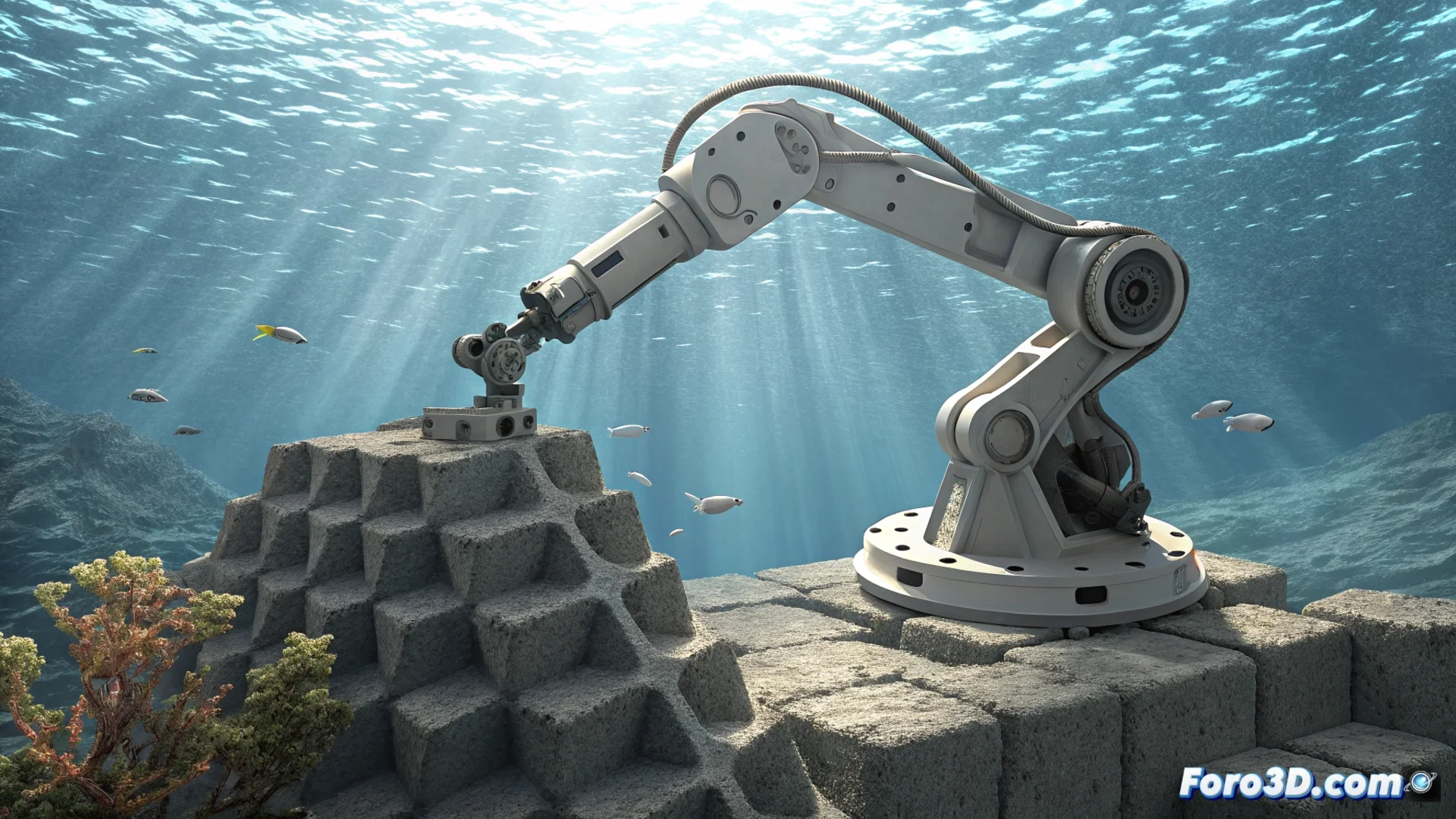
A team prints concrete underwater with a robotic arm
Scientists from Texas A&M University have presented an innovative technique that allows manufacturing concrete structures directly on the seabed. This advance promises to revolutionize how structures are maintained and built in aquatic environments, from pilings to artificial reefs 🏗️.
A system that fuses automation and advanced materials
The key to the process lies in an industrial robotic arm that extrudes a cement mortar formulated exclusively. This compound has the unique quality of not disintegrating upon contact with water, maintaining its integrity and strength from the very first moment.
Main features of the system:- The robot can operate autonomously or be controlled remotely by a human operator.
- The cementitious material is deposited layer by layer to create complex and customized shapes on the seabed.
- The technique solves the fundamental problem of how to make concrete set in a controlled manner underwater.
This technology avoids the need to build expensive dry docks or halt port operations for repairs.
Practical uses in the marine environment
The applications of this method are very varied and offer tangible advantages. Primarily, it can repair damage to pipelines, piers, and other submerged elements in a faster, more economical, and safer way.
Benefits and direct applications:- Repair critical infrastructure without needing to dry the work area, minimizing downtime.
- Create custom marine habitats to promote biodiversity and repopulate ecosystems.
- Reduce ecological impact and risks to workers compared to conventional underwater construction methods.
A stronger future under the waves
This development not only improves efficiency in marine engineering but also opens the door to underwater architectural designs that were previously difficult to achieve. Although the final material is stronger than a sandcastle, robotic precision allows sculpting complex structures with new freedom 🌊.