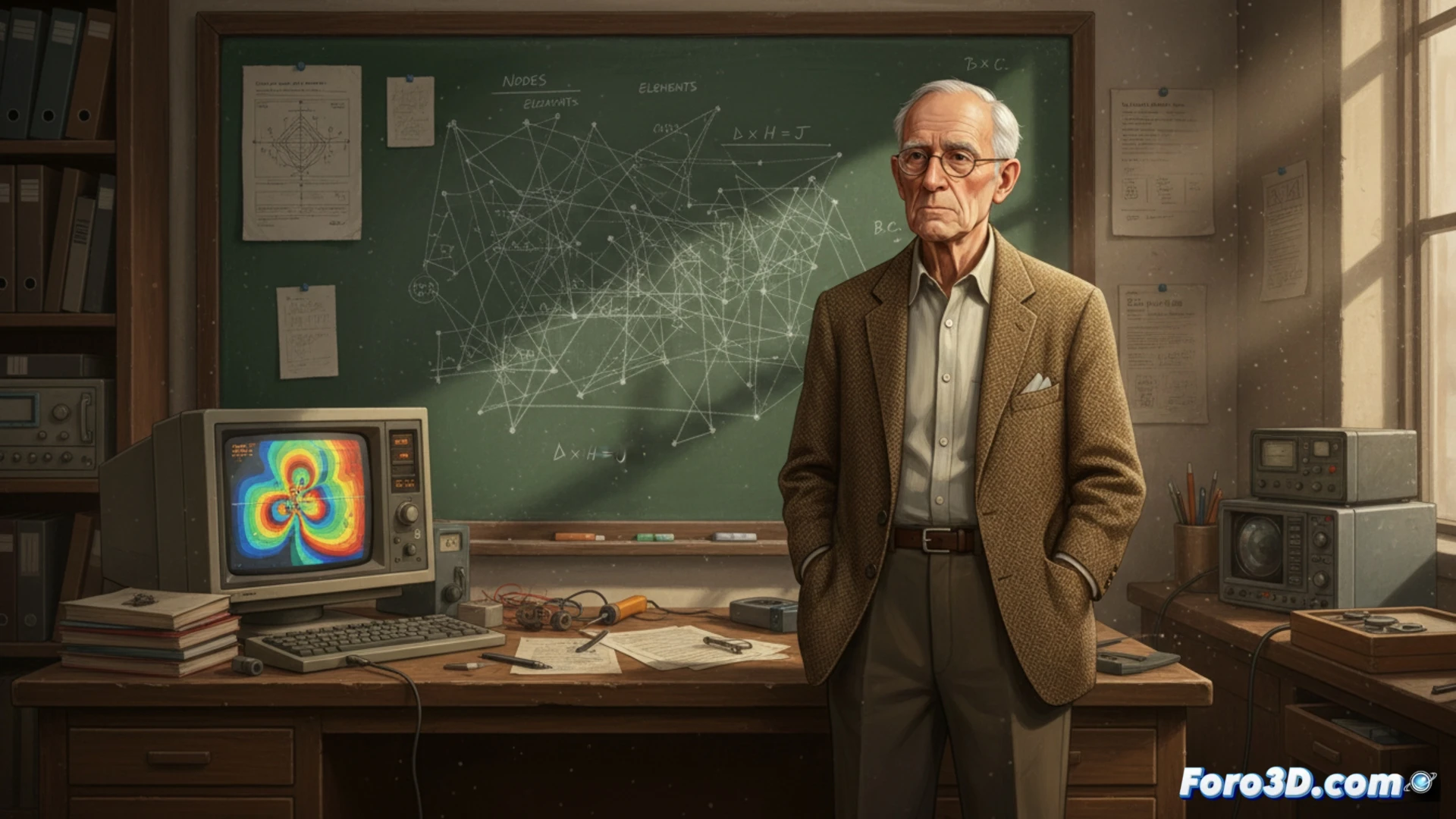
A pioneer of the finite element method for electromagnetism passes away at 85
The computational engineering community mourns the loss of Peter Silvester, a central figure in adapting the finite element method to solve electromagnetic field problems. His passing marks the end of an era for those who design electrical and electronic devices using modern simulation tools. 🧠⚡
The mathematical foundations of a revolution in design
Silvester collaborated with other researchers to establish the foundations that allow numerical techniques to be applied to Maxwell's equations. This approach decomposes complex geometries into a mesh of simple elements, facilitating the calculation of field behavior inside components. His contribution completely transformed the approach to electromagnetic design.
Direct impact of his methodology:- Precision in simulation: It enabled accurate modeling of field behavior in electric motors, transformers, and antenna systems.
- Reduction of physical prototypes: Engineers could begin validating designs virtually, saving costs and development time.
- Establishment of a new standard: His work became the reference for globally used commercial analysis software.
Designing an electric motor without these tools would be like trying to navigate without a compass, a journey full of failed prototypes and endless manual calculations.
A legacy that endures in every modern simulation
The techniques he helped develop did not remain in the academic realm. They were integrated into Finite Element software packages that are indispensable in industry today. This advance eliminated the need to rely solely on building and testing multiple physical versions, radically optimizing engineering resources.
Areas where his influence is most evident today:- Development of motors and generators: Their efficiency is optimized and size reduced before manufacturing a single piece.
- Design of antennas and communication devices: Their performance is analyzed and adjusted completely virtually.
- Engineering of transformers and power equipment: Their reliability is ensured and regulations are met through computational models.
The compass for future generations of engineers
Silvester's approach remains the backbone of modern CAE simulation environments. His work not only provided a tool but defined a new philosophy for conceiving and validating electromagnetic technology. The path he opened allows today's engineers to explore innovative solutions with unprecedented confidence and speed, consolidating a legacy that will continue to guide the future of design. 🛠️🌍