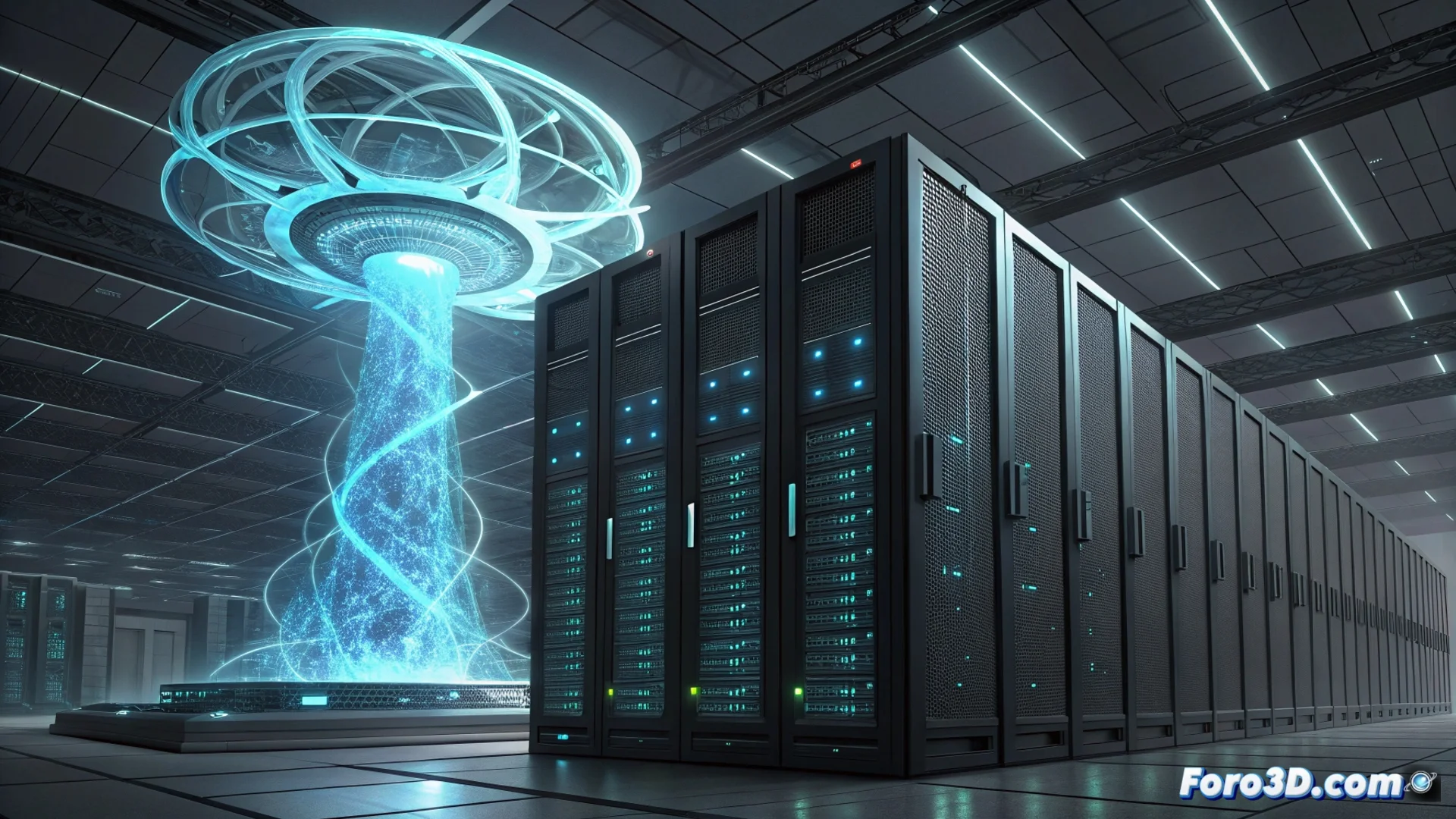
A Digital Brain to Design the Nuclear Energy of the Future
Imagine a machine capable of solving the most complex enigmas of nuclear engineering? In a laboratory in Idaho, they have activated a colossus computer called Teton, whose sole reason for being is to decipher those challenges. 🧠⚛️
The Raw Power of Thousands of United Cores
Think of combining the capacity of hundreds of thousands of the most powerful gaming GPUs. That's what defines Teton. This system reaches a data processing speed of 20.8 petaflops. In practical terms, it can complete mathematical operations that would take a human eons, in a matter of hours. All to model in unprecedented detail how materials behave under the extreme conditions of a nuclear reactor. 💻🔥
Key features of this giant:- Computing power: 20.8 petaflops, equivalent to hundreds of thousands of modern processors.
- Main objective: Simulate reactor physics and advanced nuclear technologies.
- Impact: Accelerate the design of safer and higher-performing energy systems.
Science progresses with curiosity and, now, with an enormous computing capacity.
A Neural Network for Science
This titan does not operate in isolation. It has been connected with other computational resources from the center, forming a vast computing network dedicated to research. Although its focus is nuclear modeling, the precision of its results will also benefit broader initiatives in the energy sector.
Areas of application for its simulations:- Design and optimize next-generation nuclear reactors.
- Analyze the behavior of materials in high-radiation and temperature environments.
- Provide data to make energy sources more efficient and reliable.
From an Idea on a Blackboard to Simulating Universes
Reflect that this machine, with the power to emulate realities at the subatomic scale, surely arose from a simple question of "what if...?". Scientific advancement is built on that spark of curiosity, now enhanced by a massive computing tool like Teton. 🚀