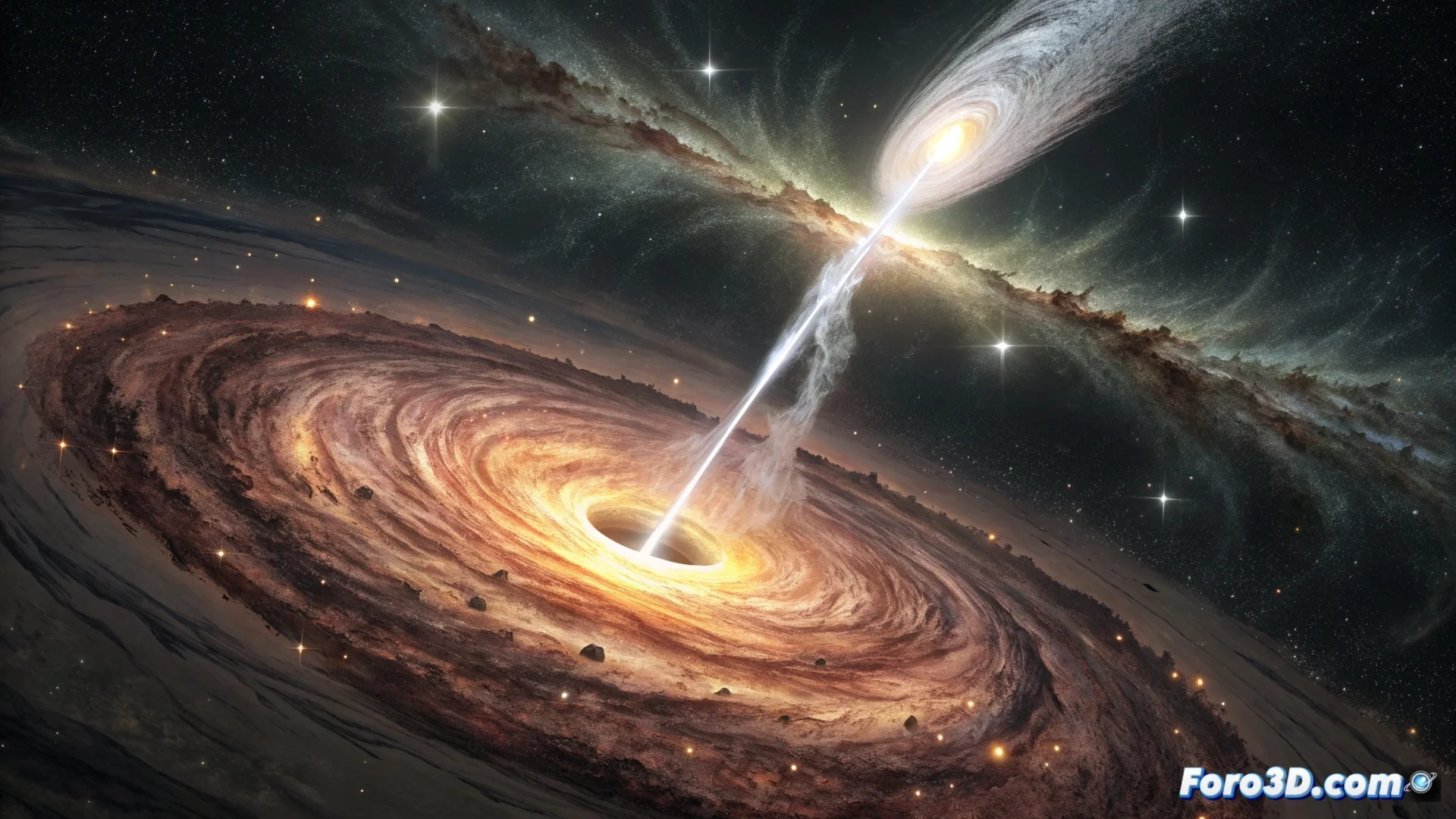
A Black Hole Expels a Powerful Jet After Tearing Apart a Star
The astronomical community is following an extraordinary event that began four years ago and has not yet concluded. It involves a supermassive black hole that, after capturing and destroying a star, is now launching its remnants into space in the form of an ultra-energetic particle jet. This event, cataloged as AT2018hyz, represents the longest-lasting accretion process ever documented. 🌌
An Unprecedented Power Jet
The stream of matter ejected by the black hole travels at speeds approaching that of light. Analyses confirm that it is the most powerful relativistic jet detected to date. Observing this phenomenon allows scientists to investigate how matter behaves under extreme gravity and how these enormous cosmic jets are generated.
Key characteristics of the AT2018hyz event:- The event began in 2018 and its intensity increases every year.
- The particle jet travels at a significant fraction of the speed of light.
- It provides a unique laboratory for studying physics under extreme conditions.
Models predict that the activity will continue to grow and promises to reach its peak in a few years.
A Cosmic Spectacle in Progress
Projections indicate that this event will reach its peak activity around 2027. This offers an exceptional observation window to follow the complete evolution of a tidal disruption event. Telescopes around the planet already have their instruments pointed at that region of the sky to record every phase.
Preparations for observation:- The global network of observatories is coordinated to monitor the event.
- Unprecedented data is expected to be captured during the peak of activity.
- The study will cover multiple wavelengths of the electromagnetic spectrum.
A Prolonged Cosmic Digestion
This prolonged phenomenon suggests that even black holes can experience complex processes when absorbing matter. The energetic and long-lasting expulsion of the jet indicates that the object is actively releasing material that it cannot stably incorporate. This behavior offers new clues about accretion dynamics in the universe's gravitational monsters. 🕳️