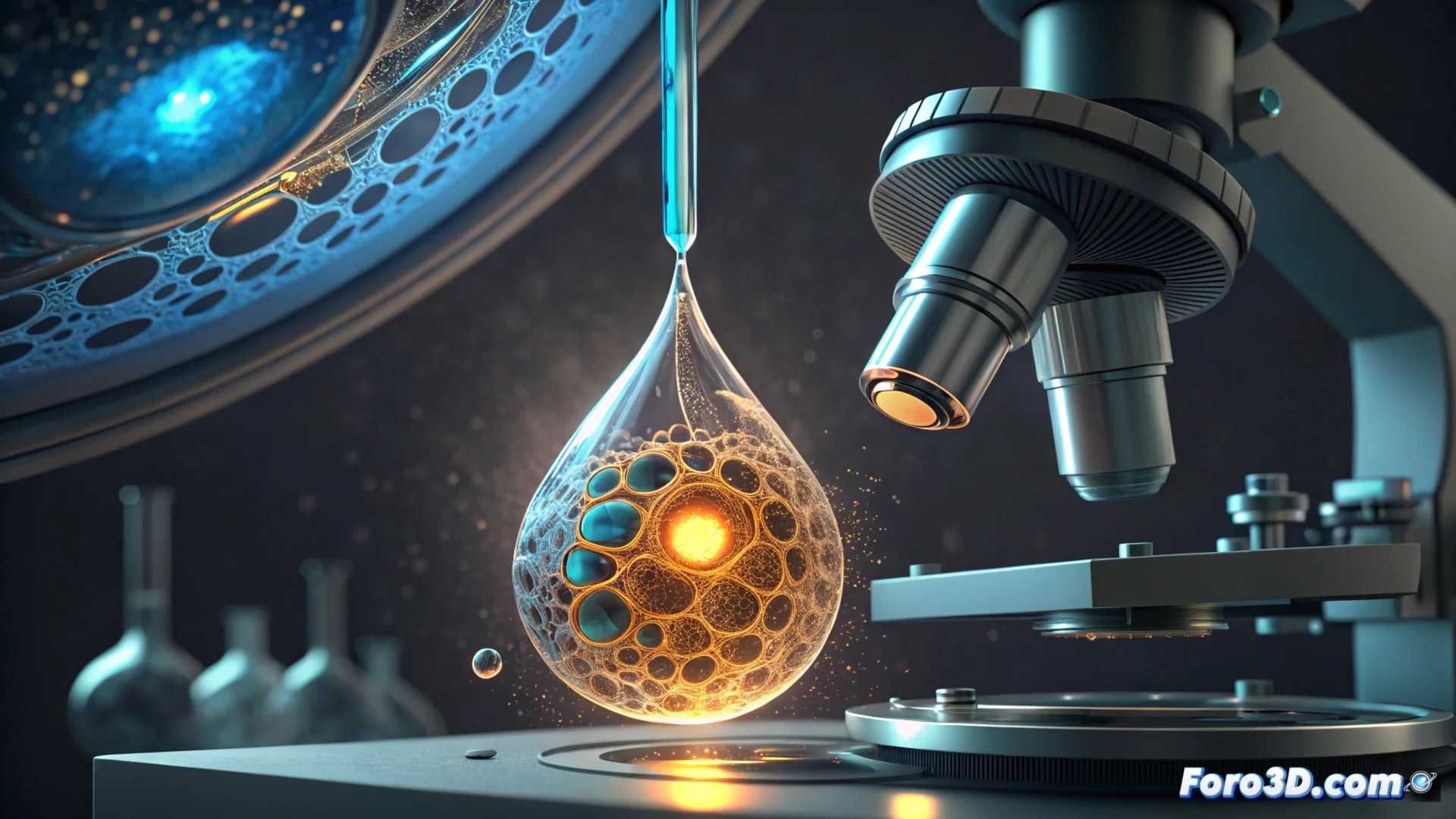
3D Printing at Microscopic Scale Using Light and Liquid
How are the ultra-small components that power the most advanced devices manufactured? 🔬 A global team of scientists has achieved a significant breakthrough by presenting a process that uses laser light pulses to build complex 3D objects within a fluid medium, acting as an ultra-high-resolution 3D printer for the realm of the minuscule.
The process centers on a tiny droplet
The technique is based on an optofluidics principle. Extremely short laser pulses are directed toward a microdroplet containing the material precursors. The light energy induces localized and precise solidification right at the focal point, tracing the volumetric geometry element by element. It is similar to sculpting with a fine light beam in three dimensions, on a scale so reduced that numerous of these pieces would fit in the diameter of a capillary filament. 💡
Versatile materials for innovative applications:- Not limited to polymeric resins; it also integrates gold nanoparticles and other metals.
- It can process ceramic oxides and even hard carbon compounds like diamond.
- This flexibility allows manufacturing from autonomous micro-machines to ultrasensitive biosensors.
The future of producing cutting-edge technology will not only be smaller, but it could also flow and light up in unexpected ways.
Implications and transformative potential
This breakthrough goes beyond mere miniaturization. By being able to mix and solidify different substances in a single process, creating multifunctional devices is greatly simplified. The ability to manipulate matter at the nanoscale with light within a fluid establishes a new paradigm for assembling advanced electronic components or parts for quantum computing.
What possibilities does this technology unlock?- Manufacturing microscopic medical robots that navigate the bloodstream.
- Developing integrated sensor arrays for diagnosing diseases more quickly.
- Producing custom optical and mechanical elements for micro-systems.
A new perspective for manufacturing
This method suggests that the next evolution in how we make things could originate from environments as simple and ubiquitous as a drop of water. The combination of photonics and fluids to create functional 3D objects marks a milestone, indicating that tomorrow's production lines could be more liquid, adaptable, and luminous than we ever imagined. 🌊✨