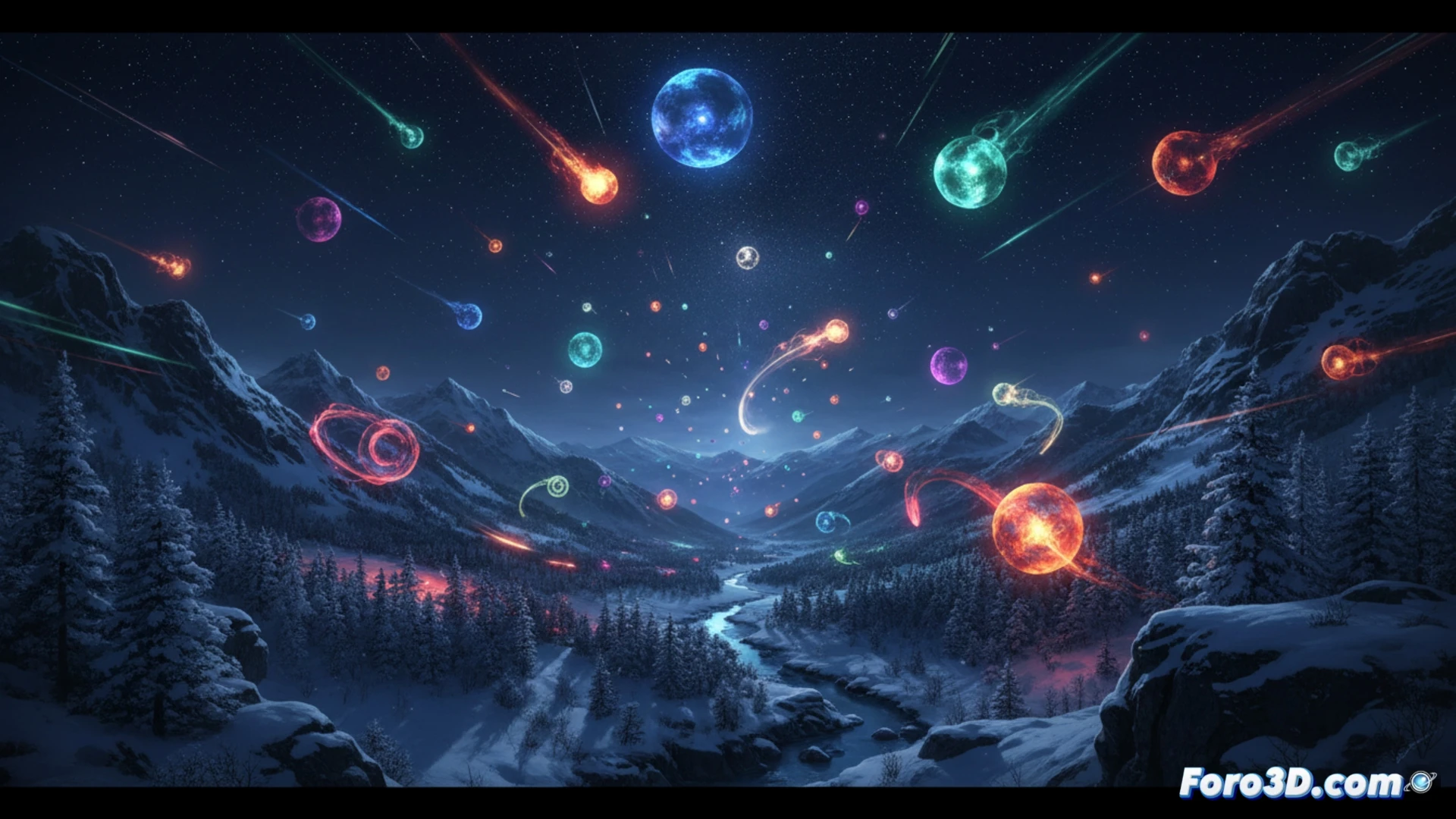
In the remote Hessdalen valley, Norway, a luminous phenomenon has defied all explanation for decades. The so-called Hessdalen Lights appear as spheres, pulses, or elongated shapes of various colors, moving at impossible speeds and with no apparent energy source. This perfect scientific enigma finds in 3D visualization a key tool. An interactive digital model allows not only for documentation but for dissecting the phenomenon, offering a unique platform for the analysis and dissemination of this unsolved mystery. 🔦
From Observation to Model: A Scientific Visualization Pipeline 🧪
The reconstruction begins with the integration of multidisciplinary data: GPS coordinates, calculated speeds, captured light spectra, and records of geomagnetic variations. In 3D software, this data is translated into geometry and particle systems. The erratic trajectories are modeled as NURBS curves, assigning velocity attributes to color (for example, a gradient from blue to red). Hypotheses compete in visual layers: one layer shows a spherical plasma model with volumetric emission shaders, while another overlays a visualization of piezoelectric stresses in the valley's geology, generating a heat map of possible points of origin.
3D as a Laboratory for Hypotheses 🧬
This 3D model transcends mere illustration to become a virtual testing ground. By isolating variables and simulating specific atmospheric or geological conditions, we can visually contrast which hypothesis best fits the observed behavior. Scientific visualization democratizes research, allowing the community to understand the complexity of the case. Hessdalen ceases to be an anecdote and transforms into an interactive dataset, where light, shape, and movement are questions still awaiting a definitive answer.
How can scientific 3D visualization techniques, such as volumetric tracing of atmospheric data and photogrammetric reconstruction, be applied to model and analyze the unknown physical properties of the Hessdalen Lights?
(PS: at Foro3D we know that even manta rays have better social links than our polygons)