The 2026 Lyrid meteor shower reaches its peak splendor today, April 22, with a moderate activity of about 20 meteors per hour, although it can be irregular and exceed 100. This phenomenon, visible from April 16 to 25, has its peak expected around 21:40 (Spanish peninsular time), one hour less in the Canary Islands, allowing it to be enjoyed before midnight. The Lyrids originate in the constellation Lyra, near the star Vega, and are visible from any hemisphere, with greater intensity in the north.
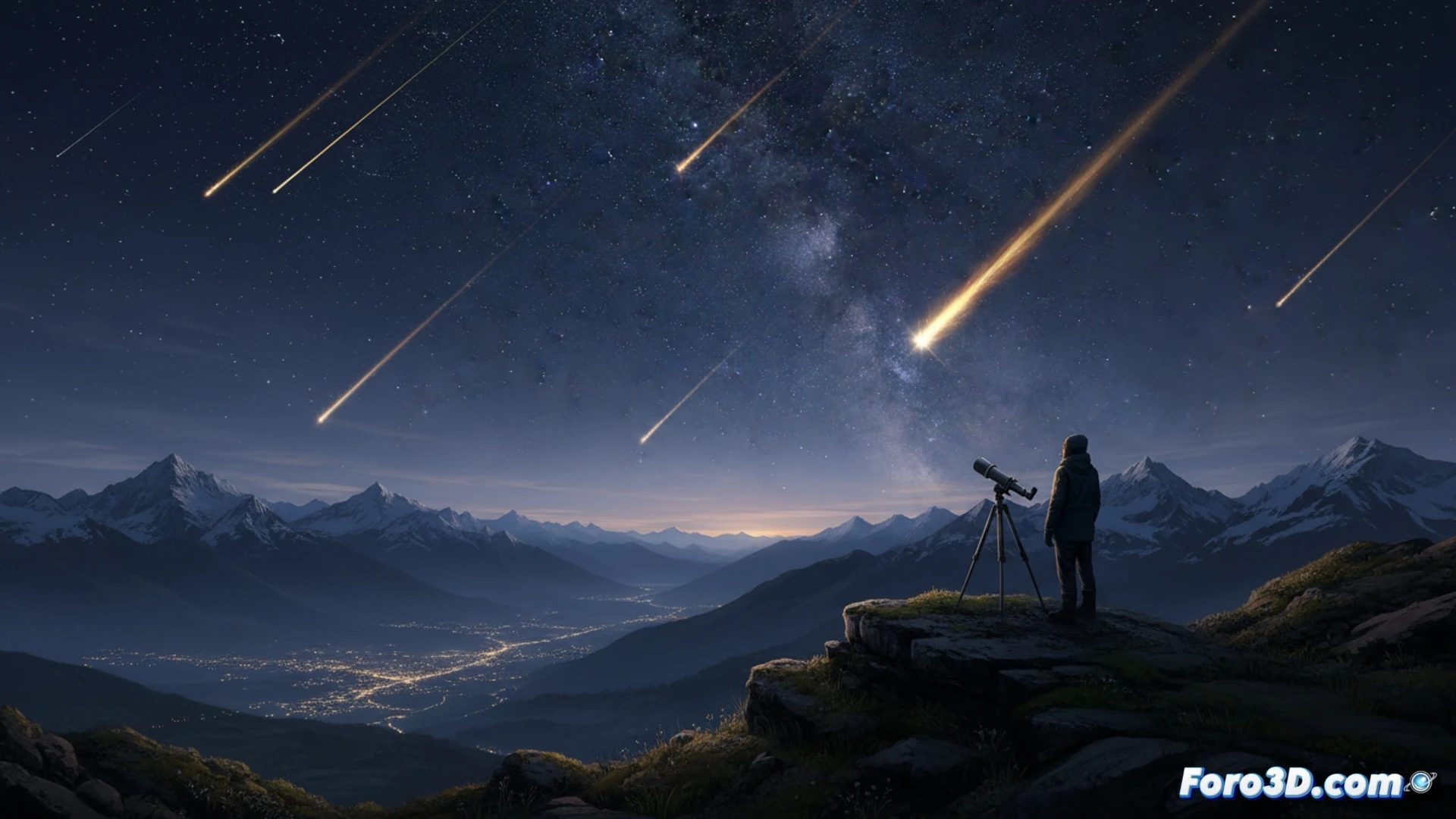
3D Modeling of Trajectories and Particle Simulation 🌠
To represent this event in a scientific visualization environment, we propose an interactive 3D infographic that models the trajectory of the meteors from the radiant in Lyra, using the star Vega as a visual reference point. The model should include a dynamic visibility map showing the optimal observation times for both peninsular Spain (UTC+2) and the Canary Islands (UTC+1). The particle simulation should animate a variable frequency from 20 to 100 meteors per hour, adjusting the density of the trails in real time. Furthermore, geospatial data layers representing city light pollution will be integrated, allowing the user to identify areas of clear sky and low light interference for optimal observation.
The Challenge of Visualizing the Ephemeral 🚀
The main technical challenge lies in balancing astronomical precision with real-time interactivity. The simulation of the trajectories must be based on the celestial coordinates of Lyra and the Earth's rotation so that the visibility map correctly reflects the peak at 21:40. At the same time, the interface must be intuitive, allowing the user to switch between the northern hemisphere and peninsula view, and adjust the light pollution scale to understand how the urban environment affects the perception of the spectacle.
What particle simulation techniques in 3D engines like Blender or Houdini allow for a more accurate representation of the trajectories and variable frequency of the 2026 Lyrid meteors for scientific visualization?
(PS: fluid physics for simulating the ocean is like the sea: unpredictable and you always run out of RAM)