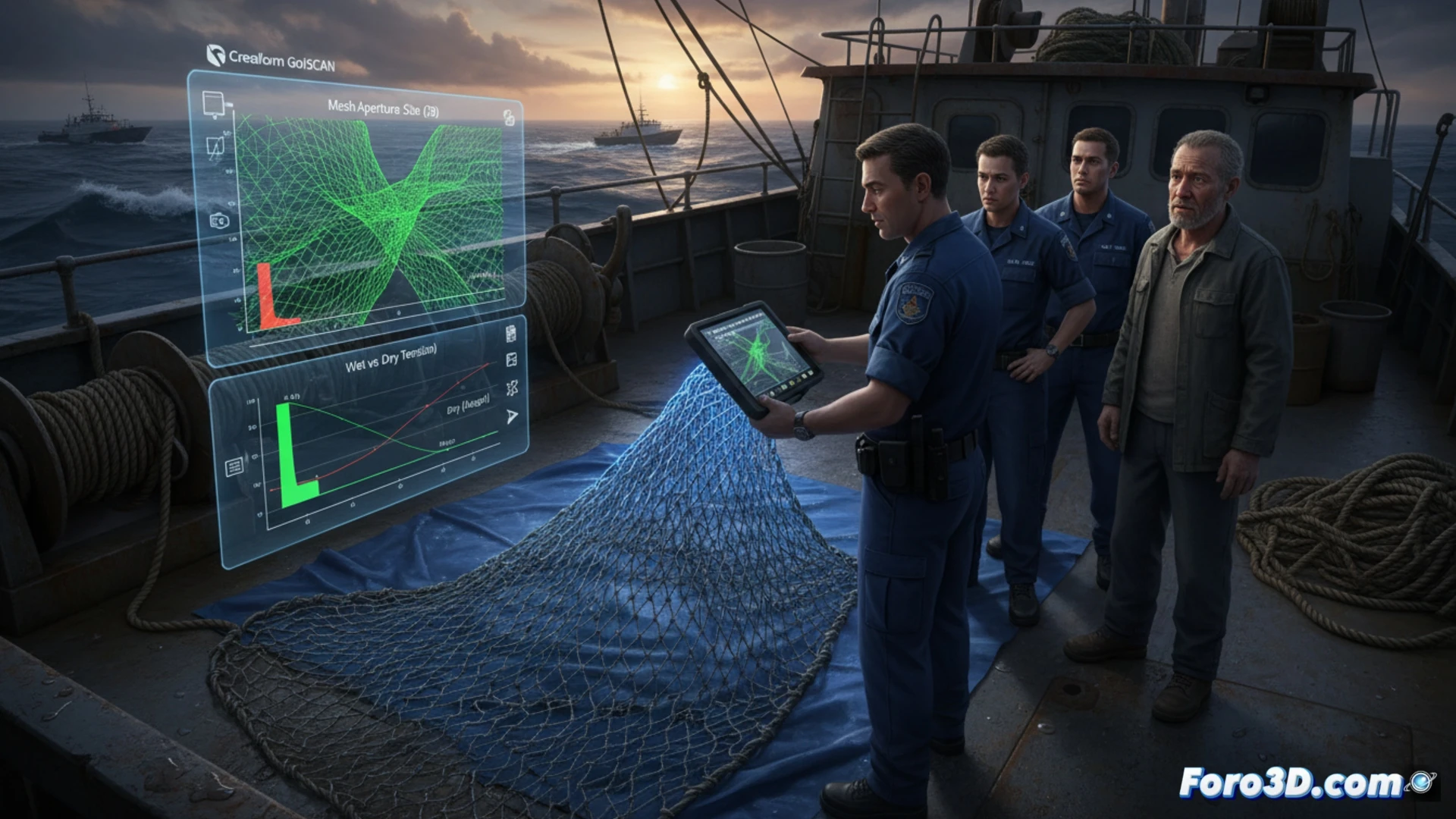
In a case of alleged illegal fishing, the visual inspection of a wet and taut net did not provide conclusive evidence. The solution was a 3D forensic workflow. Using a portable Creaform Go!SCAN scanner, the exact geometry of a section of the net was captured under real-use conditions. This digital evidence allowed for objective metric analysis to determine if the mesh size complied with regulations.
Technical Workflow: From Physical Evidence to Irrefutable Data 🔍
The process began with field capture. The 3D scanner recorded thousands of knots and the deformation of the mesh stretched by the weight of the water. The resulting mesh was processed in MeshLab for cleaning and optimization. Then, using Python scripts and analysis in Excel, the distance between opposite knots in hundreds of mesh openings was automatically measured, calculating a three-dimensional volumetric average. This data demonstrated that, when stretched, the effective mesh size was smaller than the legal size, allowing the capture of protected juvenile species. Blender aided in clear visualization for the expert report.
The Objectivity of 3D Data at the Crime Scene ⚖️
This case highlights how 3D technology shifts forensic analysis from the subjective to the quantifiable. It no longer depends on a single manual measurement or visual interpretation. The 3D mesh is an exact and immutable replica of the evidence at the time of intervention, allowing for repeatable and statistically robust analysis. Thus, a presumption is transformed into technical evidence that is difficult to refute in a legal process.
How can portable 3D scanning transform the forensic verification of fishing nets in cases of alleged illegal fishing?
(PS: In scene analysis, every scale witness is a small anonymous hero.)