Twenty years ago, the young people of the so-called Kelifinder generation faced a paradox: they grew up in economic prosperity but collided with precarious jobs and complicated emancipation. The 2008 crisis broke the fragile balance, giving way to a generation expelled from the stable job market and access to housing. Institutions failed to fulfill their promise of progress, and today, after two decades, structural problems of precariousness and exclusion mortgage the future of an entire generation.
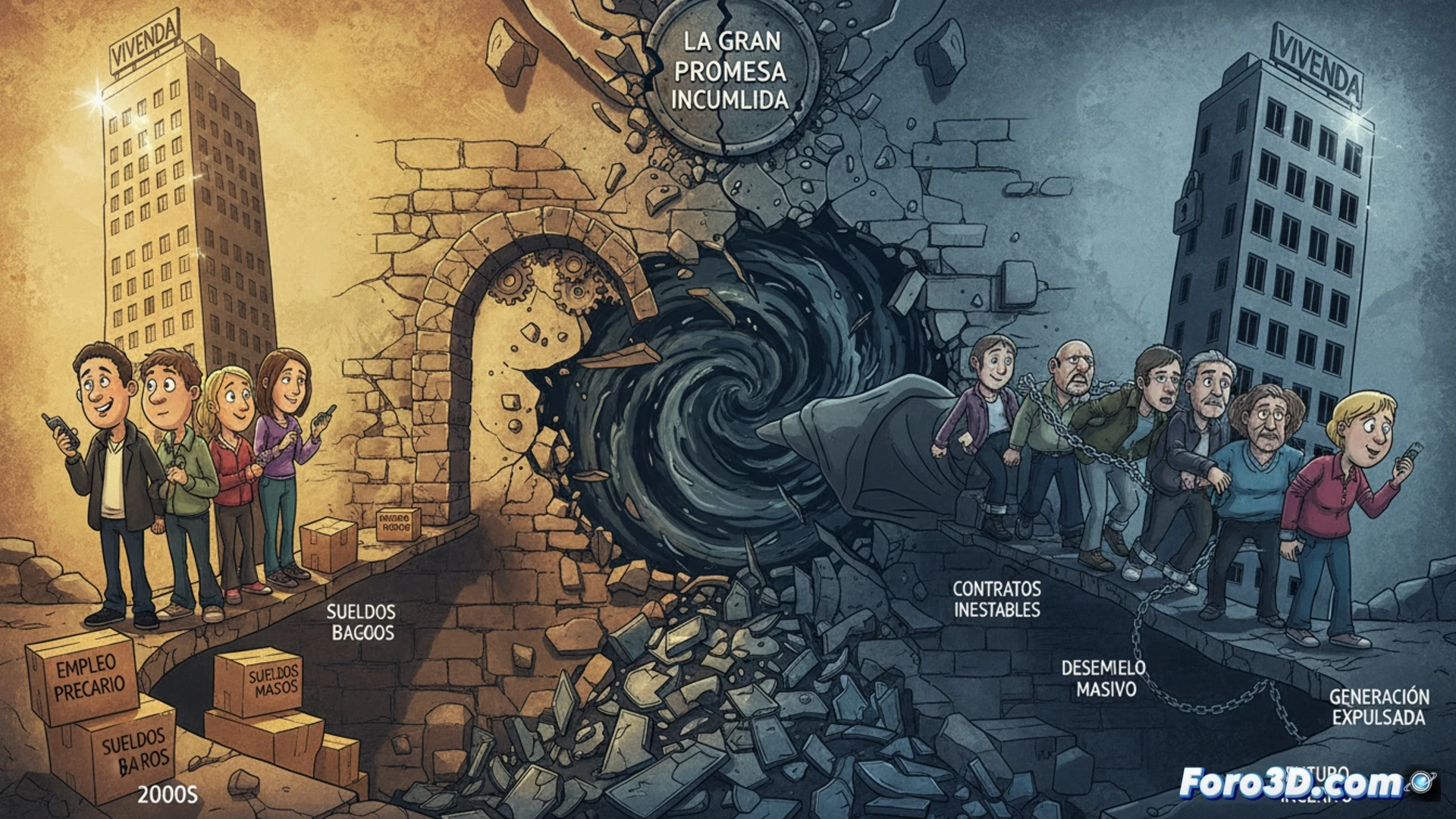
Precariousness as a feature, not a bug in the system 🐛
Analyzing the code of the Spanish job market over the last twenty years, a design with critical dependencies is observed: a high rate of temporality and part-time contracts act as default libraries. The model, far from being a one-off error, has been maintained and optimized after each crisis, generating an abstraction layer that distances young people from stability. Housing, another subsystem with closed APIs and inflated prices, completes a hostile development environment for building life projects.
Quick guide to inheriting an apartment (and other urban legends) 🏚️
For today's young people, the user manual for independence has strange chapters. The standard procedure to access housing no longer involves saving, but waiting for a random inheritance event or winning the lottery. Meanwhile, rent is managed as a premium subscription service that consumes most of the salary, another scarce resource that usually arrives in freemium mode, with ads for uncertain renewals. It's a system as stable as an unupdated Windows.