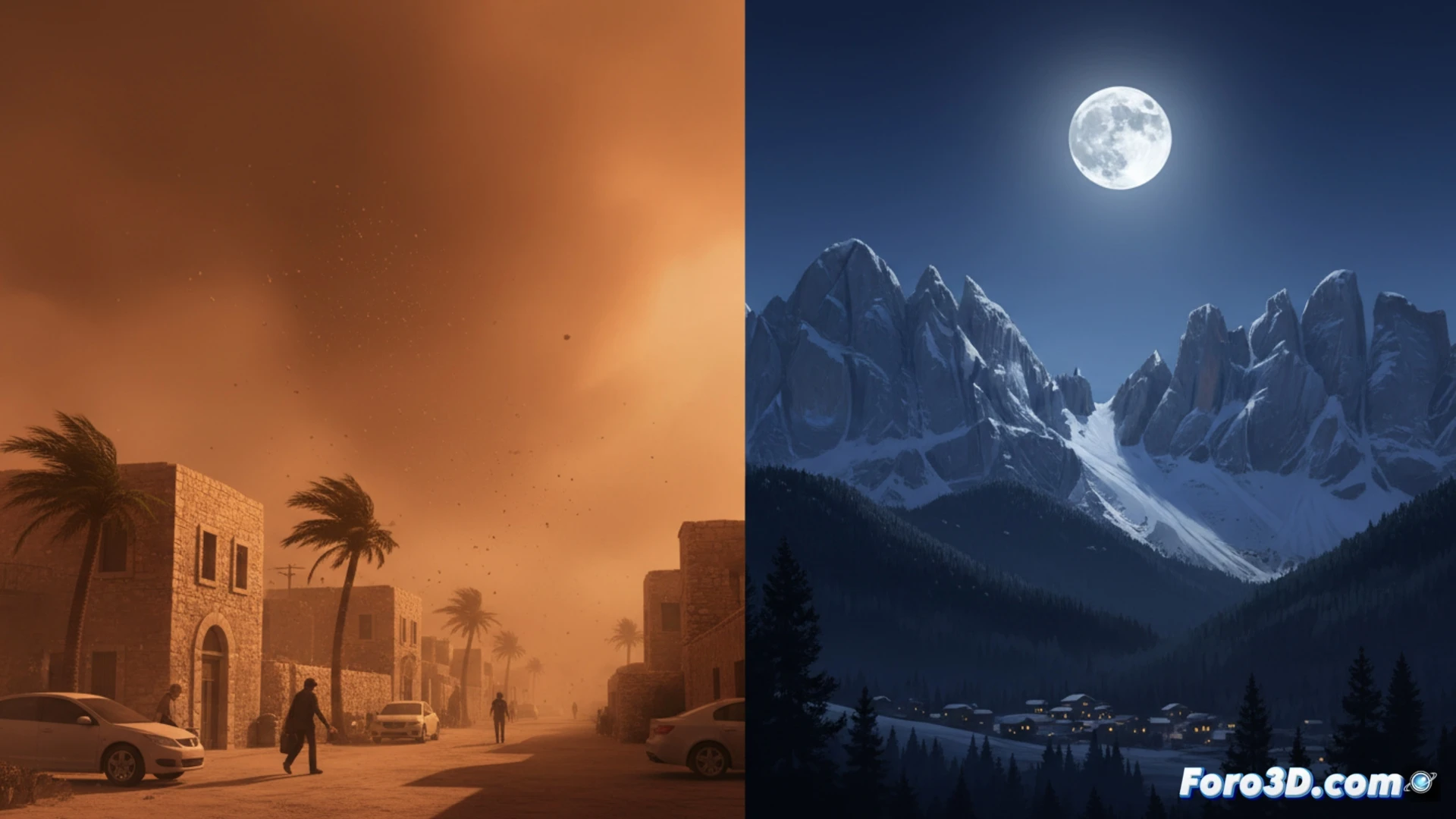
A dense mass of dust from the Sahara Desert has enveloped the island of Cyprus, degrading air quality to levels considered harmful. Health authorities have activated alerts, advising the population, especially sensitive groups, to avoid outdoor exposure. As the Cypriot sky takes on an orange hue, a separate event captures attention: the Easter full moon rose over the peaks of the Dolomites in Italy, offering a notable visual contrast. 🌍
Simulation models and sensors for tracking dust intrusions 📡
Phenomena like the Saharan dust intrusion are monitored with specific technological systems. Atmospheric dispersion models, such as NOAA's HYSPLIT, calculate the trajectory and concentration of particles using meteorological data. On the ground, sensor networks (lidar, photometers) measure the aerosol optical depth and particle size in real time. This information is cross-referenced with satellite data to validate the models and improve forecasts, which are crucial for early public health alerts.
The natural sepia filter and the lunar spotlight: extreme atmospheric lighting 🌗
Nature demonstrates it has its own post-production adjustments. While in Cyprus it applies a Saharan dust filter that saturates orange tones and reduces details at the cost of lung health, in Italy it deploys a high-intensity lunar spotlight to enhance the mountain peaks. Two techniques of ambient lighting, although the first comes with unwanted side effects and an instruction manual that basically says: stay home. A reminder that natural phenomena don't go through quality control.