A communications satellite in low orbit experienced a total power loss. The initial diagnosis pointed to a short circuit, but only analysis with scanning electron microscopy (SEM) revealed the real cause: metallic tin filaments, known as Tin Whiskers, had grown on the solder joints of the power management circuits. This phenomenon, accelerated by vacuum and orbital thermal cycles, demonstrates that reliability in semiconductors is determined at the nanoscale.
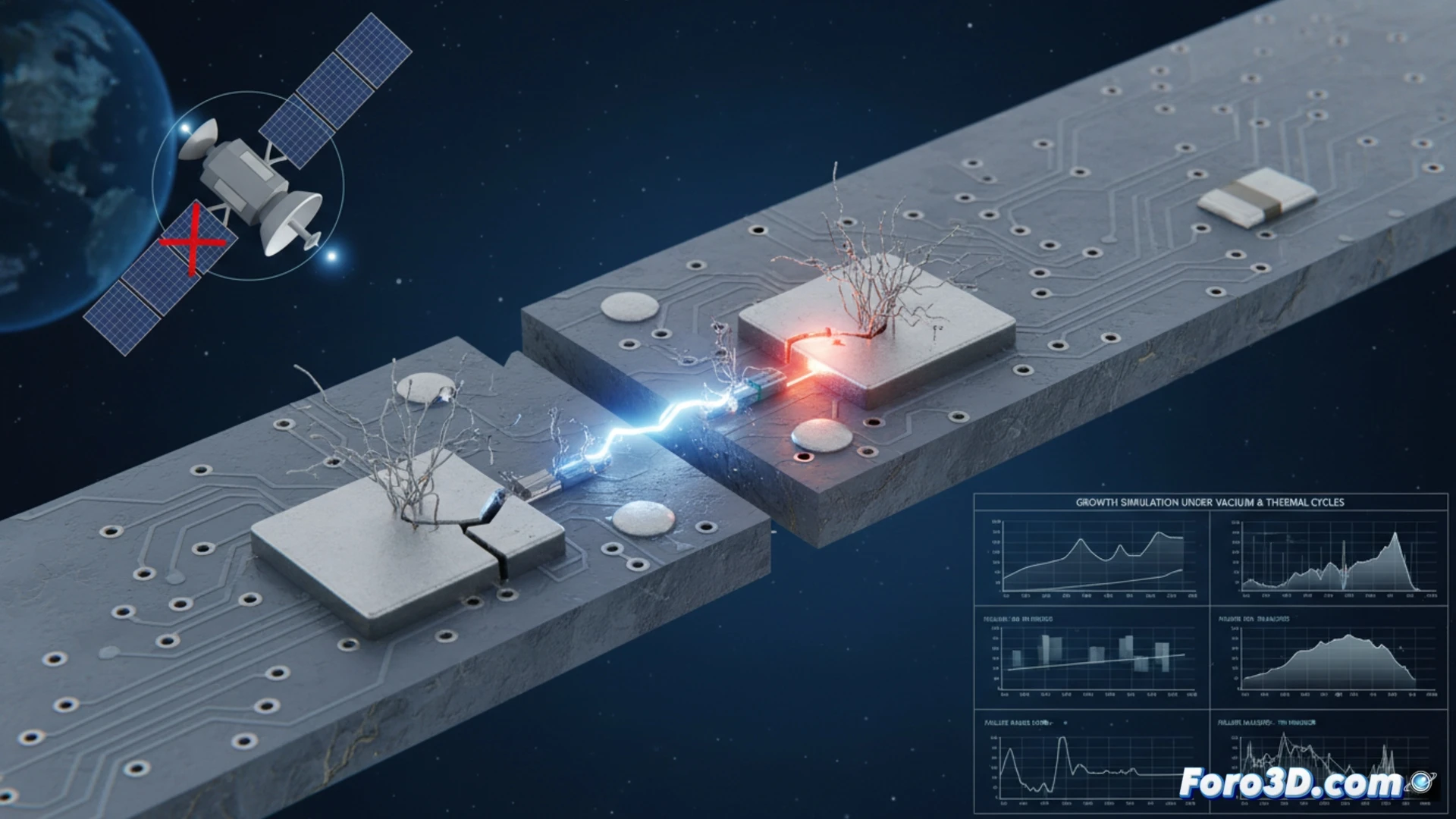
3D reconstruction and electromagnetic simulation of tin whisker growth 🛰️
The engineering team used MountainsMap SEM to process the filament images, generating a three-dimensional topographic model of the protrusions. This model was imported into Ansys Maxwell to simulate the electric field between the whisker and the adjacent trace, confirming that the separation distance (less than 5 microns) was critical for dielectric breakdown in vacuum. Finally, Blender was used to animate the growth evolution under thermal stress conditions, visualizing how mechanical stress in the solder promotes tin extrusion. The simulation predicts that these filaments can reach lengths of up to 1 mm over three years of mission.
Lessons for microfabrication of critical components 🔬
The case underscores the need to integrate 3D modeling into semiconductor validation processes for extreme environments. The use of conformal coatings, pure tin-free alloys, and accelerated stress testing with simulated thermal cycles are measures that can mitigate the risk. The combination of SEM with electromagnetic simulation software and 3D rendering not only allows for identifying failures but also predicting them before launch, improving the reliability of satellites and implantable medical devices.
Considering that current 3D models predict tin whisker growth but fail to simulate vacuum and radiation conditions in low Earth orbit, what experimental validation methodology would you propose to close this gap between simulation and reality in satellites?
(PS: integrated circuits are like exams: the more you look at them, the more lines you see)